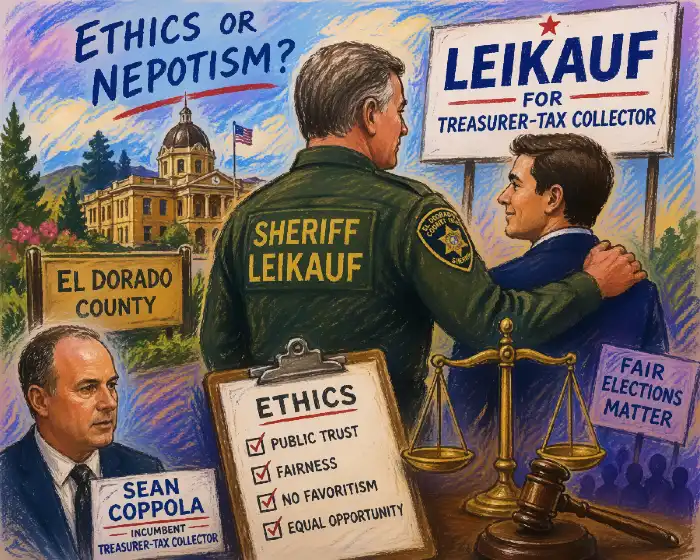
PLACERVILLE, Calif. — A developing political dynamic in El Dorado County’s upcoming election is drawing scrutiny, as questions emerge about the role of a sitting sheriff in supporting a family member’s campaign for public office.
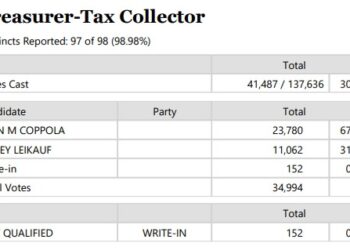
At issue is whether Sheriff Jeff Leikauf has crossed ethical boundaries by promoting his son, a candidate for El Dorado County Treasurer-Tax Collector, a position currently held by Sean Coppola, who is seeking reelection.


While it is not uncommon for family members to support one another in political campaigns, the involvement of an elected official — particularly one holding a position of authority — introduces legal and ethical considerations. Experts note that the distinction hinges on how that support is carried out.
Where the Line Is Drawn
Under California law, public officials are permitted to engage in political activity on their own time. However, the use of public resources, official titles in a coercive manner, or leveraging influence tied to one’s office can raise red flags under statutes such as California Government Code Section 8314, which prohibits the use of public resources for campaign purposes.
“The key question is whether public office is being used to influence the outcome of an election,”
said a spokesperson familiar with municipal ethics standards.
“Personal support is one thing — institutional influence is another.”
The California Fair Political Practices Commission (FPPC), the state’s political watchdog agency, has long held that elected officials must avoid even the appearance of impropriety when their personal relationships intersect with official duties.
Context and Local Impact
The Treasurer-Tax Collector oversees critical county functions, including property tax collection, treasury management, and public fund investment — roles that directly affect residents, businesses, and local government operations.
Incumbent Sean Coppola has served in the role and is campaigning on continuity and experience. The challenger, backed in part by familial ties to law enforcement leadership, is positioning his campaign as an alternative choice for voters.
Local observers say the situation has sparked conversations about fairness and transparency in smaller counties, where professional and personal networks often overlap.
Community Reaction
Some residents have expressed concern that such involvement could create an uneven playing field.
“It’s not about whether a father supports his son — that’s natural,”
said one Placerville resident who asked not to be named.
“But when that father holds a powerful office, it raises questions about influence and fairness.”
Others argue that political expression is a constitutional right that applies equally to elected officials.
Oversight and Accountability
Any formal determination of wrongdoing would likely fall under the jurisdiction of agencies such as the FPPC or the El Dorado County District Attorney’s Office, depending on the nature of the complaint.
As of now, there is no public record indicating that any formal investigation has been launched related to this matter.
Still, the situation underscores a broader issue in local governance: balancing personal freedoms with public trust.