PLACERVILLE, Calif. — El Dorado County is continuing its fight against an invasive insect that officials say poses a significant threat to the county’s vineyards and agricultural economy, and District 1 Supervisor Greg Ferrero is asking residents to help.
“If the county contacts you about treating your property for the glassy winged sharpshooter, please comply,” Ferrero said in a statement. “We’re currently losing the fight in combating this invasive pest, and we need to get it under control before it can destroy our ag crops!”
The warning comes as county and state officials continue an extensive eradication program centered primarily in the El Dorado Hills area.


A continuing infestation
The California Department of Food and Agriculture confirmed the presence of the glassy-winged sharpshooter, commonly known as GWSS, in El Dorado Hills in October 2024. State officials subsequently determined that an infestation existed and launched an emergency eradication effort in cooperation with the El Dorado County Agriculture Department.
The latest CDFA figures show the challenge remains substantial.
From January through June 2026, officials recorded 288 adult GWSS, 731 nymphs and 166 egg masses in the El Dorado infestation area. During the same period, 492 properties were treated and more than 5,000 biological-control wasps were released. In 2025, 907 properties were treated after officials detected 465 adults, 241 nymphs and 142 egg masses.
Those numbers explain why officials continue to ask homeowners to participate.
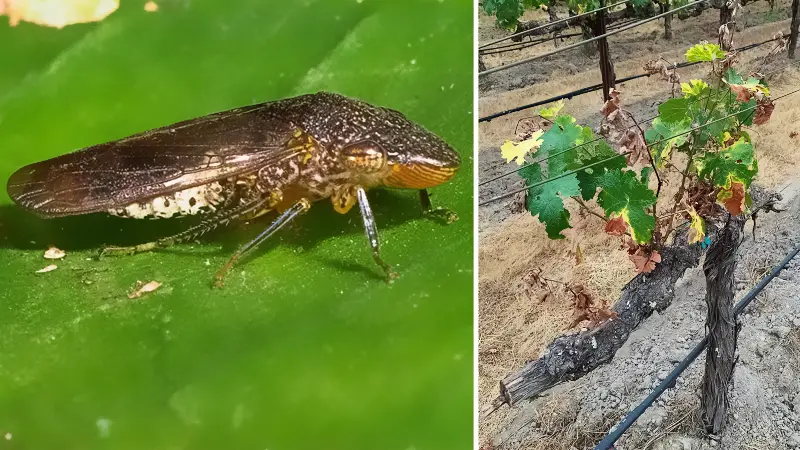
CDFA describes the glassy-winged sharpshooter as an invasive pest capable of attacking hundreds of plant species. More importantly for El Dorado County, the insect can transmit Xylella fastidiosa, the bacterium responsible for Pierce’s disease, which can kill grapevines.
Why El Dorado County agriculture is at risk
The threat extends beyond commercial vineyards.
County officials told the Board of Supervisors in February that 274 grape-production properties were considered at risk from the recent GWSS detections. The county reported that the 2024 value of its grape production was approximately $8 million.
Pierce’s disease is particularly concerning because there is no cure for infected grapevines. County documents state that vines infected with the bacterium can die within two to five years.
That makes controlling the insect before it becomes permanently established a priority for agricultural officials.
“This pest has not been fully eliminated and continues to pose a risk of spreading Pierce’s disease to vineyards within our County,” the Agriculture Department reported to the Board of Supervisors in February.
What homeowners should know
For residents who receive notification from the county, the treatment process is not necessarily an indication that their property is infected.
The county’s current treatment FAQ says properties within 500 feet of a confirmed GWSS find may be included in a treatment area. Officials treat host plants — including grapevines, citrus, crape myrtles, maples and oleander — rather than lawns or vegetable gardens.
The county also says residential treatment requires a signed consent form before treatment takes place. Once consent has been obtained, residents receive another notification at least 48 hours before treatment. The county FAQ states that emergency-program treatments are performed at no cost to property owners.
Residents with questions about treatment can contact the El Dorado County Agriculture Department at (530) 621-5520 or eldcag@edcgov.us.
The county says that once treatment has dried, residents can use their yards normally. However, residents with specific health concerns are advised to consult their physicians regarding pesticide exposure.
A fight that has moved beyond El Dorado Hills
The GWSS problem is not unique to El Dorado County. CDFA currently lists active eradication projects in five California counties, including El Dorado, and says eradication projects can take several years. Under the state program, an infestation is considered eradicated after approximately two years without a GWSS detection following the last treatment.
El Dorado County’s Agriculture Department has maintained a GWSS monitoring program for decades. County records show the program was initiated in 1999 to prevent the insect from becoming established locally and historically included extensive trapping throughout urban, rural and nursery areas.
The current outbreak represents a significant escalation of that long-running prevention effort.
The county is also monitoring potential pathways by which the pest could arrive in new areas. In May 2026, the Agricultural Commissioner issued a consumer alert after GWSS was found on grapevines delivered to Costco stores throughout California, advising residents who purchased grapevines or other plants at Northern California Costco locations between April 21 and May 26 to take precautions.
For El Dorado County residents, Ferrero’s message is straightforward: cooperation with county agricultural officials is an important part of containing the infestation.
The county’s objective is not simply to reduce the number of insects found this year. It is to prevent GWSS from becoming established and spreading Pierce’s disease into one of El Dorado County’s signature agricultural industries.
For residents contacted about treatment, county officials are asking them to participate rather than allow untreated properties to become potential refuges for the pest.
Additional information: Residents can access the El Dorado County Agriculture Department’s current GWSS information, treatment FAQs and consent materials through the El Dorado County Agriculture, Weights and Measures Department. CDFA’s current statewide eradication information is available through its Glassy-Winged Sharpshooter Control Projects page.