


PLACERVILLE, Calif. — El Dorado County voters are facing a straightforward question in November that carries a much longer financial tail: Should the county add a $390 million sales tax over the next 30 years?
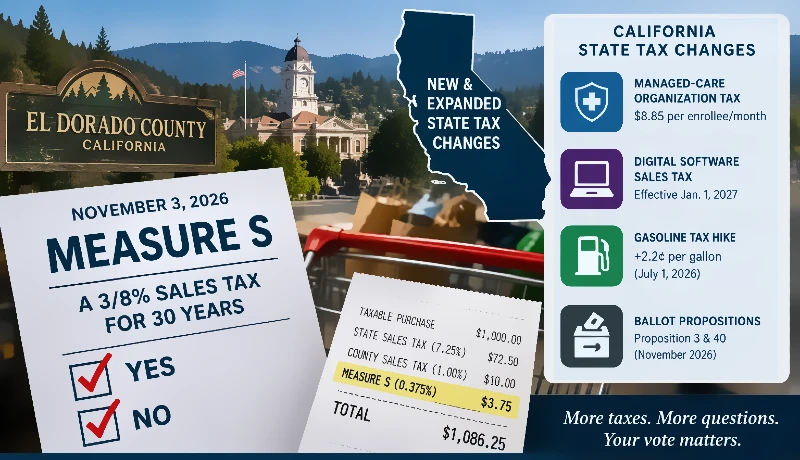
That is the question presented by Measure S, which will appear on the Nov. 3, 2026, ballot.
According to the El Dorado County Elections Department, Measure S would impose a 0.375% countywide sales tax and is expected to generate approximately $13 million annually, $390 million sales tax over the next 30 years. The official ballot language says the money would be used to update hospital facilities, equipment and technology, maintain local emergency-room access, reduce wildfire risk through fire protection and prevention, and provide rapid 9-1-1 emergency response.
The county measure is local. But it arrives at a time when California taxpayers are also confronting a series of state-level tax changes and ballot propositions.
What Measure S would add
The proposed tax is relatively small when viewed as a percentage, but it would apply repeatedly to taxable purchases for three decades.
A $1,000 taxable purchase, for example, would carry an additional $3.75 under Measure S.
A $10,000 taxable purchase would add $37.50.
On a $45,000 taxable purchase, the additional 0.375% would equal $168.75, before considering the existing state and local sales-tax rates.
The actual tax treatment of a particular purchase can vary because not every transaction is subject to sales tax, and vehicle purchases have separate tax rules. But the basic calculation illustrates the point: Measure S would increase the tax collected on qualifying taxable transactions within the county.
The county says the measure would provide approximately $13 million a year, $390 million sales tax over the next 30 years and includes provisions for independent oversight, audits and local control.
The state tax picture is changing, too
Measure S is not a state tax. It would not increase California’s income-tax rates or gasoline tax by itself.
But its appearance on the November ballot comes as California implements other revenue measures.
The state’s 2026-27 spending plan includes a renewed managed-care organization tax. Under the enacted legislation, health plans face a tax of $8.85 per enrollee per month for 2027 through 2029, subject to federal approval. The Legislative Analyst’s Office says the renewed tax is expected to produce roughly $2.3 billion in net revenue over that period, while the budget package counts approximately $575 million in General Fund savings in 2026-27.
California is also expanding sales-tax treatment to certain prewritten digital software, including electronically delivered and remotely accessed software. The change takes effect Jan. 1, 2027. The Legislative Analyst’s Office reports an estimated $450 million in General Fund revenue during 2026-27, with the amount rising to approximately $900 million annually in later years. Local governments are also expected to receive additional sales-tax revenue.
That distinction matters for El Dorado County businesses. Software used for accounting, communications, productivity and other business functions could become part of the taxable software universe depending on the transaction and how the software is classified.
California’s gasoline tax also increased July 1 under the state’s existing annual inflation adjustment. The gasoline excise tax rose 2.2 cents per gallon, while diesel increased 1.6 cents per gallon.
In other words, Measure S is arriving alongside—not instead of—changes occurring at the state level.
November brings more tax questions
California voters will also face several statewide tax-related questions in November.
Proposition 3 would make permanent the higher income-tax rates currently imposed on California’s highest-income taxpayers. Those rates were originally approved by voters in 2012 and extended in 2016. The Legislative Analyst’s Office estimates Proposition 3 would maintain approximately $5 billion to $15 billion annually in state income-tax revenue rather than allowing the higher rates to expire in 2031. Roughly 40% of the resulting funding would go toward schools and community colleges.
Proposition 40 takes a dramatically different approach. It would impose a one-time 5% tax on the net worth of California residents whose wealth exceeded $1 billion at the beginning of 2026. Supporters estimate the measure could generate approximately $100 billion, with most of the money directed toward health care. The measure is already facing significant opposition and potential legal challenges.
The Legislature and voters therefore are approaching taxation from several directions: income, wealth, health plans, software, gasoline and local sales.
Why Measure S matters locally
For El Dorado County residents, the most immediate distinction is where the tax is collected.
A statewide income-tax change affects qualifying income throughout California. A gasoline tax follows drivers to the pump. A managed-care tax is imposed on health plans, although some or all of its cost can ultimately be reflected elsewhere in the health care system.
Measure S would be different.
It would be collected locally on qualifying taxable purchases in El Dorado County.
That means the debate is not simply whether $13 million a year is needed. It is also whether county voters believe the proposed services justify imposing the $390 million sales tax over 30 years.
The county’s official ballot statement identifies three primary purposes: hospital improvements and emergency-room access, wildfire prevention and protection, and rapid emergency response.
That creates a particularly local policy question.
Residents in Placerville, Cameron Park, Shingle Springs, El Dorado Hills, Pollock Pines and the unincorporated communities of the county may have different experiences with — and expectations of — the services identified in the measure.
The hospital component is particularly relevant because Marshall Medical Center is located in Placerville, while emergency response and wildfire prevention extend throughout the county.
Supporters can argue that emergency medicine, fire protection and 9-1-1 response are countywide concerns regardless of where a resident lives.
Opponents can argue that voters should scrutinize whether a 30-year sales tax is the most appropriate mechanism to pay for those services, how the money will be distributed and whether future county revenues could eventually provide some of the funding without a new tax.
Those are policy questions voters—not the tax collector—will ultimately decide.
The bottom line for El Dorado County taxpayers
Measure S would not create California’s other state taxes, and California’s state tax changes would occur regardless of whether El Dorado County voters approve the measure.
But if Measure S passes, residents and businesses would face an additional 0.375 percentage point sales-tax charge equaling $390 million sales tax over the next 30 years on taxable purchases subject to the county measure.
At the same time, Californians are entering a period in which the state tax system itself is changing, including the expansion of taxation to certain digital software and the continuation or implementation of other revenue measures.
For El Dorado County voters, the November decision therefore goes beyond the question of whether another 3/8 of a percentage point sounds significant.
It is a question of whether the services promised by Measure S are worth a 30-year commitment to an additional local sales tax—and whether voters believe that commitment remains appropriate as the state’s broader tax burden continues to evolve.
The official county ballot language describes the proposal plainly: “a 3/8% sales tax for 30 years.” That means $390 million sales tax over the next 30 years.
The decision belongs to the voters.
Source verification: The El Dorado County Elections Department confirms the Measure S rate, 30-year duration, estimated annual revenue and stated uses. The California Legislative Analyst’s Office provides the current fiscal analysis of Proposition 3 and the state’s 2026-27 budget; California Senate budget documents and enacted legislation substantiate the managed-care and gasoline-tax changes.