SACRAMENTO — A new California law is aimed at closing the gap between what wildfire victims were promised and what they ultimately received.
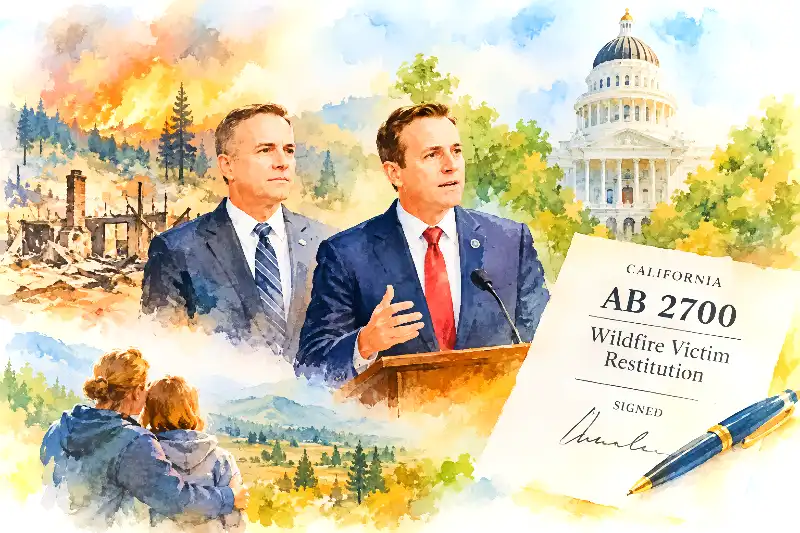
Gov. Gavin Newsom has signed Assembly Bill 2700, legislation designed to establish a state process for addressing restitution shortfalls suffered by victims of utility-caused wildfires.
The bill was originally introduced by then-Assemblyman James Gallagher, R-Nicolaus, before his election to Congress. Assemblyman Joe Patterson, R-Rocklin, subsequently took over as author and carried the measure through the Legislature.


Patterson and Gallagher announced the governor’s action Wednesday.
“AB 2700 provides a pathway for accountability and real justice for fire survivors,” Gallagher said.
The legislation comes after years of frustration among survivors of major California wildfires who have received only partial compensation for homes, businesses and other property destroyed by fires linked to electrical utilities.
What AB 2700 does
Under the law, the California Public Utilities Commission must prepare a report assessing verified restitution shortfalls involving electrical corporation-caused wildfires that occurred before July 12, 2019.
The CPUC also must recommend mechanisms that electrical corporations could use to address those shortfalls. The legislation requires the commission to develop recommendations intended to ensure verified losses are paid fairly and in a timely manner.
The report is due by Jan. 1, 2028.
Importantly for California electricity customers, the measure is structured around restitution mechanisms that do not shift the cost of compensating wildfire victims onto utility ratepayers.
That distinction is significant in a state where electricity costs and wildfire liability have become intertwined policy issues.
Camp Fire survivors among those affected
Gallagher has repeatedly pointed to the Camp Fire and the town of Paradise as examples of why additional action is needed.
The 2018 Camp Fire devastated Paradise and became one of the defining disasters in California’s modern wildfire history. Survivors have spent years navigating bankruptcy proceedings, insurance claims and restitution systems while attempting to rebuild their lives.
AB 2700 does not immediately issue checks to wildfire survivors. Instead, it establishes a regulatory process for determining the scope of verified restitution shortfalls and identifying potential ways to address them.
That distinction matters for victims and their families, who may otherwise interpret the signing of the legislation as an immediate payment authorization.
A bipartisan legislative effort
The measure received unusually broad support in the Legislature.
The Assembly ultimately approved the bill’s final version 78-0, while the Senate approved it 40-0 before the Assembly concurred with Senate amendments.
The legislation’s support included Republicans and Democrats as well as wildfire survivor advocates.
During a June 30 Senate committee hearing, Patterson said the bill was being carried on behalf of Gallagher and described its purpose as creating a process for fully paying restitution owed to victims of utility-caused wildfires before July 12, 2019.
The Utility Wildfire Survivor Coalition played a prominent role in advocating for the measure. Survivors testified before legislative committees and contacted lawmakers as the bill moved through the Capitol.
Will Abrams, an organizing advocate for the coalition and a wildfire survivor, said survivors had waited long enough.
“All utility wildfire survivors deserve fair, full and timely restitution.”
The coalition characterized the measure as a step toward addressing compensation gaps left by earlier wildfire recovery mechanisms.
Why El Dorado County residents should pay attention
The legislation is statewide, but its implications reach well beyond Paradise, Sonoma County and other communities that have experienced catastrophic utility-caused fires.
El Dorado County sits in one of California’s most wildfire-prone regions. Communities stretching from El Dorado Hills and Cameron Park through Placerville, Camino, Pollock Pines and into the Sierra face recurring wildfire threats, while electrical infrastructure remains an important part of the broader wildfire-risk discussion.
For local homeowners and businesses, the issue is not simply whether a future fire can be prevented. It is also what happens when a catastrophic fire occurs, who bears financial responsibility and whether victims can recover the full value of legitimate losses.
California’s wildfire liability system has undergone major changes since the catastrophic fires of the last decade. AB 2700 adds another piece to that evolving framework by directing the CPUC to examine restitution gaps rather than leaving survivors to navigate those gaps individually.
Patterson carries Gallagher’s legislation across the finish line
Patterson said taking over the legislation was a responsibility he accepted after Gallagher moved from the state Capitol to Congress.
“No amount of money can undo what they have suffered, but my hope is that this bill provides a tangible step for them to rebuild and move forward,” Patterson said.
Gallagher called passage one of his final legislative actions before leaving the Assembly, while Patterson described the effort as a continuation of Gallagher’s work on behalf of wildfire survivors.
The CPUC now has the responsibility of translating the Legislature’s directive into a formal assessment and recommendations.
For wildfire survivors, that process will be closely watched.
For communities such as those across El Dorado County, the broader lesson is equally consequential: wildfire recovery does not end when the flames are extinguished. The financial and legal consequences can continue for years.
AB 2700 is intended to give survivors another avenue toward resolving those consequences.
What happens next
The next major milestone is the CPUC’s required report, due Jan. 1, 2028.
Until that process is completed, AB 2700 does not establish an immediate dollar amount for individual victims or guarantee a particular payment. Instead, it requires California regulators to identify verified restitution shortfalls and recommend mechanisms for addressing them.
The legislation therefore represents a significant policy step — but for survivors still waiting to be made whole, the harder question remains how and when the promised restitution will actually reach them.