The $390 Million Question: Who Really Benefits From Measure S?
EL DORADO HILLS — There is an old argument in El Dorado Hills:
We pay more. We get less.
- Does “Measure S” make EDH a Cash Cow for services they will not use?
- Most of the “Measure S” tax revenue will come from the community of EDH.
- Most of Tax Proceeds generated by “Measure S” Tax will go to Marshall Hospital in Placerville but few in EDH will go there.
- Is “Measure S” a Bad ROI for taxes collected? Of the sales tax monies generated by “Measure S” for fire issues will be less than a 9% ROI.
———————-
Notes:
- This Sales Tax will apply to: residents the same as people passing through; The Unincorporated areas and in addition to the two cities of South Lake Tahoe and Placerville local taxes; Car/Truck purchases regardless of where they are purchased the sales tax will apply at purchaser’s address.
- “Measure S” is bifurcated into two major beneficiaries, Marshall Medical and Fire services.
- Marshall’s current CEO has said that the facility opted out of the State provided Grants for retrofitting because the Grant has performance status mandates and they have a high rate of expense. So the Marshall is seeking a stream of money without these limiting constraints.
The $390 Million Question: Who Really Benefits From Measure S?
There is an old argument in El Dorado Hills that never seems to die:
We pay more. We get less.
Taxpayers of the El Dorado Hills area have often argued that they are subsidizing the rest of the county with their taxes but do not get a fair amount of services back for the amount of money they contribute to the County as a whole. One of the issues argued in City Formation is to gain independent use of local taxes collected. If Measure S passes the included sales tax will be in addition to any local taxes.
Now Measure S gives that argument a price tag.
A very large one.
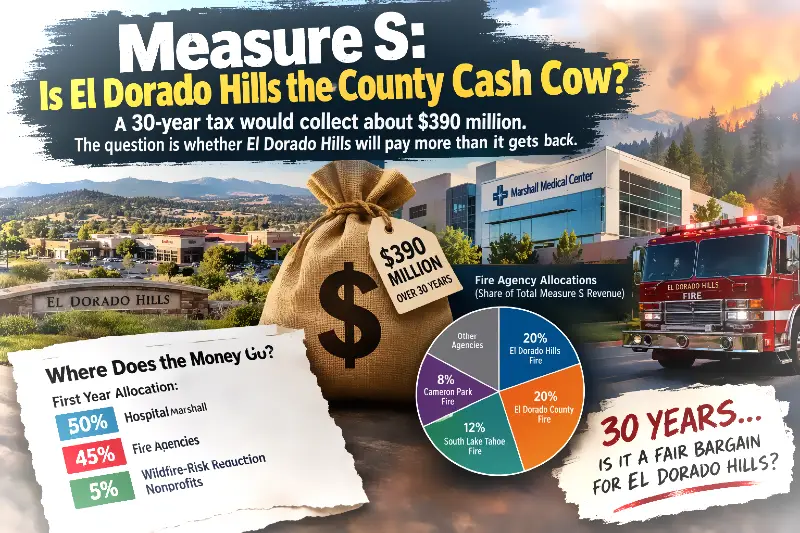
If approved Nov. 3, Measure S would impose a 3/8% sales tax for 30 years, generating approximately $13 million annually, according to the official El Dorado County ballot language.
That’s roughly $390 million over three decades.
Three hundred ninety million dollars is not pocket change.
It is not a rounding error in the county budget.
And it is certainly not something El Dorado County voters should approve merely because the tax adds only a few cents to an individual purchase.
The real question is much bigger:
Who is going to provide that $390 million — and who is going to receive it?
This argument begs the question, who is paying the sales tax money used by the County?
That’s why the correct debate isn’t:
“Can you afford 38 cents?”
The correct debate is:
“Is this the best use of approximately $390 million in taxpayer-generated revenue?”
Those are two very different questions.
El Dorado County does not officially publish sales tax revenues explicitly segmented into strict “East,” “Central,” and “West” categories. However, we can generate a reliable annual regional estimate based on the county’s major retail hubs, population distribution, and sales tax allocation profiles prepared by local financial updates.
The county’s unincorporated sales tax revenue trends around $18 million to $22 million annually (excluding the specific municipal allocations belonging strictly to the cities of Placerville and South Lake Tahoe).
The geographic breakdown of the county’s annual sales tax revenue roughly aligns as follows:
Estimated Annual Sales Tax Revenue Distribution
| Region | Primary Economic Hubs & Tax Drivers | Estimated Revenue Share | Estimated Annual Revenue |
| West County | El Dorado Hills, Cameron Park, Shingle Springs. Driven heavily by major retail hubs like the El Dorado Hills Town Center, auto dealerships (e.g., Shingle Springs Honda/Subaru), Target, Walmart, and Nugget Markets. | 55% – 60% | $10.5M – $12.5M |
| Central County | Unincorporated areas surrounding Placerville, Diamond Springs, El Dorado, and Pollock Pines. Driven by regional gas stations, building materials, and local grocery stores. (Note: The City of Placerville’s own municipal tax is separate). | 20% – 25% | $4.0M – $5.0M |
| East County | Unincorporated Lake Tahoe Basin areas (e.g., Meyers, Tahoma) and major ski resorts like Heavenly Valley Cal Base Lodge and Sierra-at-Tahoe. Heavily dependent on seasonal tourism, restaurants, and hotels. (Note: The City of South Lake Tahoe’s internal municipal tax is separate). | 15% – 20% | $3.0M – $4.0M |
Key Economic Drivers of the Breakdown
- The West County Dominance: The western corridor bordering Sacramento County is the densest and fastest-growing area. It captures the largest share of high-volume retail transactions, business-to-business industrial spending, and new car sales.
- The Central County Baseline: Central county revenues rely heavily on commuter service businesses, hardware/lumber yards, and fuel stations along the Highway 50 corridor.
- The East County Volatility: While East County features massive seasonal tourist spikes, much of that sales tax flows directly into the city treasury of South Lake Tahoe. The unincorporated county portion captures a lower percentage but benefits from the ski resorts and basin fuel/groceries.
Looking at this breakdown it is clear that the El Dorado Hills area pays over Half of the county’s Sales Tax revenues. Public records of county budget expenditures validate that EDH does pay more into the county budget than it gets back in county services.
With that determined how would Measure S passage affect this metric?
The proponents for Measure S have argued that the majority of the sales tax generated over the next 30 years will go to improve Marshall Medical buildings and services. With the EDH community contributing over half of the Tax it is fair to ask how much will they benefit?
El Dorado County’s healthcare market share splits primarily along its distinct geographic boundaries, dictated by mountain terrain and proximity to major medical networks.
When analyzing countywide market share, hospital discharge data divides El Dorado County cleanly down the middle: Marshall Medical Center commands roughly 70% of total county hospital discharges, while Barton Memorial Hospital handles the remaining 30%.
However, looking at specific regional use patterns reveals how market share shifts drastically between the regions:
🏥 Region-by-Region Healthcare Market Share Breakdown
| Region | Primary Health Provider | Estimated Regional Market Share & Patient Dynamics |
| Placerville | Marshall Medical Center | Dominant (>80% market share). As Marshall’s home base, Placerville (ZIP 95667) and the immediate surrounding Central Slope communities account for the vast majority of Marshall’s inpatient care (over 54% of their total inpatient volume originates specifically from the Placerville hub). |
| El Dorado Hills (Unincorporated) | Sacramento Systems (Dignity, Kaiser, Sutter, UC Davis) | Very Low Marshall usage (<5% for inpatient/emergency care). Geographically attached to the Sacramento metro area, residents almost exclusively use facilities in Folsom or Sacramento. To capture outpatient and specialty market share here, Marshall opened a $26 million multi-specialty facility locally. |
| Lake Tahoe Basin (East, West, Central) | Barton Memorial Hospital | Dominant (100% of the county’s Tahoe discharges). Because of the Echo Summit mountain pass, Lake Tahoe Basin residents (spanning South Lake Tahoe, West Shore, and the state-line areas) do not travel down the western slope for care. They utilize Barton Memorial Hospital, which commands the remaining 30% of total El Dorado County market share. |
Regional Dynamic Drivers
- The Sierra Crest Divide: The mountain geography completely isolates the Lake Tahoe Basin from western slope healthcare infrastructure. Residents in the Central/West Lake Tahoe areas rely entirely on Barton Health or cross over into Reno/Carson City networks for specialized tertiary care.
- The Highway 50 Commuter Pull: Because unincorporated El Dorado Hills acts as a suburban extension of Sacramento, its residents choose healthcare networks linked to their employers or closer physical locations. Major providers like Dignity Health, Kaiser Permanente, and Sutter Health capture the vast majority of El Dorado Hills’ market share.
Again we can see that El Dorado Hills sales tax funds over half of Measure S tax revenues but enjoys less than 5% of the benefits. A 5% ROI mandated for the next 30 years.
Fire protection is the second leg of Measure S and it again shows a drastic disparity of cost to benefits. The dismal ROI begs the question, should EDH reject Measure S and create a new Measure that gives EDH taxpayers a reasonable ROI? If approved Measure S mandates an unfavorable 30-year tax that mandates EDH funds the rest of EDC with less than a 9% ROI.
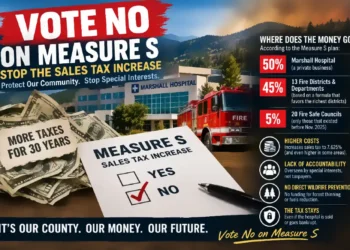
The Measure itself mandates that 45% of tax revenues will be used for Fire prevention services and of that 45% only 20% will go to EDH. That is an effective rate of 9%. Over 50% invested, 9% returned, looked in for the next 30 years. Most of the fire protection funds will go to the unincorporated areas of the county and to the Tahoe area of the county. [Note that most of those areas are in the Eldorado National Forest and already managed by Cal Fire.]
El Dorado Hills taxpayers should reject Measure S unless they want to be EDC’s cash cow.
If the answer is no, supporters should be able to demonstrate that with numbers — not slogans.

Because this isn’t really about 38 cents.
It is about $390 million.
And once the tax is collected, it will be taxpayers — not campaign committees — who will have to live with the bargain for the next 30 years.
That should be the standard for voters, too.
Follow the money.
Follow the allocation formula.
Follow the hospital financing.
Follow the assumptions.
And then ask the most important question:
Is El Dorado Hills being asked to finance a countywide solution without receiving a fair countywide return?
If the answer is yes, El Dorado Hills voters have a legitimate reason to reject Measure S and demand a better-designed alternative.
If the answer is no, supporters should be able to demonstrate that with numbers — not slogans.
Because this isn’t really about 38 cents.
It is about $390 million.
And once the tax is collected, it will be taxpayers — not campaign committees — who will have to live with the bargain for the next 30 years.