EL DORADO HILLS, Calif. — Oct. 8, 2026
Serrano J Park dispute centers on developer obligations and taxpayer funds
A long-running dispute over the financing and construction of a planned park in the Serrano development has renewed questions about developer obligations, public funding and accountability in El Dorado Hills.


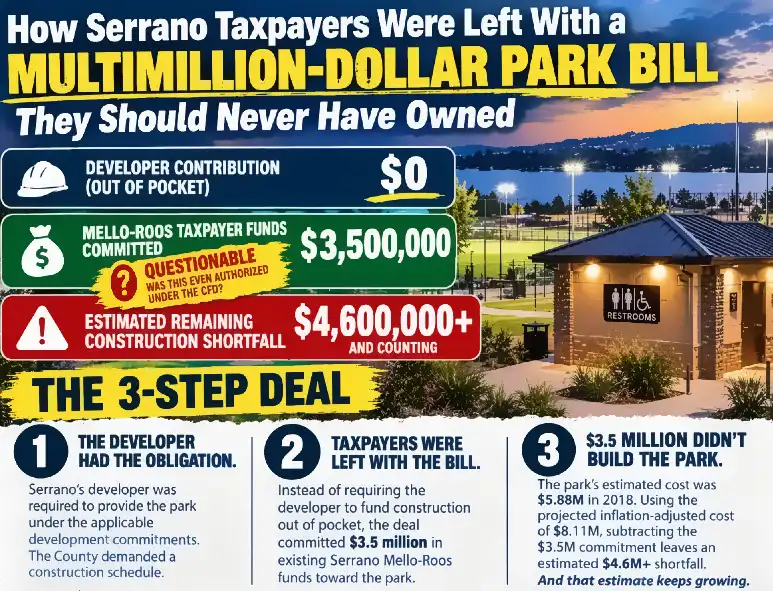
In a statement published Oct. 8, Dean Getz alleges that Serrano taxpayers were left exposed to millions of dollars in construction costs for J Park, also known as the Village J, Lot H parkland, after public agencies agreed to use up to $3.5 million from Serrano’s Community Facilities District 1992-1, commonly known as a Mello-Roos district.
However, public records establish a more complicated history than the claim that taxpayer funds simply replaced a developer’s obligation. El Dorado County approved an agreement in August 2020 involving the county, the El Dorado Hills Community Services District and Serrano Associates LLC to resolve a dispute over the park’s dedication, financing and construction.
The agreement is central to understanding what the developer was required to provide, why the funding arrangement changed and whether the expenditure complied with the applicable legal documents.
What the county’s 2020 agreement says
The county’s eldorado.legistar.com identifies the project as a 12.5-acre park in Serrano’s Village J, Lot H, near Serrano Parkway and Greenview Drive.
According to the county staff report, a dispute had developed over the amount of Community Facilities District funds available to construct the park. The agreement resolved that dispute by establishing that up to $3.5 million from Serrano CFD 1992-1 could be made available for construction.
The staff report described the arrangement as an assignment of rights to those district funds, subject to the agreed maximum. It also identified an alternative: If the county and Serrano could not reach an agreement after good-faith negotiations, the developer could construct the park under the applicable development conditions.
The county’s stated funding designation was developer-funded subdivision improvements and Community Facilities District funds. That distinction matters: The official record describes a negotiated financing arrangement, not simply an unrestricted transfer of general county tax revenue.
The agreement does not, by itself, settle every question about whether the funds were used in compliance with all applicable restrictions or whether the eventual construction budget is sufficient.
Why the $3.5 million commitment is under scrutiny
Getz’s statement argues that the developer should have paid the park’s construction costs without relying on funds raised through Serrano’s Mello-Roos district.
He cites a reported 2018 construction estimate of $5.88 million and a projected inflation-adjusted cost of $8.11 million. Subtracting the $3.5 million commitment from that projected figure produces a potential funding gap of $4.61 million.
Those figures are estimates presented in Getz’s statement, not independently verified current bids or a confirmed outstanding county liability. A current construction estimate, accounting of funds already spent and documentation of the project’s remaining scope would be necessary to establish the actual shortfall.
The distinction is important for Serrano homeowners and other El Dorado Hills residents following the development of Bass Lake Park. A projected cost gap does not automatically mean the entire amount will be charged to taxpayers, nor does it establish which party is legally responsible for paying it.
Grand Jury response adds context to the park’s history
The park arrangement has also been discussed in El Dorado County Grand Jury materials.
In its response to the 2023-24 Grand Jury report, the El Dorado Hills Community Services District explained that it participated in a settlement negotiated among the district, the county and Parker Development. The settlement provided the 12.5-acre park site and $3.5 million in funding from Serrano CFD 1992-1.
The district said the decision was influenced by years of delay in constructing the park and the opportunity to incorporate the Village J property into a larger Bass Lake Park project.
The district also stated that it would seek to create a public review of the events leading to the settlement. civilgrandjury.org .
That history raises a key question: Did the settlement appropriately resolve the developer’s existing obligations, or did it shift financial responsibility in a way that warrants further scrutiny?
Answering that question requires examining the original development agreement, the Public Improvements Financing Plan, the CFD formation documents and the executed 2020 agreement. The existence of a funding arrangement approved by the county does not, by itself, prove either wrongdoing or full compliance with every applicable restriction.
Were the Mello-Roos funds legally authorized for this purpose?
Getz’s most significant allegation concerns the legal authority to use Serrano CFD funds for the project.
Mello-Roos Community Facilities Districts are established under California law to finance specified public facilities and services. The permitted uses of a particular district’s funds depend on the applicable formation documents, financing plan, authorizations and other governing requirements.
The county’s 2020 staff report says the El Dorado Hills Specific Plan’s Public Improvements Financing Plan authorized the district to fund construction or acquisition of identified community and district parks, subject to a $2 million limit adjusted annually using a construction cost index. The agreement subsequently established that up to $3.5 million in CFD 1992-1 funds could be made available for Village J Park. eldorado.legistar.com .
That documented adjustment is important. It means the legal question cannot be answered solely by comparing $3.5 million with the original $2 million figure. The underlying documents, the permitted inflation adjustment, prior expenditures and the agreement’s legal effect all matter.
A conclusive assessment would require reviewing those records and any relevant legal analysis. The available records cited here do not establish that the $3.5 million commitment was unlawful.
What residents should expect next
For Serrano homeowners and El Dorado Hills residents, the issue is not simply the price of a park. It is whether public commitments were honored, whether the financing decisions were properly authorized and whether the community faces additional costs.
Several questions merit clear, document-based answers from the responsible agencies:
-
Developer obligations: What did Serrano Associates agree to provide under the original development agreement, and how did the 2020 settlement affect those obligations?
-
Fund authorization: Which provisions of the CFD formation documents and Public Improvements Financing Plan authorized the $3.5 million commitment?
-
Project accounting: How much of the committed funding has been spent, what construction remains and what is the current independently supported cost estimate?
-
Future liability: Which entity is contractually responsible for any remaining costs, and what funding sources are being considered?
-
Public disclosure: What became of the district’s stated intention to provide a public review of the events leading to the settlement?
These questions should be answered with executed agreements, project budgets, expenditure records and public meeting documents rather than assumptions about who ultimately bears the cost.
Dean Getz has published his allegations and supporting materials on his website: deangetz.com . Readers should consult the underlying documents and distinguish his interpretation from established facts.
For now, the public record confirms that the county approved a negotiated arrangement allowing up to $3.5 million in Serrano CFD funds to be used for the Village J park. The actual remaining construction cost, the ultimate allocation of financial responsibility and the resolution of any questions about spending authority require further documentary verification.
For a community that funds public infrastructure through development agreements and special taxes, transparency is essential. Residents deserve a clear accounting of the decisions made, the obligations agreed to and the money still needed to finish the project.