EL DORADO COUNTY, Calif. — As voters prepare to decide the fate of Measure S in the Nov. 3 election, a retired military officer is challenging the proposed sales tax initiative’s funding priorities, arguing that Tahoe Basin residents could contribute to a countywide tax without receiving a comparable share of its benefits.
In a letter addressed to the Tahoe Basin community, retired Maj. Kenneth J. Curtzwiler urges voters to reject Measure S. He contends that the proposed distribution favors West Slope hospitals, fire agencies and nonprofit organizations while providing insufficient direct support for services in the Lake Tahoe Basin.


His criticism follows a public explanation of the measure by El Dorado County District V Supervisor Brooke Laine, who outlined how the revenue would be distributed and encouraged residents to make an informed decision.
“Decisions like this one belong to the voters,” Laine wrote in an Oct. 13 letter published by South Tahoe Now. She urged residents to ask questions, talk with neighbors and vote in November.
Dispute centers on who receives the money
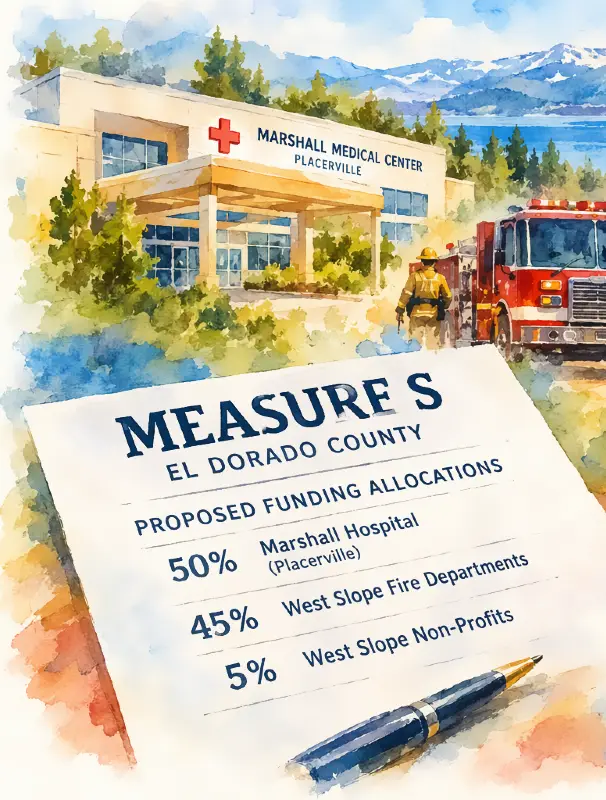
According to the county’s official election materials, Measure S would impose a countywide sales tax increase of three-eighths of 1% for 30 years, generating an estimated $13 million annually. Its stated purposes include hospital facility improvements, maintaining local emergency room access, wildfire prevention and emergency response.
Curtzwiler disputes whether the initiative’s funding formula adequately serves the Tahoe Basin, where residents rely on local emergency services and Barton Memorial Hospital in South Lake Tahoe.
He argues that the measure directs 50% of the designated funding toward Marshall Medical Center in Placerville, approximately 75 miles from the Tahoe Basin, leaving Barton without a direct allocation under that provision.
He also questions how much money would reach Tahoe-area fire agencies. According to his letter, the El Dorado Hills Fire Department and El Dorado County Fire Protection District would receive substantial portions of the funding allocated to fire services.
Curtzwiler further argues that the 5% designated for nonprofits would do little to support organizations serving Tahoe Basin residents.
Those are the central claims in Curtzwiler’s opposition. The precise amounts each agency would receive, however, depend on the initiative’s funding formula and applicable eligibility requirements. The county has published an official measure page and a Board of Supervisors staff analysis for voters reviewing the proposal.
Sales tax cap raises separate concern
Beyond the allocation of revenue, Curtzwiler raises a concern about the measure’s potential effect on future local tax proposals.
He says the resulting combined sales tax rate of 9.125% would leave only a 0.125-percentage-point margin before reaching the applicable state limit. In his view, that could constrain future efforts to raise local revenue for police and fire protection, road maintenance and critical infrastructure.
The county’s Sept. 29 staff-analysis agenda item confirms that officials examined the sales tax cap and the remaining capacity for the county and its cities as part of their review of Measure S. The analysis also addressed projected revenue distributions beyond the first year and the types of nonprofit organizations eligible for funding.
The distinction matters: the tax-rate calculation and the legal ability of individual jurisdictions to impose additional taxes are related but separate questions. The exact effect on future tax measures depends on the applicable rate limits, existing local taxes and the rules governing any proposed increase.
Laine’s position and the voter’s decision
Laine’s Oct. 13 letter explained that the funding would be distributed in stages. She wrote that Marshall Medical Center’s debt service would be paid first, followed by nonprofit allocations, with the remaining revenue distributed among fire agencies.
Curtzwiler argues that explaining the proponents’ intended spending does not adequately address the consequences of the initiative’s actual language for Tahoe Basin residents.
He believes Laine, as the supervisor representing District V, should join local residents, businesses and the South Lake Tahoe City Council in challenging what he views as an inequitable distribution of public revenue.
His letter concludes with a direct appeal to voters: examine the measure’s details and vote no if they believe the funding structure fails to protect Tahoe Basin interests.
The November election will give voters the opportunity to decide whether to approve the proposed countywide tax. For residents weighing the competing arguments, the central questions are how the initiative legally allocates revenue, which agencies and nonprofits qualify, and how the additional tax could affect future local funding decisions.
How to review Measure S
Voters can consult these public resources before casting their ballots:
-
Official ballot information: eldoradocounty.ca.gov . The county’s election page provides the official summary of Measure S and related election materials.
-
Board of Supervisors staff analysis: eldorado.legistar.com . The agenda item identifies the county’s review of tax-rate limits, projected distributions and nonprofit eligibility.
-
Laine’s public explanation: southtahoenow.com . Her Oct. 13 letter outlines the proposed funding sequence.
Measure S is scheduled to appear on the Nov. 3, 2026, ballot. The decision ultimately rests with voters, who must weigh the initiative’s stated goals for health care access, wildfire prevention and emergency response against questions about the distribution of its revenue and the long-term flexibility of local taxation.