PLACERVILLE, Calif. — LOCAL HISTORY
Blair brothers built a timber empire from Placerville



Long before home improvement chains and modern building supply stores served the Sierra foothills, the Blair family helped build the communities of El Dorado County with lumber cut from the surrounding forests.
The family’s story began during the Gold Rush, when Scottish immigrants John, James and Matthew Blair became part of the commercial growth transforming Hangtown, now Placerville. Their business grew from a lumberyard near Cedar Ravine and Main streets into a network of sawmills, logging operations and related enterprises that served the county for generations.
Today, the original lumberyard is a reminder of a different era in Placerville’s history — when local businesses supplied the materials needed to build homes, storefronts, mining operations and the infrastructure of a growing region.
From Scotland to Gold Rush-era Placerville
The Blair brothers came from the Paisley area of Scotland, arriving in California during the early decades of the Gold Rush. John Blair was in El Dorado County by 1852, according to local historical accounts.
John and James also established themselves in the hospitality business. In 1854, John purchased Sportsman’s Hall, a roadside establishment along the overland route connecting Placerville with Carson Valley. The brothers subsequently expanded it into a major stopping place for stagecoaches, freight teams and travelers crossing the Sierra Nevada.
Sportsman’s Hall later became an important station on the Pony Express route. California recognizes the historic site as Landmark No. 704, connecting the Blair family’s early business history to one of the best-known transportation stories of the American West.
But the brothers’ lasting influence on El Dorado County would extend well beyond the roadside inn.
The lumberyard at Cedar Ravine and Main
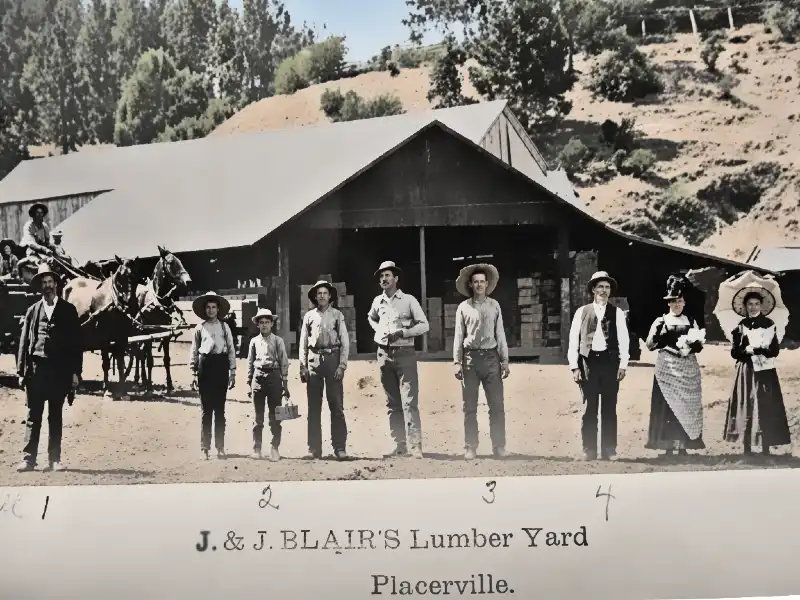
The Blair family’s lumber business took shape in the 1850s, as miners, merchants and settlers needed wood for buildings, mine supports, fuel and other essentials. Local historical accounts place the establishment of their sawmill operation in 1856 and identify the family lumberyard at the corner of Cedar Ravine and Main streets in Placerville.
The location put the business close to the town’s commercial center, where lumber could be sold to local builders and transported to customers throughout the county.
The operation expanded as demand grew. Historical accounts describe steam-powered sawmills capable of producing thousands of board feet of lumber daily, with ox teams hauling logs and finished timber. Because moving large logs over rough mountain roads was difficult, the family established or operated mills closer to timber stands and active logging areas.
The company became known as J. & J. Blair Lumber Co., with later generations continuing the family trade under the Blair Brothers Lumber name.
From Sly Park to Pollock Pines
The Blair family’s reach extended into the forested country east of Placerville, where timber supplied a growing regional economy.
Historical accounts document Blair family milling and logging connections at several locations, including:
-
Sly Park: James B. Blair operated a mill in the meadow now covered by Jenkinson Lake.
-
Fresh Pond: Blair family members operated a mill serving the surrounding timber country.
-
Long Canyon: The family ran milling operations that supplied lumber for the Placerville business.
-
Pacific House: Blair family partners operated a mill and maintained timber holdings in the area.
-
Pollock Pines and Pine Vine Ridge: These areas formed part of the wider landscape of Blair family timber and logging activity.
The operations were part of a broader industry that connected remote forest camps with the shops, mines, farms and communities of the Mother Lode. The family’s business interests also included mining, gravel, railroads, produce-box manufacturing and other enterprises.
The Blair story also carried its share of tragedy. A local family history records that Matthew Blair died in 1867 in a sawmill accident. Despite such losses and the demands of operating in difficult terrain, the family’s business continued through subsequent generations.
The 1958 sale and the end of an era
By the mid-20th century, the family’s major timber holdings and mill operations had become part of a changing regional lumber industry.
According to The Pollock Pines Epic, the Blair family sold its timber holdings to Michigan-California Lumber Co. in 1958. The Blair Brothers Lumber business then concentrated on its Placerville retail operation, which continued until 1985.
The transition marked a significant change for a business whose history stretched back to the Gold Rush. Large-scale timber operations were no longer the center of the family’s enterprise, but the retail lumberyard remained a familiar presence for local residents.
For people who grew up in Placerville during those years, the Blair name was more than a reference in a history book. It was a business tied to everyday life: buying lumber, repairing a home, building a project and watching a local community change.
A personal memory of a vanished Placerville landmark
The original lumberyard at Cedar Ravine and Main streets holds a particular significance for longtime residents who remember the Blair family’s later retail operation near Main Street and Broadway.
One local recollection captures the feeling of watching familiar businesses disappear as Placerville changed:
“Both of these businesses — Blair Brothers Lumber Co. and the businesses around it — are lost in time.”
The memory adds a personal dimension to the documented history. The original yard and the later retail operation were not simply commercial properties; they were part of the landscape through which generations of residents experienced their hometown.
The photograph accompanying this story, identified as showing the original lumber company at Cedar Ravine and Main streets, offers a visual connection to that past. Its exact date and the details visible in the image would need to be established from the photograph’s original caption or archival record.
Preserving El Dorado County’s working history
The Blair family legacy remains visible in local historical accounts, surviving family homes and landmarks associated with the county’s development. The El Dorado County Historical Society documents the family’s role in the lumber industry and identifies the original Placerville yard as part of its early commercial footprint.
That history also tells a larger story about El Dorado County. Gold brought people into the region, but it took lumber, transportation, construction materials and generations of local businesses to turn mining settlements into lasting communities.
The Blair brothers helped supply those needs. Their business linked Placerville’s commercial center to the forests east of town, and their descendants continued the enterprise long after its original mills had changed hands.
The sawmills and lumberyards may be gone, but their story remains part of the county’s industrial heritage — a reminder that the communities residents know today were built, in part, by the people who cut, hauled and sold the timber beneath their feet.
Sources and further reading
-
El Dorado County Historical Society — Historic Picture of the Month — local historical research on John Blair, Sportsman’s Hall and the original Placerville lumberyard.
-
Placerville NewsWire — A Journey Through Time: Tracing the Roots of the Blair Family — family history and business background.
-
The Pollock Pines Epic — The Blair Family — historical account of the family’s mills, timber holdings, 1958 sale and 1985 retail closure.
-
California State Parks — Sportsman’s Hall, Historical Landmark No. 704 — official historical landmark information.