Pilot Hill’s Place in California History: The Birth of the Grange
EL DORADO COUNTY, Calif. — More than two decades after James W. Marshall’s discovery of gold at Sutter’s Mill transformed California, another chapter in the state’s history began in the foothills of El Dorado County.
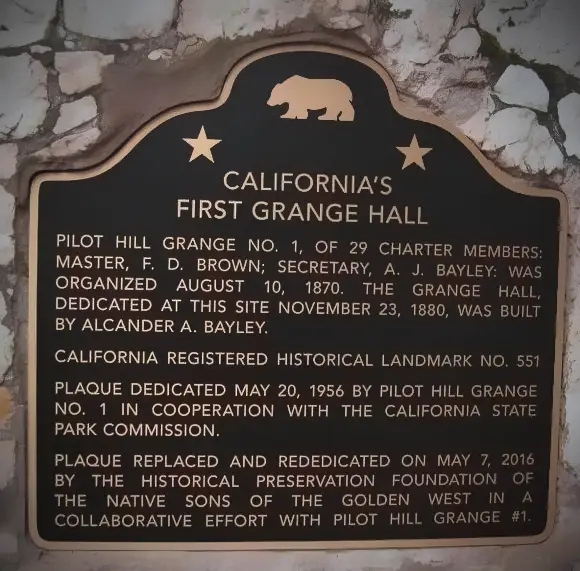
On Aug. 10, 1870, residents of Pilot Hill organized Pilot Hill Grange No. 1, establishing what is recognized as California’s first Grange organization. The founding brought together 29 charter members and connected a growing agricultural community to the National Grange of the Order of Patrons of Husbandry.
The organization was more than a local social club. It represented a nationwide effort to strengthen farming communities, encourage cooperation among agricultural producers and give rural residents a collective voice.
Today, the story of that organization remains an important part of El Dorado County’s Gold Rush and agricultural heritage.
From Gold Country to Farming Communities
The timing of Pilot Hill Grange’s formation was significant.
The Gold Rush had brought thousands of people into the Sierra Nevada foothills, including the communities surrounding Coloma, Georgetown, Pilot Hill and Placerville. But by the late 1860s and early 1870s, the region’s economy was becoming increasingly diversified.
Mining remained part of local life, but farming, livestock raising, fruit cultivation and other agricultural pursuits were becoming increasingly important.
Pilot Hill was particularly well positioned for that transition. Its surrounding foothills offered land suitable for cattle, grain, orchards and vineyards.
By the early 1880s, general farming and stock raising had become prominent economic activities in the Pilot Hill area, although prospectors continued searching for gold.
The Grange movement offered farmers something the mining camps had not necessarily provided: an organized community institution built around shared economic interests, education, cooperation and mutual support.
The National Grange, formally known as the Order of Patrons of Husbandry, was established in 1867. Its purpose was to strengthen the position of American farmers through education, cooperative activity and community organization.
Pilot Hill residents became part of that movement three years later.
Twenty-Nine Charter Members Established Grange No. 1
According to the California State Parks historical landmark record, Pilot Hill Grange No. 1 began with 29 charter members.
The original officers included:
-
F.D. Brown: Master.
-
A.J. Bayley: Secretary.
Alcandor A. Bayley played a central role in bringing the organization to California. Historical accounts describe how correspondence with Oliver Hudson Kelley, a founder of the National Grange, led to Bayley’s authorization to organize the new chapter.
The founding also connected the Grange with an important figure in California history.
James W. Marshall, whose discovery of gold at Coloma in January 1848 helped ignite the California Gold Rush, is identified in historical accounts as an early member of Pilot Hill Grange.
The connection is noteworthy. A man whose name became inseparable from California’s mining history was associated with an organization devoted to strengthening the agricultural communities that increasingly followed the mining era.
The Building Came Nearly 20 Years Later
Although Pilot Hill Grange No. 1 was established in 1870, its permanent meeting hall came later.
Alcandor A. Bayley constructed the building at the original Pilot Hill location. It was formally dedicated on Nov. 23, 1889.
The distinction between the organization’s founding and the building’s completion is important. The Grange existed for nearly two decades before members had their dedicated hall.
That building eventually became one of the most recognizable physical reminders of the county’s agricultural organizing history.
From Pilot Hill to Cool
The historic Grange Hall did not remain at its original location.
During the 1930s, the building was relocated approximately four miles north to Cool, where land was made available for its preservation.
The relocation gave the historic structure a continuing place in the community while preserving its connection to the organization that began in Pilot Hill.
Today, Pilot Hill Grange No. 1 is associated with the historic building at 1701 Highway 193 in Cool.
For residents traveling through the Georgetown Divide, the building represents more than an old meeting hall. It connects two communities and two distinct periods of El Dorado County history.
California Historical Landmark No. 551
The original Pilot Hill location received formal state recognition as California Historical Landmark No. 551.
California State Parks records the landmark as the Site of California’s First Grange Hall.
The landmark was registered on March 29, 1956. Its official description identifies the 29 charter members, the original officers, the Aug. 10, 1870, organizational date and the dedication of the building in 1889.
The landmark’s recorded location is along State Highway 49, approximately 0.2 miles north of Pilot Hill.
A bronze commemorative plaque and stone monument mark the historic location, distinguishing the original site from the building’s later location in Cool.
The designation recognizes the importance of the original Pilot Hill location in the development of California’s agricultural organizations.
Pilot Hill Helped Launch a Statewide Movement
The influence of Pilot Hill Grange extended well beyond El Dorado County.
In the years following its organization, additional Granges began appearing throughout California. Farmers increasingly recognized the value of working together to address transportation costs, agricultural markets, irrigation, cooperative purchasing and other challenges facing rural communities.
On July 15, 1873, representatives of 28 Granges gathered in Napa and formally organized the California State Grange.
According to the California State Grange’s historical account, the organization subsequently expanded rapidly. Thirty-three additional Granges were organized during the two years preceding the state organization.
The movement eventually became an important voice for California’s agricultural communities.
The original mission remains reflected in the philosophy of today’s Pilot Hill Grange. Its published mission statement describes the organization as:
“The vibrant heart of our community”
The statement emphasizes community gatherings, education, grassroots advocacy and preserving the values of rural communities.
That philosophy reflects the same community-centered principles that helped establish the organization more than 150 years ago.
A Living Connection to El Dorado County’s Past
Pilot Hill Grange No. 1 occupies a distinctive place in California history.
Its establishment in 1870 came at a time when the foothills were evolving beyond their identity as Gold Rush mining country. The people who remained were building communities, establishing farms, raising families and creating institutions that would serve generations.
The Grange was one of those institutions.
Its history also illustrates an important distinction in El Dorado County’s development: The Gold Rush did not simply end and disappear. Its communities evolved, and many residents turned their attention toward agriculture, commerce and permanent settlement.
From the original organization in Pilot Hill to the historic building now standing in Cool, the Grange remains a tangible reminder of that evolution.
For El Dorado County residents, California’s first Grange was not founded in Sacramento, Napa or San Francisco.
It began right here in the foothills.
And on Aug. 10, 1870, 29 local residents made sure that Pilot Hill would have a permanent place in California history.
Historical sources and further reading
The following sources provide documentary support for the article and additional opportunities for readers to explore the history.
1. California State Parks — Historical Landmark No. 551. The official state record documents the founding date, charter membership, original officers, builder and dedication date.
Site of California’s First Grange Hall — Landmark No. 551
2. California State Parks — El Dorado County Historical Landmarks. State listing of historic sites, including the first Grange Hall.
California State Parks historical landmarks
3. California State Grange — History. Documents the correspondence leading to the Pilot Hill organization and the formation of the California State Grange in 1873.
California State Grange history
4. Pilot Hill Grange No. 1 — About and History. The local organization’s account of its founding, charter members and historic building.
5. El Dorado County community history — Pilot Hill. Additional historical context about the Bayley family, mining and the development of agriculture in the area.
Community Profiles: Pilot Hill
Historical accuracy note: The official state landmark record identifies F.D. Brown as the first Master and A.J. Bayley as Secretary. The names Caleb Gardner Carpenter, reportedly a two-time Master, and Gilbert N. Brown, identified as a Grange member, deserve further verification against original Grange membership and officer records before publication as established historical facts. Likewise, James Marshall’s membership is reported in secondary historical accounts rather than the state landmark description.