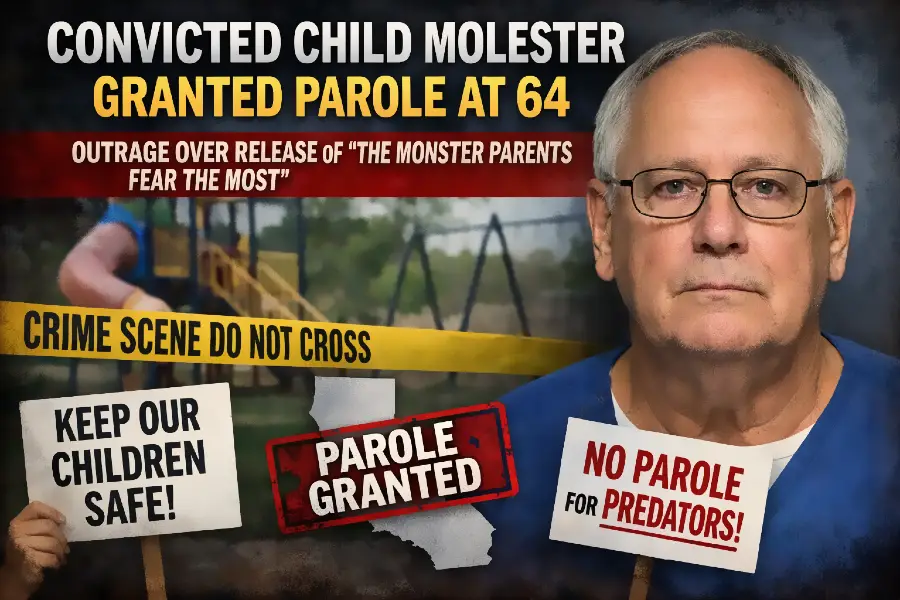
Serial Child Molester Granted Parole at 64 Under California Elderly Parole Law
The upcoming release of convicted serial child molester David Allen Funston has ignited public and political backlash, raising a broader question now echoing across California communities: Does being 64 years old mean someone is no longer a danger to children?
Funston, 64, is currently incarcerated at the California Institution for Men in Chino. He was granted parole under California’s Elderly Parole Program despite being sentenced in 1999 to three consecutive life terms plus an additional 20 years and eight months for a series of violent crimes against young children.


A Crime Spree That Shocked the Sacramento Region
Between 1995 and 1996, Funston targeted children in Sacramento-area suburbs including North Highlands, Foothill Farms and Roseville. According to court records, he lured children — ages 3 to 7 — into his vehicle using candy, toys and Barbie dolls.
He was convicted on 16 felony counts involving eight victims — seven girls and one boy. The charges included kidnapping, forcible sexual assault and physical beatings.
At sentencing, the presiding judge described Funston as
“the monster parents fear the most,”
imposing three consecutive terms of 25 years to life.
Parole Granted Under Elderly Parole Program
Under California law, inmates who are 50 or older and have served at least 20 continuous years are eligible for a parole hearing. The program was designed to address aging prison populations and reduce incarceration costs.
Funston was denied parole in 2022. However, on Sept. 24, 2025, the California Board of Parole Hearings found him suitable for release.
In January 2026, Gavin Newsom requested a re-review of the decision. On Feb. 18, 2026, the board reaffirmed the grant of parole.
Under current California law, the governor cannot reverse parole decisions in non-homicide cases.
The California Department of Corrections and Rehabilitation has not publicly disclosed Funston’s exact release date or placement location, citing security concerns.
Law Enforcement and Prosecutors Push Back
The decision has drawn sharp criticism from law enforcement and former prosecutors.
Sacramento County Sheriff Jim Cooper condemned the parole decision, calling it “dead wrong.”
“Age does not erase predatory behavior,” Cooper said in a public statement. “The risk to children remains.”
Anne Marie Schubert, the former prosecutor who handled the case, has requested that Funston be evaluated under California’s Sexually Violent Predator program. If designated a Sexually Violent Predator, he could face civil commitment in a state hospital rather than release into the community.
Legislative Response Under Consideration
State lawmakers are now discussing potential reforms to exclude violent sexual predators from the Elderly Parole Program. Proposals under consideration would limit eligibility for inmates convicted of certain violent sex offenses involving children.
The case has reignited debate about the balance between criminal justice reform and public safety — particularly in cases involving crimes against children.
For communities across El Dorado County and neighboring Sacramento County, the issue is not theoretical. It is deeply personal.
As one law enforcement official summarized the concern: the passage of time alone does not necessarily equal rehabilitation.