EL DORADO COUNTY, Calif. — The hoofbeats of history will echo through El Dorado County this June as the 2026 Pony Express Re-Ride retraces the legendary mail route linking St. Joseph to Sacramento.
Scheduled for June 15–25, the annual relay ride commemorates the short-lived but storied Central Overland California and Pikes Peak Express Company and this year aligns with nationwide observances of America’s 250th anniversary. Riders will cover approximately 1,966 miles along the Pony Express National Historic Trail, a designated component of the National Trails System.


The first rider will depart at 3 p.m. CDT on June 15 from the historic Patee House Museum. Over the next 10 days, volunteer riders will carry commemorative and personal letters in a traditional mochila — a leather saddle cover fitted with four locked cantinas — across Missouri, Kansas, Nebraska, Colorado, Wyoming, Utah, Nevada and into California.
The route includes a pass through South Lake Tahoe before concluding in Sacramento. Local residents will have opportunities to witness rider exchanges, attend community celebrations and participate in educational programming tied to the America 250 initiative.
Organized by the National Pony Express Association, the Re-Ride operates continuously, day and night, honoring the original 1860–61 mail service that proved the Central Route through Salt Lake City viable year-round. The enterprise sought a federal mail contract but ceased operations after 18 months when the transcontinental telegraph rendered it obsolete.
“This event connects Americans directly to the grit and determination that shaped our early communication network,” the National Pony Express Association states on its website. “By carrying letters the entire route on horseback, we preserve a living link to our shared heritage.”
Members of the public may purchase commemorative letters for $5 — the same rate charged in 1860 — or send personal letters for $10. Each piece of mail will be stamped as officially carried by Pony Express riders before being transferred to the U.S. Postal Service for final delivery. Letter applications and event details are available through the National Pony Express Association website.
A GPS tracking device will travel inside the mochila, transmitting real-time updates viewable through an interactive online map. Progress reports, photos and videos will also be shared through official social media channels.
Equestrians and volunteers interested in participating can contact their state president through the association’s national directory. Organizers say several ride sections remain open.
For El Dorado County residents, the 2026 Re-Ride offers more than a spectacle — it provides a tangible connection to the frontier legacy that once defined the Sierra Nevada corridor and helped bind a young nation together.
Placerville Anchored the West in Pony Express History
PLACERVILLE, Calif. — Long before it became a Gold Rush landmark, Placerville played a decisive role in binding a young nation together through speed, endurance and raw determination.
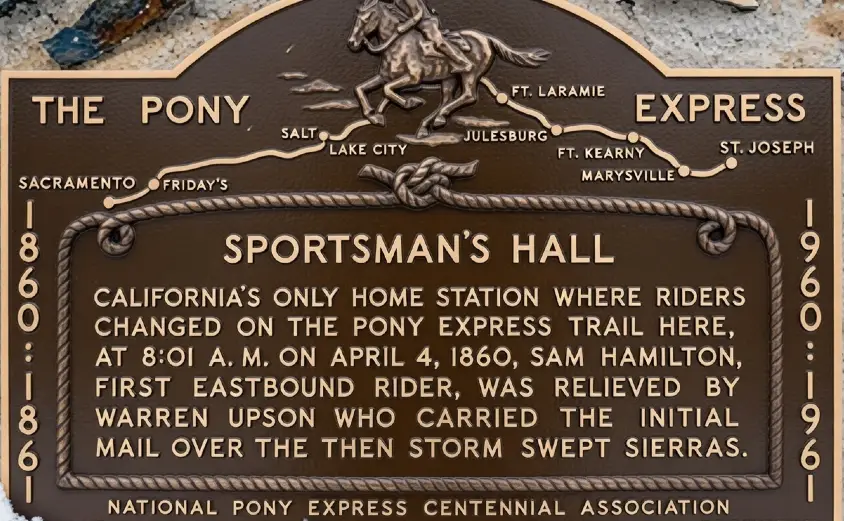
When the Central Overland California and Pikes Peak Express Company launched the Pony Express in April 1860, Placerville quickly emerged as a crucial relay station along the rugged Sierra Nevada corridor. Riders pushing westward from St. Joseph depended on the foothill outpost as they navigated some of the most treacherous terrain on the 1,900-mile route to California.
From April 1860 through the summer of 1861, fresh horses and riders rotated through Placerville in a precisely timed exchange system that kept mail moving 24 hours a day. At the height of operations, relays occurred roughly every 10 to 15 miles, with individual riders covering 75 to 100 miles before handing off the mochila.
Placerville’s importance deepened on July 1, 1861, when it became the western terminus for Pony Express mail. From that point until the service ended on Oct. 26, 1861, eastbound and westbound correspondence reached Placerville before final delivery to San Francisco.
The last leg to the coast was often completed not by horseback alone but by stagecoach, rail connections and steamboat service operated by Wells Fargo, which already maintained a strong transportation network throughout California.
The Pony Express ultimately proved the viability of the Central Route through Salt Lake City, but it operated for just 18 months before the transcontinental telegraph rendered it obsolete. Despite its brief lifespan, the enterprise became one of the most enduring symbols of American frontier resolve.
Today, as the 2026 Pony Express Re-Ride commemorates America’s 250th anniversary, Placerville’s legacy stands as a reminder that El Dorado County was not merely along the route — it was a strategic anchor point at a pivotal moment in national expansion.