By Cris Alarcon, InEDC Writer. March 8, 2026
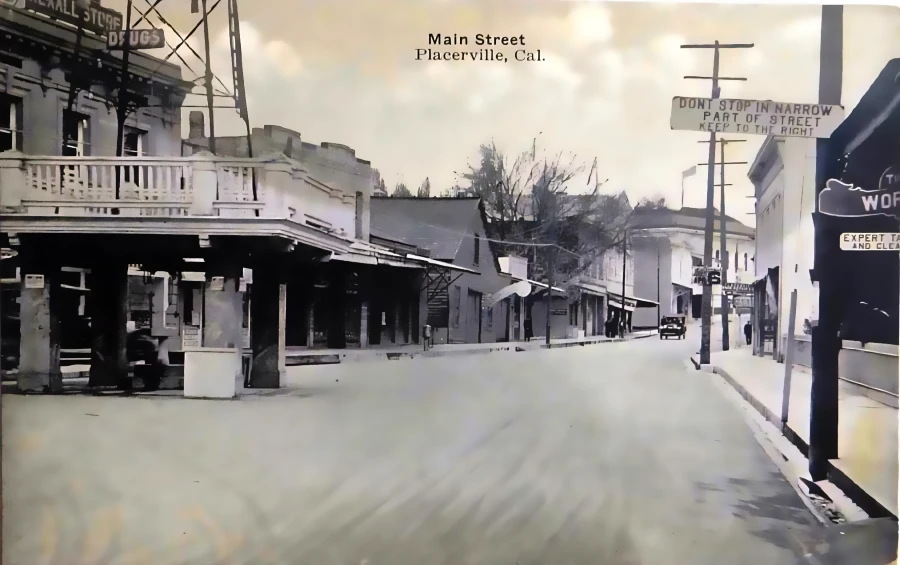
Sit back friend and let me take you on a ride, and mind the dust of the road a moment. What you behold in this old photograph is Main Street of Placerville as it appeared in the years just after the Great War—when the old frontier town was shaking hands with the modern age.
A Street Between Two Worlds
In those days—somewhere around the 1910s to the middle 1920s—a traveler rolling down Main Street might witness a curious sight. A wagon drawn by a patient team of horses could be clopping along one moment, and the next moment an automobile—snorting like a brass contraption escaped from a machine shop—would rattle past in a cloud of dust and gasoline fumes.
Placerville had known many names before settling on its present dignity. In the rough-and-tumble years of the Gold Rush it was called Dry Diggins, and later the more infamous Hangtown, owing to the swift justice meted out beneath a certain oak limb. But by the 1920s the town had softened its reputation and matured into a respectable Sierra foothill community.
Still, the old bones of the Gold Rush were everywhere.
The Heart of Town: The Bell Tower
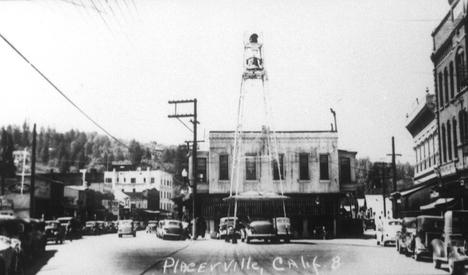 At the center of life stood the proud Placerville Bell Tower, which locals simply called the Plaza. It was the town’s meeting place, bulletin board, and celebration ground all rolled into one.
On summer evenings, a fellow might hear a brass band tuning up beneath the tower while couples gathered for dancing on a wooden floor laid out by the chamber of commerce. During the famous Days of ’49 celebrations, the plaza became a lively carnival of whiskered prospectors, brass bands, and parade wagons rolling by in grand procession.
Many a gentleman spent six months cultivating an impressive beard in hopes of winning the Whiskerino contest, where the champion whiskers could earn a tidy purse of thirty dollars—a respectable sum in those days.
Main Street: The Highway of the Nation
Folks today might think of Main Street as a quiet historic district, but in the 1920s it was the principal highway through the Sierra.
Before federal numbering arrived, the road through town was part of the grand Lincoln Highway, the nation’s first automobile road stretching from the Atlantic to the Pacific. Then in 1926 the government rechristened the route as U.S. Route 50.
That meant every motorist bound for Lake Tahoe or the Nevada desert had to roll right through this narrow canyon of storefronts.
And narrow it was.
One sign posted along the street warned drivers in bold lettering:
“DONT STOP IN NARROW PART OF STREET – KEEP TO THE RIGHT.”
Good advice, considering wagons, pedestrians, and motorcars were all vying for the same strip of road.
Commerce Along the Boardwalk
Look close at the storefronts and you’ll spy the familiar sign of Rexall drugs hanging above the sidewalk. Drugstores like this were more than mere places to fetch medicine. They were gathering spots where townsfolk came for soda water, gossip, and the latest news from Sacramento.
Just down the way stood the stately Cary House Hotel, already famous among travelers. By 1926 the establishment had installed an electric elevator—an impressive marvel for a mountain town—and had temporarily taken on the fashionable name Raffles Hotel.
Nearby businesses bustled with the needs of a changing economy. As the gold mines quieted, orchards, vineyards, and lumber camps took their place. Timber from the high country poured down the slopes thanks to the mighty Michigan-California Lumber Company, whose aerial tramway carried immense loads of lumber across the American River canyon.
Meanwhile the California Door Company turned Sierra timber into doors, windows, and wooden packing boxes for the valley’s fruit growers.
The Older Stories Beneath the Street
Even as new automobiles hummed along the roadway, Placerville kept reminders of its older past.
Visitors often sought out the curious establishment known as Hangman’s Tree, whose cellar preserved the stump of the original hanging tree from frontier days. It made for a popular photograph among motorists eager to prove they had passed through the legendary town of Hangtown.
And tucked along Main Street stood the old stone building now known as the Fountain & Tallman Museum, originally built in 1852 as a soda works. By the 1920s it remained a landmark of the town’s earliest prosperity.
Sirens of the Modern Age
Placerville was not content to live entirely in memory. Between 1920 and 1921, the city installed a system of electric sirens—modern marvels intended to warn citizens of fires or emergencies. One was placed near the high school, another in Upper Town on Broadway, and a third atop the firehouse of Confidence Engine Company No. 1.
Thus the quiet toll of the bell tower now shared the skyline with the shriek of electricity—an audible reminder that the twentieth century had arrived.
A Town Standing at the Crossroads
So this photograph captures more than storefronts and wagons. It shows a town balanced neatly between two centuries.
Placerville in the 1920s was no longer the lawless mining camp of Hangtown, yet neither had it lost its frontier spirit. The horses had not quite disappeared, the automobiles had not quite taken command, and the old wooden balconies still cast their shade over travelers passing west toward Sacramento or east toward the high Sierra.
In that brief moment of history, Main Street was not merely a street—it was the road of America itself.
And every traveler who passed beneath the Bell Tower carried away a little dust of Hangtown on their boots.