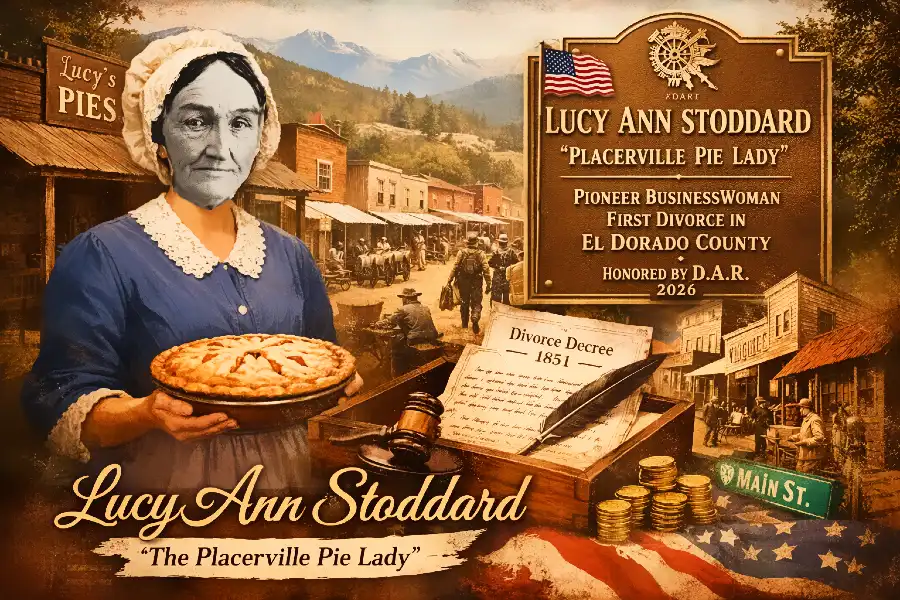
PLACERVILLE, Calif. — The remarkable story of a Gold Rush entrepreneur who turned dried apples into a thriving business—and helped shape early women’s rights in California—is being honored again in Placerville.
On March 11, 2026, the local chapter of the Daughters of the American Revolution unveiled a historic recognition of Lucy Ann Stoddard, widely remembered as Placerville’s legendary “Pie Lady.” Her life story blends the grit of the 1849 Gold Rush with a groundbreaking legal victory that made her the first woman to receive a divorce in El Dorado County.


A Difficult Journey to Gold Rush California
Stoddard arrived in California in 1849, traveling by wagon train during the height of the Gold Rush to what was then known as Hangtown, now Placerville.
Like thousands of other emigrants, she endured a months-long journey over rough terrain before reaching the booming mining settlement.
Historians say the trip itself was grueling, particularly for women traveling across the frontier in an era when fewer than 3 percent of Gold Rush migrants were female.
But Stoddard arrived with a plan: she intended to build an independent life.
The Birth of the “Placerville Pie Lady”
After reaching Hangtown, Stoddard established a bakery business along Main Street, producing deep-dish pies made from rehydrated dried apples—a practical ingredient for miners who lacked fresh food.
Her pies quickly became a sensation in the bustling mining town.
At the height of her business, Stoddard reportedly baked as many as 40 pies a day, selling each for $1 to $2—high prices for the time. Historians estimate she sold more than 200 pies a week, generating approximately $240 weekly, a remarkable income during the early Gold Rush years.
Using her profits, she invested in real estate and purchased property along Main Street, establishing herself as one of the town’s early female entrepreneurs.
A Historic Divorce Case
Stoddard’s influence extended beyond business.
In 1851, she filed for divorce from her husband, John Wakefield, citing extreme cruelty and abuse. The case was groundbreaking: at the time, divorce was rare, and legal protections for women were limited.
Representing herself in court, Stoddard won the case before an all-male jury, becoming the first woman granted a divorce in El Dorado County.
The jury awarded her control over her property and earnings—an unusual outcome in an era when married women often had little legal authority over their assets.
A Legal Pioneer
Stoddard’s case also intersected with evolving laws governing women’s property rights.
In 1852, legislation allowed women to reclaim their maiden names and conduct business independently as “sole traders,” enabling them to operate commercial ventures under their own legal authority.
Stoddard formally restored her maiden name that year, again becoming Lucy Ann Stoddard.
Soon after, she married Christopher “C.C.” Batterman, a respected local mining official. According to historical accounts, Batterman had served on the jury that granted her divorce.
Life Beyond Placerville
The couple eventually moved to Virginia City during the boom years of the Comstock Lode. Batterman later served in prominent mining and financial roles, including work connected with Nevada’s early government institutions.
Stoddard remained widely respected in the community until her death in 1895 at age 78.
Remembering a Gold Rush Trailblazer
Members of the DAR say honoring Stoddard highlights the role women played in shaping California’s early communities.
“Lucy Ann Stoddard was not only a successful businesswoman but also a pioneer for women’s independence during the Gold Rush,”
a DAR representative said during the commemorative presentation.
Today, her legacy lives on in local history programs and downtown Placerville’s “Miners on Main” heritage scavenger hunt, where visitors can learn about the colorful figures who helped build the city.
For many local historians, Stoddard’s story represents more than a famous pie recipe.
It reflects the determination of a woman who crossed a continent, built a business from scratch, and helped carve out new rights for women in the early days of California.