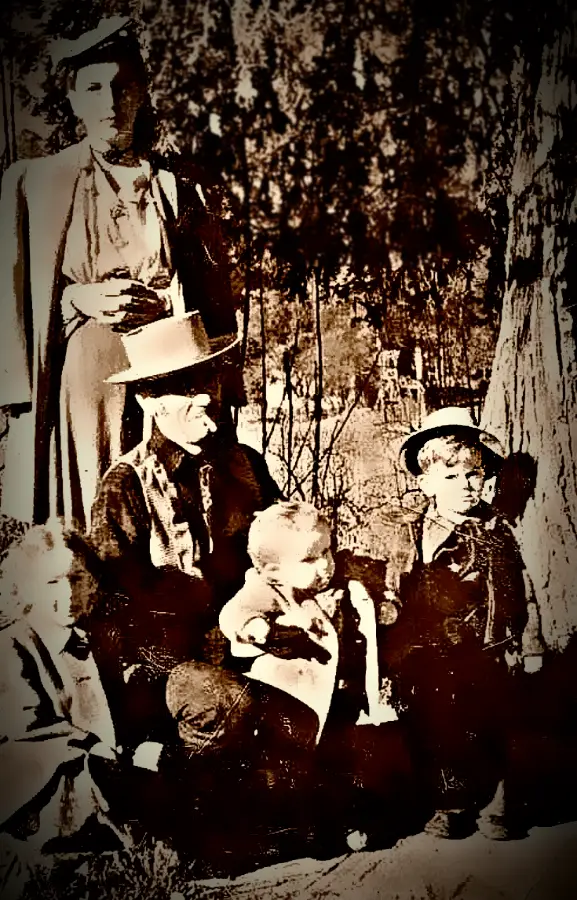
COLOMA, Calif. — Seventy-eight years ago this week, as California marked the centennial of the discovery of gold, a family photograph captured a fleeting moment at Sutter’s Mill that now serves as a living bridge between past and future in El Dorado County.
The black-and-white image was taken Jan. 24, 1948, during the statewide Gold Discovery Centennial celebration in Coloma, commemorating James W. Marshall’s 1848 discovery that launched the Gold Rush and transformed California. In the photo are multiple generations: a young woman identified as Maryeda, who recently celebrated her 90th birthday; her father, A.J. Hayes, known to family and friends as “Jimmy”; and, at the right edge of the frame, a serious-faced toddler dressed as a cowpoke is Dennis Hayes.
That toddler is now 80 years old.
“I was about 2 and two-thirds years old in that picture,” Dennis Hayes said. “I’m 80 and two-thirds now, and I’m planning on attending the bicentennial celebration. If I make it, I’ll be 102 and two-thirds. That would be something.”
The 1948 centennial brought national attention to Coloma and El Dorado County, drawing large crowds and state leaders to what is now Marshall Gold Discovery State Historic Park. Among them was then-Gov. Earl Warren, who proclaimed Jan. 24, 1948, as “Gold Discovery Day” and appeared at the celebration following significant state investment in preserving and expanding the historic site.
Warren’s administration played a key role in shaping the park ahead of the centennial. In 1947, he signed legislation enabling the State Park Commission to more easily acquire land, followed by $80,000 in urgency funding to prepare the Gold Discovery site, including $10,000 earmarked for acreage in Coloma.
For the family in the photograph, the day is remembered not only for its historic importance but also for its human details.
“I’m told I had to pee, so my parents let me go by a tree just as the governor walked by,”
Dennis Hayes recalled with a laugh.
“Turns out I was one of the first people to ‘go’ before Earl Warren, who later became Chief Justice of the U.S. Supreme Court.”
Warren would go on to serve as chief justice from 1953 to 1969, overseeing landmark decisions that reshaped American law and civil rights. In 1948, however, he stood in Coloma emphasizing the broader meaning of the Gold Rush Centennial, calling for reflection and a forward-looking vision beyond California’s borders.
Today, the photograph stands as a reminder that history is not only preserved in monuments and proclamations, but also in family albums and living memory. With planning already underway statewide for the 200th anniversary of the gold discovery in 2048, the man hopes to once again stand at Sutter’s Mill—this time as a witness to two centuries of California history.
“It would be pretty cool,” Dennis Hayes said, “to be the old man who was there for both.”
About Earl Warren in Coloma Gold Discovery
Earl Warren’s connection to the Coloma Gold Discovery primarily stems from his tenure as Governor of California (1943–1953), during which he spearheaded the state’s centennial celebrations of the 1848 discovery. Warren was a member of the Native Sons of the Golden West, an organization that was instrumental in erecting the Marshall Monument in Coloma and advocating for the preservation of California’s Gold Rush history.
- Proclamation of Gold Discovery Day: In January 1948, Governor Warren officially proclaimed January 24 as “Gold Discovery Day,” marking the 100th anniversary of James Marshall’s find at Coloma.
- Park Development: Warren signed legislation in June 1947 that allowed the State Park Commission to acquire land for what would become Marshall Gold Discovery State Historic Park. He approved an urgency measure of $80,000 to purchase and develop 14 acres in Coloma specifically for the 1948 centennial.
- Public Appearances: During the 1948 celebrations, Warren was filmed and photographed walking through the historic sites in Coloma, waving to crowds and interacting with participants in Gold Rush-themed parades.
- Moral Determination: He emphasized that achieving peace required more than just desire; it required a collective national and global determination similar to the grit shown by early California pioneers.
- Rededication to Principles: He called for a rededication to the “great principles of the American way of life,” viewing these values as the foundation for both California’s progress and a stable global order.
- Global Understanding: In related statements during 1948, he highlighted “world understanding” as a “mighty contributor” to achieving this lasting peace.
- Universal Brotherhood: His vision often invoked “universal brotherhood” as a goal that all nations, particularly those impacted by the two world wars, should strive toward together.
- Governor Earl Warren: He was the most prominent figure, delivering a major address and participating in the events, which included a large parade and pageant.
- State and local officials: The ceremonies were a significant state event, involving the State Park Commission and local government, so various officials were present.
- Members of the Native Sons of the Golden West: This fraternal organization, involved in preserving the Marshall Monument and local history, was present and involved in the planning and execution of the centennial activities.
- Descendants of pioneers: The event focused on honoring early pioneers, including likely descendants of figures like James Marshall and John Sutter, some of whom were portrayed in the pageant.
- Local Participants and Spectators: Thousands of people from across California attended the festivities, which included costumed participants re-enacting historical scenes and gold panning demonstrations.
- Impact on Black Families: The state used these powers to forcibly purchase land from local Black families, including the descendants of Pearley Monroe, to create the park. Descendants and activists are currently advocating for reparations or the return of this land.
- Historical Advisory Committee: In 1948, Warren created the California Historical Landmarks Advisory Committee to formalize the state’s landmark program, which now manages the Coloma site (California Historical Landmark No. 748).
- Chief Justice Transition: Shortly after the three-year centennial cycle (1948–1950) concluded, President Eisenhower appointed Warren as Chief Justice of the U.S. Supreme Court in 1953.