By Cris Alarcon, InEDC Writer. March 30, 2026
The Valley Before the Water: A Hidden Chapter of El Dorado County History
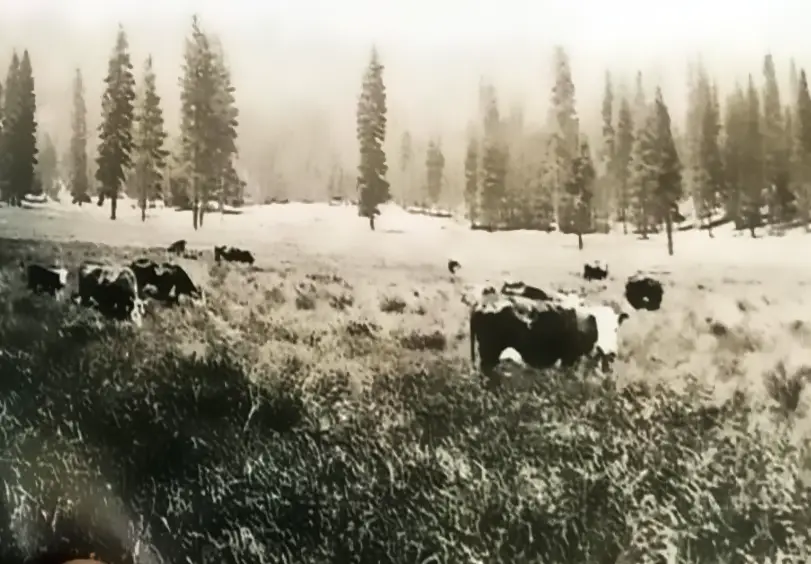
Long before kayaks skimmed the surface of Jenkinson Lake, the basin below was a wide, open meadow known as Sly Park—rich in grass, water, and history. Local accounts, including a recent family recollection shared by Maria Neilsen, affirm what historians have long documented: the valley once supported cattle drives, ranch operations, and early travelers moving through the Sierra Nevada.
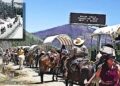
“Cattle ranchers used it to pasture cattle especially on the way to mountain ranges for summer”
Neilsen wrote, echoing records of seasonal grazing routes that predate the reservoir by decades.
The First Trailblazers: The Mormon Battalion’s 1848 Passage
The story of Sly Park begins in earnest in 1848, when a group of discharged members of the Mormon Battalion crossed the Sierra Nevada in search of a route back to Utah.
Led in part by James Calvin Sly, the party entered a lush, meadowed valley that Sly described as “park-like.” He named it “Sly’s Park,” a term that endured long after the expedition moved on.
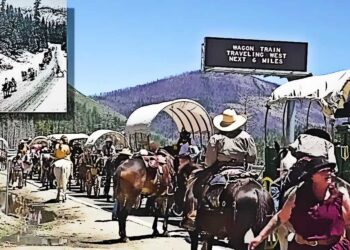
From this encampment, the group carved what became known as the Mormon Emigrant Trail—one of the earliest wagon roads over the Sierra via Carson Pass. This route would soon carry thousands of Gold Rush emigrants into California.
Tragedy at the Springs
Not all chapters of this journey were triumphant. Just miles from Sly Park lies Tragedy Spring, where members of the party discovered the bodies of three missing scouts in July 1848.
The men—Daniel Browett, Ezra Allen, and Henderson Cox—had been killed under unclear circumstances. Contemporary accounts noted “a newly-made mound” and signs of violence, including arrows and scattered belongings.
Despite uncertainty over whether the attack was carried out by Indigenous groups or others, the surviving party honored the dead by constructing a rock cairn that still stands today. A section of an inscribed tree marking the site is preserved at Marshall Gold Discovery State Historic Park.
Ranching Era: The Stark Family and Early 20th Century Life
By the late 19th century, Sly Park had transitioned from trail stop to working landscape. In 1882, Henry Alfred Stark established what became one of the valley’s most prominent ranches.
After his death in 1898, his family—often referred to as the “Stark brothers”—continued operations into the early 20th century. Between 1900 and the 1920s, the ranch functioned as a small economic hub:
- A 15-room hotel served travelers along the old emigrant trail
- A dairy operation supported livestock production
- A general store supplied nearby lumber workers and teamsters
Neilsen’s account aligns with documented ownership transitions: the Stark family maintained control until roughly the 1920s, when the property changed hands—eventually being acquired for water development purposes.
From Ranch to Reservoir: The Vision of Walter Jenkinson
The transformation of Sly Park from meadow to reservoir reflects a broader shift in California’s priorities during the mid-20th century. Facing recurring water shortages, Walter E. Jenkinson championed the idea of damming the valley.
In 1951, construction began on the Sly Park Dam under the guidance of the El Dorado Irrigation District and the U.S. Bureau of Reclamation. By 1954, the valley had filled with water, creating Jenkinson Lake—named in Jenkinson’s honor.
Local memory, like that shared by Neilsen’s family, places dam construction in the late 1950s, reflecting the extended timeline of infrastructure completion and community impact.
Echoes Beneath the Surface
Today, the Sly Park Recreation Area draws thousands of visitors each year. Few realize that beneath the lake lie the remnants of a once-bustling ranching community—homes, barns, and the foundations of a waystation that served generations of travelers.
When water levels drop, fragments of this past reappear: stone foundations, old road traces, and even Indigenous grinding holes from the Maidu and Miwok people, who inhabited the region for thousands of years before American settlement.
A Landscape Defined by Two Eras
Sly Park stands as a rare convergence of California history—where pioneer trailblazing meets modern infrastructure. The legacy of James Calvin Sly represents the 19th-century push westward, while the work of Walter E. Jenkinson reflects the 20th-century demand for water and growth.
Together, they shaped a landscape that continues to serve the region—both as a historical landmark and a vital resource.