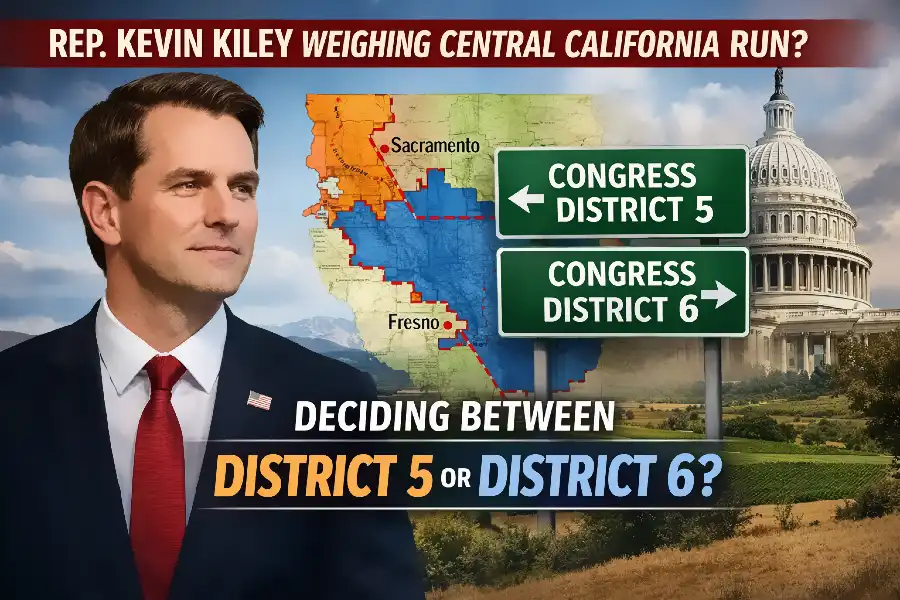
EL DORADO COUNTY, Calif. — Republican Rep. Kevin Kiley (R–Rocklin) confirmed Thursday that he is contemplating a 2026 campaign in one of two Central California U.S. House districts after California’s watershed redistricting overhaul reshaped his current seat.
Kiley, whose political base includes parts of the Sacramento region, made the announcement amid fallout from Proposition 50, the high-profile ballot measure passed last year that redrew California’s congressional map to favor Democratic constituencies for the next three election cycles. The new lines significantly alter the partisan balance of several districts, leaving some incumbents — including Kiley — to reassess where they might run.


His current district, historically encompassing the Sierra foothills and portions of Placer and Nevada counties, now extends farther into Democratic-leaning Sacramento neighborhoods while shedding portions of his Republican base.
Kiley did not specify which two districts he is considering, but political analysts note that potential options include adjacent Central California districts reshaped by the new map, where GOP registration and voter demographics may offer better prospects. Local observers are watching closely, as El Dorado County shares economic and community ties with neighboring districts where Kiley could mount a campaign.
A spokesman for Kiley emphasized that the congressman will consult with community leaders and voters before making a final decision, underscoring the importance of local engagement ahead of the March filing deadline.
“We’re having conversations up and down the map about where I can best represent Central Valley and Sierra communities,” Kiley said Thursday. “My priority is to ensure that voices across these regions are heard in Washington.”
Redistricting advocates have defended the changes as more representative of California’s diverse population, while critics — including some Republicans — have filed legal challenges in federal court, arguing the maps disadvantage GOP voters.
The decision will shape the political landscape across the region next year, particularly in closely contested areas where control of the U.S. House hangs in the balance.