Lee Tannenbaum, Contributor. (Jan 15, 2026)
El Dorado County, Calif. — Most residents don’t follow county government closely, and that’s understandable. But a recent procedural change by the El Dorado County Board of Supervisors could significantly affect when — and whether — the public is able to speak before decisions are made.

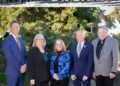
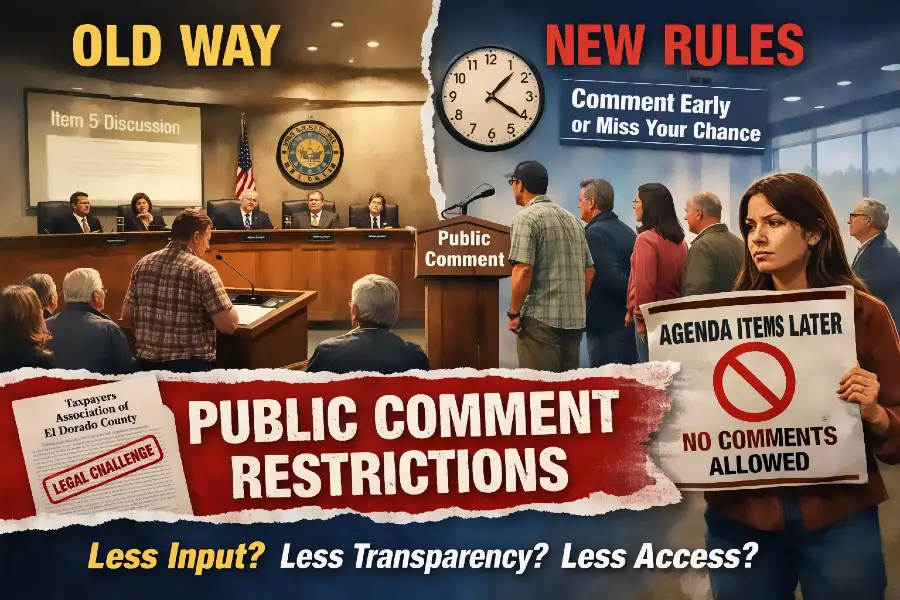
Beginning Jan. 6, 2026, the Board implemented a revised public comment structure approved unanimously on Nov. 18. Under the new format, public comments on many agenda items are grouped into a single comment period, often held early in the meeting, rather than allowing speakers to comment when individual items are taken up for discussion.
County officials describe the change as an efficiency measure intended to shorten meetings and reduce long waits. Critics, however, argue the new system creates barriers to meaningful public participation.
Under the revised rules, residents who want to comment on certain agenda items may be required to speak before staff presentations, before supervisors ask questions, and before it becomes clear how the Board is leaning on an issue. If a speaker misses that early comment window, they may not be allowed to comment later when the item is actually discussed.
Opponents say that turns public comment into a guessing game.
According to the Taxpayers Association of El Dorado County, the new structure has already resulted in residents being prevented from speaking on agenda items that directly affected them after being told they should have commented earlier in the meeting. The concern is particularly acute for property owners, business owners, and residents impacted by land-use, development, or regulatory decisions.
California’s Brown Act guarantees the public the right to comment before or during the Board’s consideration of each agenda item. Public comment, critics note, is intended to inform decision-making in real time — not simply serve as a procedural checkbox.
“This is not about being confrontational,” said Lee Tannenbaum, president of the Taxpayers Association of El Dorado County.
“It’s about protecting transparency, accountability, and public trust. Government can be efficient without limiting meaningful public participation.”
Tannenbaum said the association has filed a formal notice raising concerns about whether the new process complies with state law and long-standing public participation norms. He also noted that many counties across California manage full agendas while still allowing comments at the point when items are discussed.
Supporters of the changes argue the new format respects the public’s time by allowing residents to comment on multiple items in one appearance, rather than waiting hours for specific agenda items to be called. Open Forum — which allows three minutes of comment on non-agenda items — will continue to be held at 1 p.m.
Critics counter that efficiency should not come at the expense of effective public input.
“This issue is not about politics,” Tannenbaum said. “It’s about process. Regardless of viewpoint, everyone benefits when decisions are made openly and with public input at the moment those decisions are being considered.”
Residents who oppose the changes are being encouraged to contact their supervisors directly to express their views. Written comments can be brief, supporters say, but silence guarantees no change.
How to Contact Your Supervisor
-
District 1 – Greg Ferraro: bosone@edcgov.us
-
District 2 – George Turnboo: bostwo@edcgov.us
-
District 3 – Brian Veerkamp: bosthree@edcgov.us
-
District 4 – Lori Parlin: bosfour@edcgov.us
-
District 5 – Brooke Laine: bosfive@edcgov.us
As Tannenbaum put it plainly:
“If you say nothing, you get nothing.”