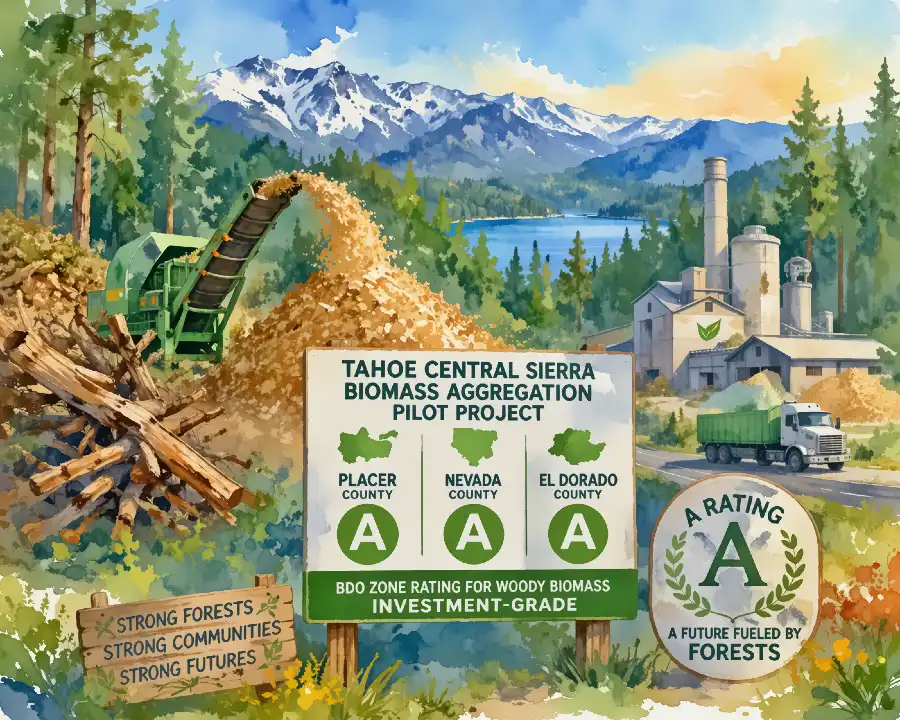
El Dorado County Secures Top-Tier Biomass Rating, Signaling Readiness for Bio-Based Industry
PLACERVILLE, Calif. — El Dorado County has been awarded an investment-grade “A” rating for woody biomass under the Tahoe Central Sierra Biomass Aggregation Pilot Project, a designation that positions the region as a leading candidate for future bio-based manufacturing development.
The rating, issued by Ecostrat through its Bioeconomy Development Opportunity (BDO) Zone Initiative, places El Dorado County alongside Placer County and Nevada County, both of which also achieved the top-tier designation. The evaluation was conducted under California’s Forest Residual Aggregation Market Enhancement program, known as CalFRAME.


Funding for the analysis was provided by the Governor’s Office of Land Use and Climate Innovation, with El Dorado County’s participation supported through a USDA Rural Business Development Grant.
The BDO Zone “A” rating is based on a rigorous assessment of more than 75 technical, economic and logistical risk factors. According to Ecostrat, the three-county region collectively offers more than 273,800 bone dry tonnes of low-risk woody biomass annually, with the potential to triple that volume under higher-risk recovery scenarios.
“This rating confirms that the Tahoe Central Sierra region is among the most investment-ready areas in North America for bio-based manufacturing,”
the BDO Zone Initiative said in a statement.
“Strong infrastructure, available feedstock, and community support all contribute to a highly favorable development environment.”
Local officials and stakeholders have long pointed to biomass utilization as a dual-benefit strategy—reducing wildfire fuel loads while creating economic opportunities in rural communities. The region’s limited competition from traditional pulp and paper mills further enhances its attractiveness to investors seeking stable, long-term biomass supply chains.
In El Dorado County, where wildfire risk remains a persistent concern, the development of biomass markets is increasingly viewed as a critical component of forest management and climate resilience strategies. Projects like the Tahoe Central Sierra pilot aim to aggregate forest residues—such as small-diameter trees and woody debris—into viable commercial supply streams.
The presence of existing industrial sites and transportation infrastructure across the counties also played a key role in achieving the top rating, according to project analysts. These assets reduce barriers to entry for companies considering new facilities tied to renewable fuels, biochar, or engineered wood products.
Regional leaders say the designation could help attract private investment, accelerate job creation, and strengthen forest health initiatives already underway across the Sierra Nevada foothills.