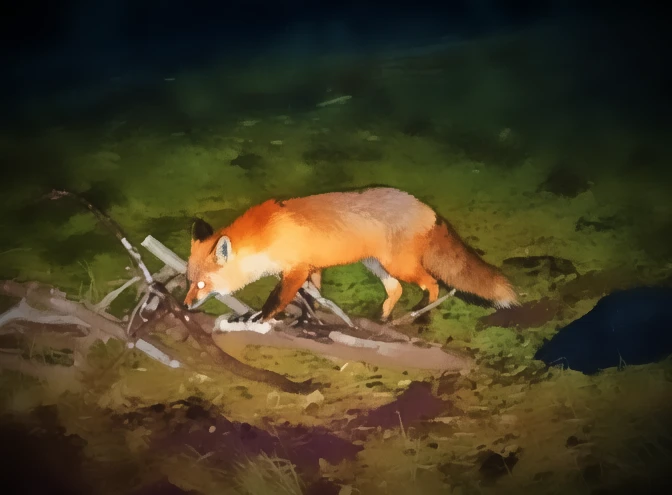
LAKE TAHOE, Calif. — A remote wildlife camera has captured a rare and elusive Sierra Nevada Red Fox on the west shore of Lake Tahoe, marking the first confirmed documentation of the species in the Tahoe West Basin.
The sighting, recorded Nov. 13, 2025, by the conservation group Pathways for Wildlife, is being hailed by researchers as a significant development for one of California’s most endangered native carnivores.

With fewer than 50 individuals believed to remain statewide, the Sierra Nevada Red Fox is rarely seen. The species is listed as threatened under the California Endangered Species Act and federally endangered.
Wildlife ecologist Tanya Diamond, who reviewed the footage alongside colleague Ahíga Sandoval, said the identification was unmistakable despite the animal’s fleeting appearance.
“They’re super fluffy because they exist at such high elevations,”
Diamond said.
“They are constantly in their puffers.”
That “puffed” appearance serves a critical survival function. The fox’s dense fur extends even to its paws—what Diamond informally described as “ski mode”—allowing it to move efficiently across deep snow. The adaptation is also evident in its tracks, which appear larger and softer-edged than those of gray foxes.
The footage was captured near Blackwood Canyon during a broader survey effort funded by the California Tahoe Conservancy. The project aims to identify key wildlife corridors and potential road-crossing sites in the Tahoe Basin, a region increasingly fragmented by development and recreation.
Researchers from Pathways for Wildlife are working in coordination with the U.S. Forest Service and a statewide Sierra Nevada Red Fox working group focused on conservation strategies.
The species’ decline is not fully understood, but historical pressures—including unregulated hunting and trapping in the early 20th century—are believed to have contributed, according to the California Department of Fish and Wildlife. Today, the population faces additional challenges from low genetic diversity, which can limit resilience and reproduction.
A 2019 study led by researchers at the University of California, Davis found that limited interbreeding with red foxes migrating from the Great Basin offered temporary genetic benefits to at least one population, providing cautious optimism for the species’ future.
Diamond said the new Tahoe Basin sighting may indicate that conservation measures are beginning to yield results.
“I think these animals are actually being able to disperse and move and establish new home ranges,”
she said.
Around the same period, biologists with the California Department of Fish and Wildlife captured and released another Sierra Nevada Red Fox near Mammoth Lakes, fitting it with a GPS collar to track its movements. Data from that effort, combined with the Tahoe camera footage, is expected to provide critical insight into habitat use and migration patterns.
For a species long considered on the brink, even a single confirmed sighting carries weight. Researchers say it underscores the importance of preserving habitat corridors and minimizing human impact in high-elevation ecosystems.