Editorial By Cris Alarcon, InEDC Writer. Jan 19, 2026. Fully reported news analysis written using historical documentation, and verifiable context. It treats the Greenland issue as a matter of record—not political novelty.
A Long Paper Trail, Not a Passing Fancy
When former President Donald Trump publicly suggested in 2019 that the United States might purchase Greenland, the reaction was swift and derisive. Late-night comedians and critics framed the idea as absurd, impulsive, or historically ignorant.


In fact, the opposite is true.
U.S. interest in Greenland stretches back more than 150 years, predating modern political parties, the Cold War, and even America’s rise as a global superpower.
In 1867, the same year the United States purchased Alaska from Russia, President Andrew Johnson’s administration formally explored acquiring both Greenland and Iceland. The rationale mirrored Alaska’s acquisition: strategic positioning, maritime access, and long-term security.
That interest intensified during World War II, when the U.S. assumed responsibility for Greenland’s defense after Nazi Germany occupied Denmark. President Franklin D. Roosevelt authorized American forces to protect the island, establishing bases that remain foundational to U.S. Arctic operations today.
The Truman Offer—and What Came After
In 1946, President Harry Truman offered Denmark $100 million in gold to purchase Greenland outright—a proposal confirmed in declassified U.S. documents. Denmark declined, but negotiations over defense and access continued.
According to the U.S. National Archives, the Pentagon argued at the time that Greenland was “essential to the defense of the United States,” particularly as long-range aviation and missile technology evolved.
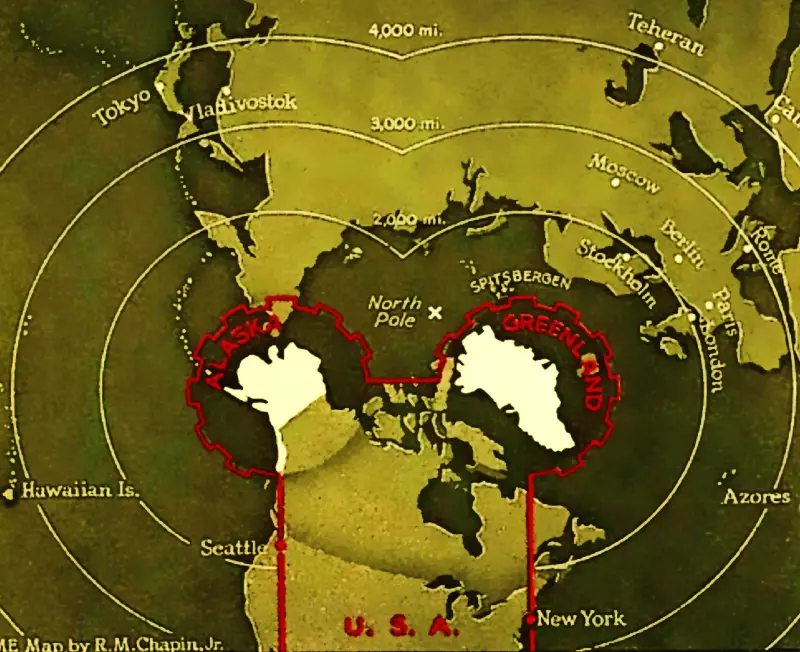
That assessment only deepened during the Cold War, when Presidents Eisenhower, Kennedy, and their successors negotiated continuously for radar installations, early-warning systems, and air bases. The most prominent of these, Thule Air Base, became a cornerstone of U.S. missile defense and Arctic surveillance.
A U.S. Air Force historical review notes that Greenland provided “an irreplaceable geographic advantage for detecting and deterring Soviet missile threats.”
After the Cold War, the Strategy Didn’t End
Contrary to popular belief, American engagement with Greenland did not fade after the Soviet Union collapsed.
Administrations under Presidents Clinton, George W. Bush, and Barack Obama expanded Arctic cooperation, modernized radar systems, and reinforced missile defense architecture as Russia and China renewed their interest in the region.
The Department of Defense has repeatedly described the Arctic as a “strategic corridor” critical to homeland defense, space tracking, and emerging shipping routes as polar ice recedes.
Greenland sits at the center of that corridor.
Why Greenland Still Matters
Today, Greenland’s value is not theoretical. It anchors U.S. influence over:
-
Arctic shipping lanes, increasingly viable due to climate change
-
Missile detection and space surveillance
-
Rare earth minerals critical to modern technology
-
Great power competition as Russia and China expand Arctic ambitions
Trump did not introduce these concerns. He verbalized them.
As one former U.S. defense official told Reuters in 2019, “Every administration has looked at Greenland through the lens of national security. Some just preferred not to say it out loud.”
What Changed in 2019
Trump’s statement broke a long-standing tradition of diplomatic understatement. Where previous presidents negotiated quietly, Trump spoke publicly—collapsing 150 years of strategic continuity into a headline moment.
But the underlying policy did not change.
The United States has been defending, funding, negotiating, and embedding itself in Greenland since the 19th century. The laughter, critics say, reflects unfamiliarity with history—not policy.
For residents of El Dorado County—home to veterans, defense workers, and a community deeply tied to national service—the lesson is simple: geopolitics rarely begin with a tweet.
They begin with maps, history, and long memory.