
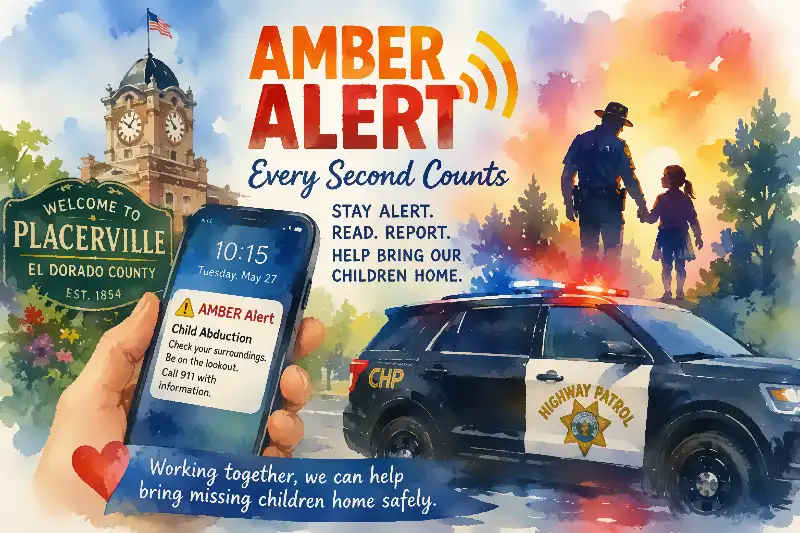
PLACERVILLE, Calif. — For motorists, parents and residents across El Dorado County, an AMBER Alert arriving on a cellphone can be startling. For law enforcement, it represents something far more urgent: an opportunity to put thousands of additional eyes and ears on the search for a child who may be in imminent danger.
The California Highway Patrol’s Placerville office is marking the anniversary of the nation’s AMBER Alert system with a simple reminder to the public: Every second counts when a child goes missing.


CHP is encouraging residents who receive an AMBER Alert to stop and read the information, pay attention to the description of the child, suspect and vehicle, and report any potentially relevant sighting to law enforcement immediately.
“If you hear an AMBER Alert, watch for the child, suspect and vehicle described in the alert,” CHP advises. “Immediately report any sightings by calling 911 or the telephone number included with the alert.”
The warning is particularly relevant in a county such as El Dorado, where major transportation corridors connect rural communities, foothill neighborhoods and the Sacramento region. A vehicle described in an alert could move considerable distances in a short period, making timely information from members of the public potentially significant to an investigation.
A system born from tragedy
The AMBER Alert system traces its origins to the 1996 abduction and murder of Amber Hagerman, a 9-year-old girl who was riding her bicycle in Arlington, Texas.
Hagerman’s death prompted members of the Dallas-Fort Worth community to ask whether broadcasters could quickly notify the public when a child was abducted. Broadcasters and law enforcement subsequently developed an early-warning system designed to enlist the public in the search. The program became known as AMBER — America’s Missing: Broadcast Emergency Response — in memory of Hagerman.
The system grew from a local concept into a nationwide network. According to the U.S. Department of Justice, 1,312 children had been successfully recovered as a result of AMBER Alert activations as of Dec. 31, 2025, including at least 252 recoveries attributed to Wireless Emergency Alerts.
California’s AMBER Alert system
California’s program has its own history.
The state began using AMBER Alerts as a regional program in 1999 before adopting a statewide system in 2002. CHP became responsible for statewide coordination, including distributing alerts to law enforcement agencies, broadcasters, transportation officials and members of the public.
Today, CHP’s Emergency Notification and Tactical Alert Center serves as California’s statewide coordinator for missing-person alerts. Investigating agencies work with CHP to determine whether the legal and operational criteria for an alert have been met.
An AMBER Alert is not issued for every missing-child case. California requires confirmation that an abduction has occurred, that the victim is 17 or younger or has a qualifying disability, that the child is believed to face imminent danger of serious bodily injury or death, and that information exists that could help the public safely recover the child.
That distinction is important. An AMBER Alert signals an exceptionally serious situation in which authorities believe public assistance could make a difference.
What El Dorado County residents should do
When an AMBER Alert appears on a cellphone, CHP recommends paying attention to the specific information provided rather than simply dismissing the notification.
Residents should look for:
- The child’s description.
- The suspect’s description.
- The make, model and color of a suspected vehicle.
- A license plate number, when available.
- The location and direction of travel.
- Any photographs or other identifying information included with the alert.
If a resident believes they have seen the child, suspect or vehicle described in the alert, CHP says to call 911 immediately. Residents should not call 911 simply to ask questions or request updates about the case.
Wireless Emergency Alerts have made that public participation substantially more immediate. California’s system can send AMBER information directly to compatible mobile devices in affected geographic areas, allowing people who may be nowhere near the original investigation to become potential witnesses.
A local connection to the system’s history
The anniversary also prompted a personal observation from El Dorado County resident Jodi Rusyn, who commented that her brother was involved in establishing the system.
“My brother worked on setting it up! Long before he was Captain in Placerville!”
Rusyn’s comment offers a reminder that large public-safety systems often have local connections that are invisible to the people who eventually rely on them.
For residents in Placerville, El Dorado Hills, Cameron Park, Pollock Pines, Georgetown and communities throughout the county, the AMBER Alert system is now an established part of the emergency-alert landscape.
But the technology itself is only one part of the equation.
The system ultimately depends on people paying attention.
CHP describes the public as an essential part of the AMBER Alert program because residents can provide the additional eyes and ears needed to locate an abducted child.
For El Dorado County residents, that means the next alert should not simply be something to swipe away.
Read it. Remember it. Watch for it. And if you see something that could help, report it immediately.
A few seconds of attention could matter when a child’s safety is at stake.