
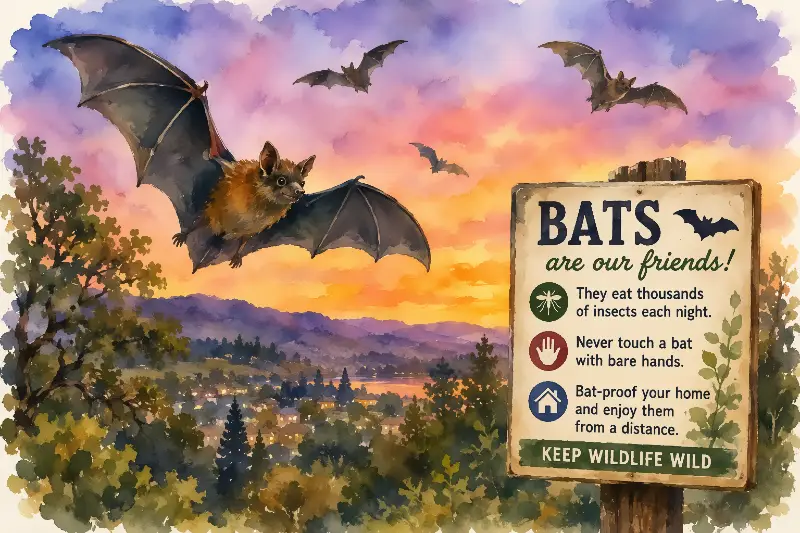
EL DORADO COUNTY, Calif. — If it seems like bats are becoming more visible around the foothills this summer, you’re not imagining it.
As warm evenings settle across communities from El Dorado Hills and Cameron Park to Placerville, Pollock Pines and Georgetown, native bat populations are becoming increasingly active. Wildlife biologists say the seasonal increase is a normal part of California’s ecosystem, with bats emerging nightly to feed on mosquitoes, moths, beetles and other flying insects.


For residents spending more time outdoors during summer evenings, the sight of bats darting overhead can be surprising. Experts emphasize that the animals are not aggressive and are performing an important ecological service by naturally reducing insect populations.
California is home to more than two dozen bat species, many of which inhabit the Sierra Nevada foothills and oak woodlands that define much of El Dorado County. Most spend daylight hours roosting beneath bridges, inside hollow trees, abandoned structures or occasionally inside attics and other quiet spaces in homes.
According to the California Department of Fish and Wildlife, bats consume thousands of insects each night, making them among the state’s most valuable natural forms of pest control. Many species are protected under California law because of declining populations caused by habitat loss, disease and human disturbance.
“Bats are beneficial wildlife and should be left alone whenever possible,” the California Department of Fish and Wildlife advises, adding that people should never touch a bat with bare hands.
Although bats provide significant environmental benefits, public health officials stress that residents should exercise caution whenever a bat is found indoors or appears sick, injured or unable to fly.
The California Department of Public Health notes that while only a small percentage of bats carry rabies, they remain the state’s most commonly reported rabid wild animal. Anyone who wakes to find a bat in a bedroom, has direct contact with one, or cannot rule out a bite or scratch should immediately contact their local health department or healthcare provider to determine whether rabies testing or preventive treatment is necessary.
Wildlife officials also discourage homeowners from attempting to trap or remove active maternity colonies during the summer. Female bats gather in protected roosts to give birth and raise their pups, which cannot fly for several weeks. Sealing entry points too early can trap young bats inside structures, leading to unnecessary mortality and odor problems.
Instead, experts recommend inspecting homes during daylight hours for gaps around rooflines, vents, chimneys and eaves, then scheduling exclusion work after young bats have matured and left the roost. Installing bat houses nearby can provide alternative habitat while helping maintain the local insect-eating population.
The seasonal increase in bat sightings is expected to continue through late summer and early fall as juvenile bats begin flying independently and colonies prepare for cooler weather. Residents hiking local trails, camping in the Eldorado National Forest or enjoying evening events throughout the foothills may notice increased bat activity around lakes, ponds and streams where insects are abundant.
Wildlife experts say the best approach is simple: enjoy watching bats from a distance, never attempt to handle one, vaccinate pets against rabies and report bats displaying unusual behavior to the appropriate authorities.
For El Dorado County residents, healthy bat populations remain an important indicator of a functioning foothill ecosystem—one that benefits both agriculture and neighborhoods by providing free, natural insect control throughout Northern California. Information on living safely alongside bats and reporting potential rabies exposures is available from the California Department of Fish and Wildlife and the California Department of Public Health.