


Opposition emerges over El Dorado County Measure S
A new political battle is taking shape over Measure S, the countywide sales tax initiative headed toward El Dorado County voters in November.
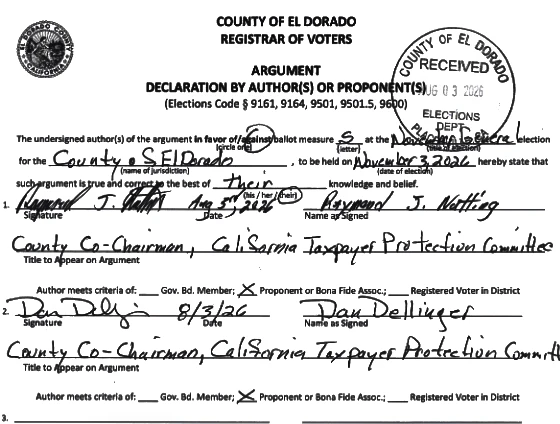
Former El Dorado County Supervisor Ray Nutting and political consultant Dan Dellinger have announced their opposition, arguing that the measure represents a tax increase that is being presented to voters primarily as a public safety proposal.
In a written opposition statement, Nutting and Dellinger, who identify themselves as county co-chairmen of the California Taxpayer Protection Committee, characterize Measure S as an unnecessary 30-year financial commitment for local taxpayers.
Their position comes as supporters of the initiative promote it as a long-term funding mechanism for emergency medical services, local fire agencies, wildfire prevention and hospital infrastructure.
The county’s official election information describes Measure S as a 3/8% countywide sales tax that would generate approximately $13 million annually for 30 years. The stated purposes include updating hospital facilities and equipment, maintaining local emergency-room access, reducing wildfire risk and supporting rapid 9-1-1 emergency response.
What voters would be deciding
The proposed tax is 0.375 percentage points.
El Dorado County’s base sales tax rate is currently 7.25% in the county’s unincorporated areas, according to California Department of Tax and Fee Administration rate information. The proposed Measure S tax would bring that rate to 7.625% where no additional local sales taxes apply.
The impact would differ in the county’s incorporated cities because they already have local sales taxes.
Using the current rates cited by the opposition, the proposed 0.375 percentage-point increase would result in rates of approximately 8.625% in Placerville and 9.125% in South Lake Tahoe. The exact tax applicable to a particular purchase can depend on the location and type of transaction.
Nutting and Dellinger frame the issue in more direct terms, writing:
“Measure S is another SALES TAX INCREASE we cannot afford!”
They argue that a $100 taxable purchase in an area with a 7.25% current rate would carry $7.625 in sales tax if Measure S were enacted, for a total of $107.625.
The initiative’s proponents describe the increase differently, emphasizing that the measure would add 3/8 of 1% and that visitors would contribute a significant share of the revenue. The campaign’s FAQ estimates the measure would add 38 cents to a $100 taxable purchase and says an estimated one-third of sales tax revenue is paid by visitors from outside the county.
Hospital funding is at the center of the dispute
One of the most significant points of disagreement involves the proposed allocation of Measure S revenue.
The initiative’s text specifies that, during the first full fiscal year, 50% of the revenue would go to eligible local hospitals, 5% to specified local nonprofit organizations involved in wildfire risk reduction, and 45% to designated fire departments and agencies.
In subsequent years, the measure provides for hospital payments related to debt service on bonds or other debt obligations for qualifying capital projects. The initiative also states that a change in ownership of an eligible hospital would not affect an appropriation made under the measure.
That provision is a major target of the opposition.
Nutting and Dellinger contend that Measure S effectively requires taxpayers to help finance a private hospital and argue that the arrangement could give one business an advantage over competitors.
The measure itself, however, does not simply designate a private hospital by name. It defines an eligible local hospital as a general acute-care hospital located in El Dorado County and licensed for at least 100 general acute-care beds as of Jan. 1, 2025.
The initiative’s website identifies Marshall Medical Center as its top funder, while supporters describe the hospital infrastructure component as necessary to preserve emergency-room access and bring facilities into compliance with modern safety standards.
Wildfire prevention provisions draw criticism
Wildfire prevention is another major point of contention.
Nutting and Dellinger argue that Measure S does not directly dedicate money to forest thinning or fuels reduction and contend that the measure restricts wildfire-related grants to nonprofit organizations that already existed as of Jan. 1, 2025.
The measure does, in fact, restrict the 5% nonprofit allocation to organizations “located and operating in the County as of January 1, 2025.” Those organizations must assist homeowners and property owners with vegetation management, defensible space, home hardening, evacuation planning, emergency alerts and other wildfire-risk reduction strategies.
The opposition’s characterization that the provision applies specifically to “previously existing fire safe councils,” however, is broader than the language in the initiative itself. The measure uses the broader category of qualifying local nonprofit organizations.
The initiative separately directs the fire departments receiving the remaining revenue to support wildfire prevention, including hazard removal, fire-safe evacuation routes, early alerts and emergency communications.
That distinction is important for voters evaluating competing campaign claims.
Fire agencies support the initiative
Measure S has attracted support from local fire agencies.
In January, El Dorado County Fire Protection District Chief Tim Cordero reported that the county fire chiefs had met with Marshall Hospital representatives several times regarding the proposal. The discussions focused on hospital seismic upgrades, wildfire preparedness, prehospital emergency medical services and fire operations.
Cordero wrote that the County Chiefs Association ultimately took a position supporting the measure and recommended that the district support the concept.
The measure’s allocation formula identifies 13 fire agencies or departments as recipients, including Cameron Park, South Lake Tahoe, Diamond Springs-El Dorado, El Dorado County, El Dorado Hills, Fallen Leaf Lake, Garden Valley, Georgetown, Lake Valley, Mosquito, Meeks Bay, Pioneer and Rescue.
Opposition challenges state-control protections
Nutting and Dellinger also challenge the measure’s claim that its revenue would remain protected from state or federal diversion.
The initiative explicitly states that its funds are to be used locally for emergency preparedness, health care access and wildfire prevention and suppression, and says the money cannot be taken away or redirected by county, state or federal governments.
The opposition argues that California has historically redirected or otherwise altered local revenue during fiscal crises and contends that statutory protections should not be treated as an absolute guarantee against future legislative action.
That is a political and legal argument rather than an established fact about what would happen to Measure S revenue. The initiative itself contains language intended to restrict diversion and also requires annual independent audits and oversight.
Oversight becomes another campaign issue
Measure S would establish an independent citizens’ oversight committee and require annual audits.
The initiative requires the committee to oversee use of the revenue and report its findings publicly.
Nutting and Dellinger question who would control the distribution of the money, arguing that ordinary taxpayers would have insufficient influence over the process.
The initiative, however, expressly identifies the oversight body as an Independent Citizens’ Oversight Committee, rather than a committee composed solely of hospital or fire officials. The exact membership requirements and appointment structure are contained later in the initiative’s text.
A 30-year decision
For El Dorado County voters, perhaps the most consequential element of Measure S is its duration.
If approved, the proposed tax would remain in effect for 30 years. The measure also states that the Board of Supervisors could not amend it without voter approval.
Supporters say the long-term revenue stream is necessary because hospital modernization, emergency response and wildfire preparedness require sustained investment rather than temporary funding.
Opponents see the same provision as a reason for caution.
Nutting and Dellinger conclude their opposition statement with a direct appeal to voters:
“Please VOTE NO on Measure S.”
The initiative is currently listed by the El Dorado County Elections Department among the local measures for the Nov. 3, 2026, general election. The Elections Department cautions that its online list is continuously maintained and voters should contact the department to confirm the status of a measure.
For residents from El Dorado Hills and Cameron Park to Placerville, Georgetown, Grizzly Flats and the communities surrounding Lake Tahoe, the debate will ultimately center on a basic question: Is a 30-year sales tax the appropriate way to finance emergency preparedness, hospital infrastructure and wildfire protection — or should those needs be addressed through existing revenues and other funding mechanisms?
That decision now moves toward the voters.