
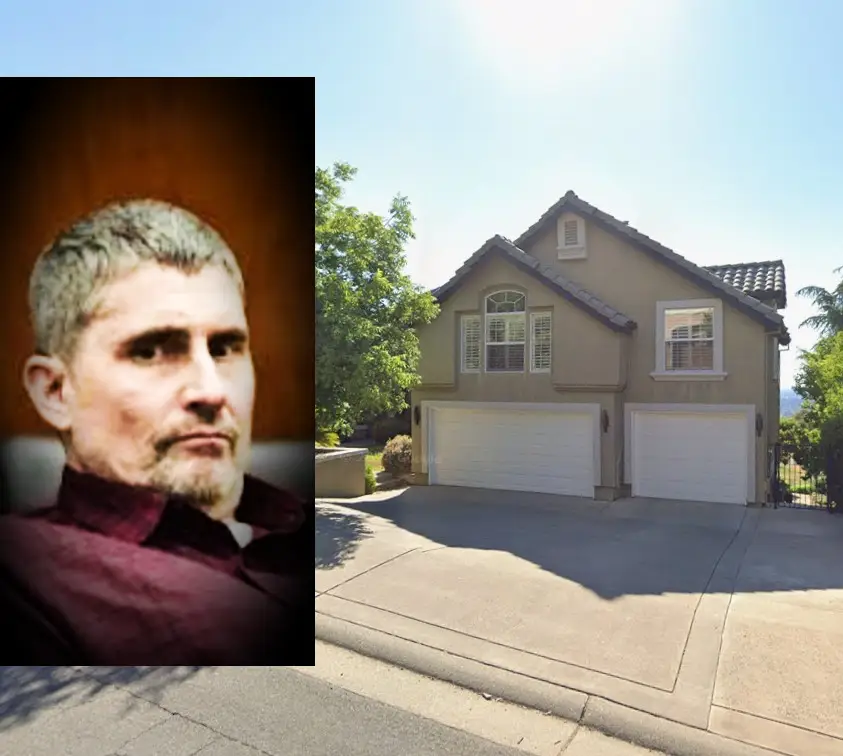
A successful attorney, a family in crisis
For years, Richard William Hamlin occupied a prominent position in the Sacramento-area legal community. A former prosecutor in Sacramento who later established a criminal defense practice, Hamlin lived with his wife, Susan, and their four children in El Dorado Hills.
From the outside, the family appeared prosperous. They enjoyed an affluent lifestyle that included an expensive lakeside home and lavish social gatherings. But by late 2003, the family’s financial circumstances had deteriorated dramatically.
You might also like

According to the California Court of Appeal’s published account of the criminal proceedings, the couple was out of money by December 2003, and their home was in foreclosure. Hamlin’s law practice had also shut down and entered bankruptcy by the time his criminal trial began.
What followed was a disturbing sequence of events that would eventually lead to one of El Dorado County’s most notorious criminal prosecutions.
An elaborate conspiracy involving a satanic cult
Prosecutors argued that Hamlin developed a scheme to pursue a $1 million lawsuit against his wealthy father-in-law, accusing him of sexually molesting Susan during her childhood.
Susan later testified that the alleged childhood abuse had never happened. According to her testimony, Hamlin repeatedly told her that she had repressed memories of sexual abuse and pressured her to accept his version of events.
The allegations eventually expanded into an elaborate story involving a satanic cult, alleged ritual abuse and a conspiracy to murder Hamlin.
The California Court of Appeal documented how Hamlin obtained literature concerning alleged satanic ritual abuse in January 2004 and subsequently incorporated those themes into the accusations.
Susan was allegedly forced to rehearse statements and provide recorded confessions supporting the fabricated narrative. The story eventually included claims that she had participated in the molestation of her own children and that people associated with the supposed cult were planning to kill her husband.
Prosecutors maintained that the elaborate allegations were part of an effort to build a financial claim against Susan’s father.
The defense presented a different account. Hamlin denied abusing his wife and maintained that her allegations concerning her father were genuine.
The jury ultimately rejected the central claims underlying his defense.
Years of violence inside the family home
The physical abuse, according to trial testimony, had begun sometime after 1999 and intensified substantially during 2003.
Susan described a pattern of escalating violence that included strangulation, repeated blows to the head, being thrown against furniture, threats with firearms and deliberate injuries inflicted with knives.
She testified that Hamlin held lit cigarettes against her face and used a knife to apply increasing pressure until it broke the skin.
The violence was not limited to isolated incidents.
The Court of Appeal summarized Susan’s testimony:
“He would strangle [her]. He would hit [her] in the head. He would throw [her] into furniture.”
The court also documented testimony that Hamlin told the children their mother was possessed and that he needed to beat the demons out of her.
Three of the couple’s four children eventually testified about their father’s conduct.
The children were not simply witnesses to a deteriorating marriage. They were living in an environment where violence, threats and disturbing accusations had become part of everyday family life.
February 2004: The story begins to unravel
The circumstances surrounding the family’s eventual separation from Hamlin began to emerge in February 2004.
Earlier that month, Hamlin accidentally shot himself in the leg. Before authorities arrived, he reportedly instructed Susan to maintain the story that she and other individuals were involved in a conspiracy to kill him.
Investigators also noticed visible bruising on Susan.
On Feb. 10, another violent confrontation occurred. According to the appellate record, Hamlin threatened Susan with a sword, struck her and forced her to sleep beside him at gunpoint.
The following day, the couple traveled to Granite Bay in search of a woman Hamlin believed was connected to the alleged murder conspiracy.
Susan testified that Hamlin struck her with his fist, hit her in the face with a firearm and used a Taser against her ribs.
On Feb. 22, another assault occurred at the family home. Susan was struck repeatedly, including with a metal pipe and a piece of wood.
Her injuries were extensive.
On Feb. 26, 2004, Hamlin accompanied Susan to the El Dorado County Sheriff’s Office.
There, Susan provided investigators with a detailed account of the supposed conspiracy and admitted to molesting her children. She attributed her visible injuries to another individual allegedly associated with the conspiracy.
Authorities did not arrest Susan. Instead, Child Protective Services became involved, and the children were removed from the home.
Two days later, Richard Hamlin was arrested.
A March 1 medical examination documented the extent of Susan’s injuries: a broken nose, five broken ribs, extensive bruising across her body and severe swelling around both ears.
The following day, a criminal complaint was filed against Hamlin in El Dorado County Superior Court.
The elaborate conspiracy story had become the starting point of a criminal investigation into the man who had brought it to authorities.
The criminal trial and a life sentence
Hamlin’s prosecution eventually developed into an 18-count grand jury indictment in April 2005.
The trial began in October 2005 and continued into January 2006.
Hamlin represented himself, with standby counsel, while prosecutors presented testimony from Susan, the couple’s children and other witnesses.
The prosecution’s case centered on the physical abuse, the alleged coercion surrounding the fabricated accusations and the injuries documented by medical personnel.
On Jan. 10, 2006, the jury found Hamlin guilty of torture, making criminal threats, three counts of inflicting corporal injury on his wife and three misdemeanor counts of child abuse.
The jury acquitted him of seven other charges and could not reach verdicts on three additional counts. Prosecutors elected not to retry those charges.
The torture conviction carried a potential life sentence.
The El Dorado County Superior Court ultimately sentenced Hamlin to life in prison for torture, along with additional sentences for the other convictions.
The State Bar of California also took action. In February 2006, Hamlin was placed on interim suspension following his conviction, effectively ending his ability to practice law while the disciplinary proceedings continued.
The conviction survives appellate review
Hamlin continued challenging his convictions through the judicial system.
On Feb. 9, 2009, California’s Third District Court of Appeal issued its published decision in People v. Hamlin, case No. C053982.
The appellate court rejected his challenges to the sufficiency of the evidence and affirmed the underlying convictions.
The court did identify sentencing errors involving the upper terms imposed for the criminal-threat and spousal-injury convictions. It ordered those matters returned to the trial court for resentencing and struck a no-contact order.
Importantly, the appellate court did not overturn the torture conviction or the jury’s findings of guilt.
Hamlin subsequently pursued federal habeas corpus relief.
In December 2012, the U.S. District Court for the Eastern District of California rejected his petition, leaving the state convictions intact.
The legal proceedings established that the case was not simply a domestic violence prosecution involving competing accounts of a troubled marriage. It involved a jury’s determination that Hamlin had committed torture through a sustained course of conduct.
A family’s struggle did not end with the conviction
The criminal conviction brought an end to Hamlin’s control over the household, but it did not erase the consequences for Susan and the children.
In November 2011, CBS Sacramento reported that Susan and several of the couple’s children were preparing to oppose Hamlin’s potential release at a parole hearing.
Their public statements described the continuing emotional consequences of the abuse and their concerns about the possibility of his return.
The case also illustrates an important distinction between physical domestic violence and coercive control.
The reported conduct involved more than repeated assaults. It involved the alleged manipulation of family relationships, the creation of elaborate false narratives, threats involving firearms and the use of children as witnesses to an increasingly distorted version of reality.
For the children, the family home had become an environment of fear. For Susan, the consequences included serious physical injuries and the experience of being pressured to make accusations she later said were untrue.
Why the Richard Hamlin case remains significant
The Richard Hamlin prosecution remains a particularly disturbing chapter in El Dorado County’s criminal history because of the combination of professional standing, alleged financial motives, psychological manipulation and sustained domestic violence.
Hamlin had worked as both a prosecutor and a criminal defense attorney. He understood the criminal justice system and the consequences of allegations involving serious crimes.
Yet the case ultimately centered on his own conduct inside his family home.
The California Court of Appeal’s published opinion provides a detailed record of the evidence presented at trial and the legal reasoning supporting the convictions. It also preserves the accounts of a family whose experiences might otherwise have remained hidden behind the appearance of an affluent household.
For El Dorado Hills residents, the case is a reminder that outward appearances, professional accomplishments and financial success reveal little about what may be happening behind closed doors.
The most consequential part of this story is not the bizarre satanic cult narrative that initially attracted attention.
It is the documented violence against a wife and children, the criminal prosecution that followed, and the jury’s decision to hold the perpetrator accountable.