A 1864 killing near the Cosumnes River sent a young man to trial in Jackson, where frontier justice faced the weight of a dead man’s fate.
More than 160 years ago, a pistol fight near the Forks of the Cosumnes turned into the kind of murder case that could hold an entire Gold Rush-era community spellbound.
You might also like


The names have largely disappeared from modern memory: B.F. Sturdivant of Iowa and Robert Blackwell of Illinois.
But an old newspaper account preserved a remarkable glimpse of what happened after their confrontation and how the killing was viewed by Californians living in the aftermath of the Gold Rush.
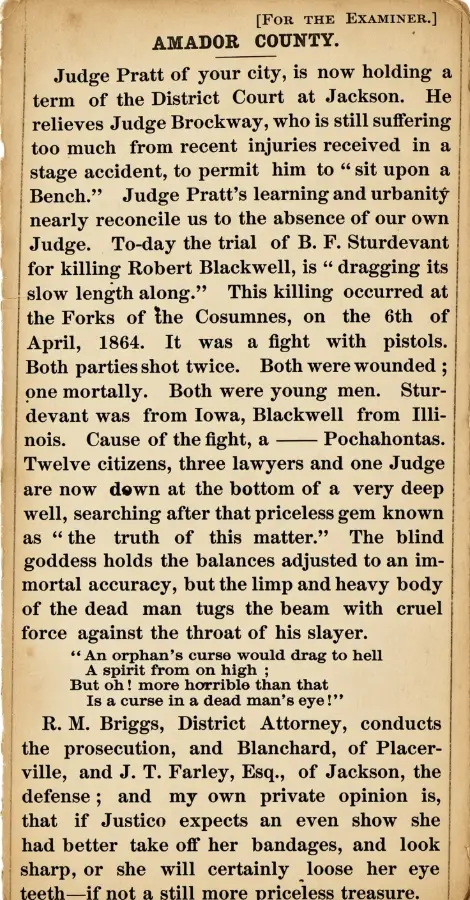
According to the historical account, the shooting occurred April 6, 1864, at the Forks of the Cosumnes. The two young men confronted one another with pistols. Each reportedly fired twice. Both were wounded, but Blackwell’s injuries proved fatal.
The case eventually landed in the District Court at Jackson, the seat of Amador County.
A courtroom filled with frontier California
The newspaper correspondent reported that Judge Pratt was presiding in Jackson while Judge Brockway remained unable to sit on the bench because of injuries he had suffered in a stagecoach accident.
The correspondent offered an unusually personal assessment of the substitute judge, writing that Pratt’s “learning and urbanity” nearly made up for the absence of the regular judge.
That glimpse is significant because California’s legal system was still relatively young. The state had been admitted to the Union only 14 years earlier, and the communities of the Sierra foothills were still shaped by the rapid migration, commerce and violence that followed the discovery of gold.
Jackson itself was one of the important mining communities of the Mother Lode. The Forks of the Cosumnes lay within a broader region connecting the mining settlements of Amador and El Dorado counties.
Historical accounts of El Dorado County identify the Cosumnes forks and nearby settlements such as Yoemet as part of the county’s early mining landscape. Yoemet, described as one of the county’s southernmost mining camps, was settled in 1851.
For residents of today’s El Dorado County, the geography can be easy to overlook beneath modern roads, subdivisions and forests. In 1864, however, the Cosumnes River corridor was part of a much different world — one where mining camps, trails and rough roads connected isolated communities.
Two shots each
The newspaper’s account is striking for its description of the actual shooting.
Both men, it reported, fired twice.
Both were wounded.
Only one survived.
The historical account identifies Sturdivant as the defendant and Blackwell as the victim. It says the two men were young and had come to California from different Midwestern states.
The newspaper gave a tantalizingly brief explanation for the dispute, describing the cause of the fight only as “a — Pocahontas.”
That phrase requires caution.
The term was used in 19th-century American writing in ways that could refer to a Native American woman, but the surviving passage does not establish the identity of any woman involved, nor does it provide enough evidence to say precisely what role she played in the dispute.
It is therefore safer to say the newspaper attributed the confrontation to a dispute involving a woman, while recognizing that the language reflects the attitudes and terminology of its era.
Twelve citizens, three lawyers and one judge
The correspondent described the trial in theatrical language.
“Twelve citizens, three lawyers and one Judge,” the writer observed, were searching for the truth.
The prosecution was led by R.M. Briggs, identified in the account as district attorney. The defense included Blanchard of Placerville and J.T. Farley of Jackson.
Farley is particularly notable to students of California history. The Jackson attorney later became a major political figure in the state and eventually served as a United States senator from California.
The presence of a Placerville attorney in the defense also provides a direct connection between the Amador County proceeding and the El Dorado County community that was then emerging as one of the region’s major commercial centers.
The correspondent clearly expected the lawyers to make the trial a contest of competing narratives.
The article’s language suggests that the question before the jury was not simply whether Sturdivant had fired a pistol. The deeper question was what happened immediately before those shots were fired — and whether the evidence justified holding Sturdivant criminally responsible for Blackwell’s death.
The weight of the dead
The newspaper writer’s description of the trial became increasingly poetic.
The correspondent invoked the image of blind Justice balancing her scales, while suggesting that the “heavy body of the dead man” was pulling the balance against the accused.
The imagery was not accidental.
The writer was borrowing directly from one of the most famous passages in Samuel Taylor Coleridge’s The Rime of the Ancient Mariner, in which the narrator describes the curse in the eye of a dead man. The passage appears in the original poem as an expression of guilt and psychological torment.
In the Amador County newspaper account, the literary reference transformed a frontier murder trial into something larger: a meditation on guilt, death and the difficulty of determining what actually happened when two armed men met and only one walked away.
Justice without modern certainty
Modern readers may be tempted to fill the gaps in the story.
That would be a mistake.
The surviving newspaper passage does not provide enough evidence to reconstruct every moment of the confrontation. It does not tell us precisely what preceded the first shot, who initiated the violence or what witnesses ultimately told the jury.
Nor does the passage available here establish the final verdict.
What it does provide is something perhaps more valuable: an eyewitness-era window into how a murder trial was perceived by people living in California only a generation after the Gold Rush began.
The correspondent clearly believed the case presented a difficult question of fact.
The writer also had little faith that the truth would emerge easily from the competing arguments of the courtroom.
A forgotten piece of El Dorado County’s frontier history
Today, travelers crossing the Cosumnes River region see a landscape of forests, ranches, roads and rural communities.
In 1864, the same general region was part of a rapidly changing frontier.
Mining camps had sprung up almost overnight. Men from across the country had arrived seeking gold and opportunity. Towns such as Placerville and Jackson became centers of commerce, government and law.
And when disputes turned deadly, the courts had to determine what happened with evidence that was often fragmentary and testimony that could be fiercely contested.
The Sturdivant-Blackwell case is a reminder that the history of El Dorado County is not confined to famous gold discoveries, stage routes or celebrated mining towns.
It is also found in the forgotten stories of ordinary people whose lives collided in extraordinary ways.
On April 6, 1864, two young men met at the Forks of the Cosumnes with pistols.
Four shots were fired.
Two men were wounded.
One died.
And in a Jackson courtroom, a jury was left to determine what those four shots meant.
More than a century and a half later, the old newspaper account still leaves the same question hanging over the story — the question the correspondent said those 12 citizens, three lawyers and one judge were trying to answer:
What really happened?
Historical note
The article is based primarily on the 19th-century newspaper passage supplied for this story. Modern searches confirm the historical importance of the Forks of the Cosumnes and its connection to early El Dorado County mining communities.
The supplied account should be distinguished from independently verified court records. In particular, the identities of the participants, the precise circumstances of the shooting and the eventual disposition of the case should be treated as historical claims from the period source unless corroborated by surviving court or newspaper records.