DIAMOND SPRINGS — The Railroad Town That Outlived Its Depot
By Cris Alarcon, InEDC Writer. Sept 24, 2026
There are places in El Dorado County where history survives in brick, timber and stone.


And then there are places where history survives mostly in the shape of the ground.
Diamond Springs is one of them.
Drive through the community today and it is easy to see a modern El Dorado County crossroads — Highway 49, Missouri Flat Road, Diamond Springs Parkway, businesses, homes and county facilities.
But beneath that modern landscape lies the footprint of a railroad town.
For generations, trains moved through Diamond Springs carrying passengers, lumber, agricultural products and other freight. At the height of the local railroad era, Diamond Springs was also the western terminus of the Diamond & Caldor Railway, a 34-mile narrow-gauge logging railroad that reached deep into the timber country of El Dorado County.
- The depot is gone.
- The railroad industry that once dominated the area is gone.
- The lumber mill is gone.
- But the story remains.
A Necessary Correction to the Old Railroad Story
One detail in the popular version of Diamond Springs railroad history deserves clarification.
The original station built in 1865 was at Shingle Springs, not Diamond Springs.
According to El Dorado County historical materials, the Placerville Branch corridor eventually contained five combination freight and passenger depots built to Southern Pacific’s standard designs: Latrobe, Shingle Springs, El Dorado, Diamond Springs and Placerville. The first county station was established at Latrobe in 1864, followed by Shingle Springs in 1865.
The railroad was extended eastward in stages. The line reached Shingle Springs in June 1865, while the extension to Placerville was not completed until 1888.
That distinction matters because it places Diamond Springs in the proper timeline — not as an 1865 railhead, but as an important later station along the completed Placerville Branch.
The railroad became part of the Southern Pacific system in the late 19th century and eventually became known as the Southern Pacific Placerville Branch.
Five Depots — One Survivor
For railroad passengers and freight shippers, the depots were more than buildings.
They were the doors through which isolated Gold Country communities connected to the outside world.
The five combination depots served both passengers and freight. They were built according to standard Southern Pacific designs and reflected the railroad’s role as both transportation system and economic lifeline.
Today, only part of one original depot survives.
The Shingle Springs freight depot, built after the earlier station burned, remains the county’s tangible survivor from that original group. County historical materials say the earlier Shingle Springs station burned in the 1890s and was replaced by the surviving structure.
The Diamond Springs depot, by contrast, disappeared sometime during the decades that followed.
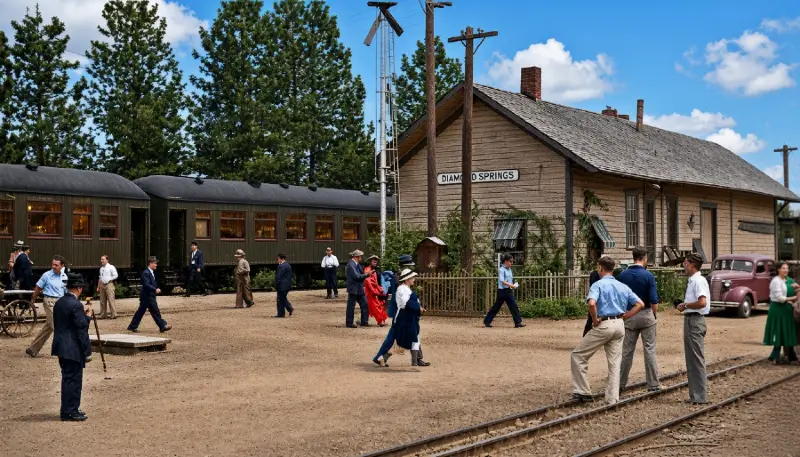
There is no restored original Diamond Springs depot waiting beside the tracks today.
What remains is the railroad landscape.
And that landscape tells another story.
Where Southern Pacific Met the Timber Railroad
Diamond Springs became particularly important because another railroad arrived there.
The Diamond & Caldor Railway was built by the California Door Company to connect its timber operations in the Caldor area with its mill and connection to the standard-gauge railroad at Diamond Springs.
The company had acquired roughly 30,000 acres of timberland in El Dorado County and began developing its Caldor operation around the beginning of the 20th century. A railroad became the logical answer to the problem of moving enormous quantities of timber through mountainous terrain.
The narrow-gauge railroad was constructed in the early 1900s and opened for operation in 1905. It stretched roughly 34 miles between Diamond Springs and Caldor, following the rugged terrain of the North Fork of the Cosumnes River.
This was no leisurely excursion railroad.
It was a working logging machine.
Powerful Shay locomotives dragged timber out of the mountains, eventually delivering logs to the Diamond Springs mill.
The railroad’s history is particularly unusual because of the technology it retained. Its cars used old-fashioned link-and-pin couplers, while federal railroad safety requirements increasingly demanded automatic couplers and air brakes.
Eventually, that technological gap became part of the railroad’s downfall.
The Diamond & Caldor could not justify the cost of bringing its equipment into compliance with federal requirements while trucking was becoming increasingly competitive. The railroad was abandoned in 1953, and its tracks were dismantled.
In other words, the same railroad technology that had made the timber operation possible eventually helped make the railroad obsolete.
The Mill Came to Diamond Springs
The Diamond & Caldor story took another dramatic turn in 1923.
A fire destroyed the company’s sawmill at Caldor.
Rather than rebuild the sawmill there, the company shifted the timber-processing operation to Diamond Springs. The railroad then became primarily a log-hauling operation, bringing timber from the forests to the Diamond Springs mill.
The result was a major industrial complex in Diamond Springs.
The railroad yard included an engine house, machine shop, car shop, truck shop, oil storage and warehouses. A modern electric mill was established at Diamond Springs, turning the community into an important lumber-processing center.
For residents living in Diamond Springs today, it is difficult to visualize the scale of what once occupied portions of the area.
- There were locomotives.
- Freight cars.
- Log decks.
- Mill buildings.
- Rail yards.
- Workers.
- And the constant movement of timber.
The community’s modern landscape was built over the top of that industrial world.
From Caldor Lumber to Winton to American Forest Products
The lumber operation changed corporate hands as the decades passed.
The California Door Company operation eventually became associated with the Caldor Lumber Company. In 1956, the regional operation was sold to Winton Lumber Company.
In 1964, American Forest Products acquired the operation.
The railroad era had already ended by then, but the Diamond Springs mill continued operating for decades.
The mill finally closed in the 1980s.
Its buildings survived for a time after production ended, but the industrial landscape was ultimately dismantled. Much of the remaining mill complex was demolished between 1999 and 2001.
Another chapter of Diamond Springs history disappeared beneath demolition equipment.
But the land did not disappear.
It was put to new uses.
From Lumber Yard to Public Infrastructure
The old industrial landscape has gradually been transformed into modern El Dorado County.
One portion of the former mill and railroad area became associated with county civic infrastructure, including the El Dorado County Sheriff’s headquarters.
Other portions became part of the evolving transportation network.
The most visible example is the Diamond Springs Parkway project.
The county described the parkway as a future four-lane divided roadway connecting Missouri Flat Road with State Route 49. Its purpose is to improve traffic circulation and reduce congestion through historic Diamond Springs. Phase 1A was completed in February 2022, while Phase 1B is anticipated for completion in January 2027.
There is an irony in that.
A road designed to move modern El Dorado County traffic through Diamond Springs is being built across a landscape once designed to move timber and freight by rail.
The machinery has changed.
The transportation problem has not.
Diamond Springs has always been a place where transportation shaped the community.
You Can Still Ride the Railroad
The remarkable part of this story is that the railroad did not completely disappear.
The El Dorado Western Railroad operates an excursion program on the historic Placerville Branch between Shingle Springs and the Missouri Flat Road area. El Dorado County identifies the program as part of the county’s living railroad history.
Instead of boarding a modern passenger train, visitors can ride historic railroad inspection cars, often called gang cars.
They are open-sided machines — utilitarian, noisy and far removed from today’s passenger railcars.
That is precisely the point.
The experience provides something a museum display cannot.
- Movement.
- The wheels roll.
- The track clicks beneath the car.
- The old railroad grade passes beneath you.
And for a few miles, the Southern Pacific Placerville Branch stops being a line on an old map.
It becomes real again.
County historical materials describe the excursion as a 40- to 45-minute round trip, with speeds limited to about 10 mph.
A Station That Exists Only in Memory
There is also a recreated El Dorado Station, built through the work of volunteers and donors to preserve the appearance and memory of the original railroad architecture.
That is an important distinction.
Historic preservation is not always about saving every original building.
Sometimes the original structure is gone.
Sometimes the land has been radically transformed.
Sometimes the only surviving evidence is a right of way, a photograph, an old timetable, a foundation or the memory preserved in local archives.
Diamond Springs presents all of those challenges.
The original depot is gone.
The great lumber mill is gone.
The Diamond & Caldor Railway is gone.
Caldor itself has largely become a ghost of the timber town it once was.
But the railroad story remains embedded in El Dorado County’s landscape.
The Rails Beneath the Modern County
The Diamond Springs railroad story is ultimately bigger than one missing depot.
It is the story of how transportation built El Dorado County.
Gold brought people into the foothills.
Railroads moved people and goods.
Timber turned mountains into an industrial resource.
Mills created jobs and communities.
Trucks eventually replaced trains.
Old industrial properties became public infrastructure, businesses and neighborhoods.
And roads now carry traffic where locomotives once hauled freight.
The physical Diamond Springs depot may be gone.
But if you know where to look, the railroad is still there — in the surviving Shingle Springs depot, in the historic right of way, in county records, in photographs and in the volunteers who continue putting wheels on those old rails.
- The depot disappeared.
- The railroad didn’t quite.
- It simply changed its job.
- Once it hauled Gold Country freight.
Today, it hauls memory.
And in El Dorado County, that may be the most important cargo of all.
Sources: The historical timeline and depot information above are grounded primarily in El Dorado County’s own museum materials and county project records, supplemented by railroad-history references.