What Is a Fiber Drop?
For many Placerville residents, the term fiber drop may sound like another piece of telecommunications jargon.
It is actually pretty simple.


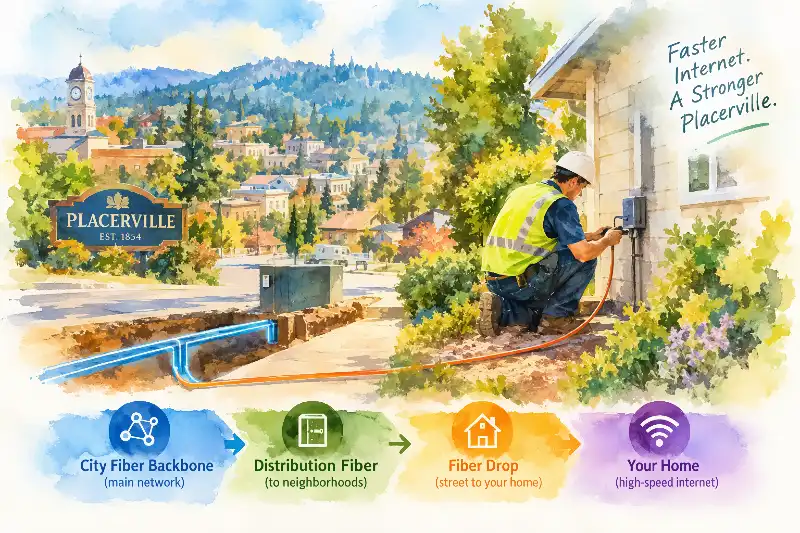
A fiber drop is the final section of fiber-optic cable that connects the main fiber network to an individual home or business.
Think of the network as a system of roads.
The city’s fiber backbone is the highway. Distribution fiber brings that network into a neighborhood. The fiber drop is the driveway — the short, final connection that gets the service from the network to the property.
The City of Placerville’s Broadband Master Plan defines a drop as the fiber run from the street to the premise, such as a home or business.
That distinction matters because simply having fiber running down a nearby street does not necessarily mean a property is physically connected to the network.
Placerville Is Building the Bigger Network
Placerville has been working for several years toward creation of a municipal fiber utility.
City officials envision an open-access network, meaning the city owns the underlying fiber infrastructure while multiple private internet service providers can use the network to offer retail broadband services.
The city’s municipal code says the fiber utility is intended to improve broadband access, increase competition among providers, improve affordability and address gaps in digital access and equity.
The project moved from planning to construction after the California Public Utilities Commission recommended up to $20.198 million in Federal Funding Account support for the Placerville Broadband Project.
According to the CPUC, the funded project is designed to serve an estimated 264 unserved locations, with approximately 40 miles of underground, last-mile, open-access fiber infrastructure. The project is designed to provide symmetrical speeds of up to 1 gigabit per second.
The city’s July 2025 announcement described the project as the beginning of construction on a city-owned fiber-optic broadband network.
“This city-owned utility represents more than just faster internet; it’s a bold investment in Placerville’s future.”
— Mayor John Clerici, July 1, 2025.
So Where Does the Fiber Drop Come In?
The backbone and neighborhood network can pass a property without actually reaching the building.
That’s where the drop comes in.
Once the city’s fiber infrastructure reaches the appropriate network access point near a property, a fiber drop provides the physical connection between that network and the customer’s premises.
Depending on the location and construction design, that connection may involve underground work or an aerial installation.
The end result is the same: fiber is physically brought to the property.
Placerville’s municipal broadband plans distinguish the drop from the larger network infrastructure. The city’s master plan describes the backbone as the fiber connecting aggregation huts with the network operations center, while the drop is the segment connecting the street to the individual premise.
Why the Drop Matters to Homeowners
For a homeowner, the difference between fiber in the neighborhood and fiber at the house is significant.
A fiber line passing a property does not automatically provide service.
The drop is what completes that physical connection.
Once the network and property connection are in place, an internet service provider can use the city’s open-access infrastructure to deliver broadband service.
Placerville Fiber says its open-access model is intended to allow multiple providers to compete for customers, giving residents more choice in speeds, pricing and service.
That approach is different from a traditional system in which one telecommunications company owns the local infrastructure and is effectively the only provider capable of using it.
Who Is Eligible?
The first phase of Placerville’s project is focused on locations identified through the federal broadband funding process as unserved.
The CPUC’s project documentation identified an estimated 264 unserved locations for the funded phase and said approximately 2,145 people could benefit from the investment.
The city’s construction information also explains that the CPUC identified the neighborhoods eligible for the initial grant-funded construction area.
For qualifying unserved and underserved locations, the city is providing the fiber-drop installation without an additional installation charge as part of the network buildout.
That is an important distinction for residents: the no-cost fiber drop is the physical infrastructure connection. It does not necessarily mean internet service itself is free.
Once service becomes available, residents will still need to select an internet service provider and choose a service plan.
What Does “Unserved” Mean?
Broadband terminology can also be confusing.
California broadband planning documents generally distinguish between unserved and underserved locations based on the speeds currently available.
An El Dorado County broadband environmental document notes that California defines areas with less than 25 Mbps download/3 Mbps upload as unserved and areas with less than 100 Mbps download/20 Mbps upload as underserved.
Those definitions help explain why a household that technically has internet access may still qualify as underserved.
In today’s world, broadband is no longer simply about checking email.
Remote work, telehealth, online education, streaming, cloud applications and modern business operations can place substantially greater demands on a connection than the internet of a decade ago.
Placerville’s Fiber Buildout Is Intended to Go Beyond the First Phase
The grant-funded construction is only part of the city’s broader vision.
Placerville Fiber says the initial construction creates the foundation for future expansion and encourages residents and businesses to register their interest so the city can evaluate demand when determining future construction priorities.
The city’s project documents describe the long-term objective as a citywide municipal fiber network capable of supporting competitive broadband providers at individual addresses.
The city’s Broadband Master Plan similarly treats the network as a layered system: backbone, common distribution infrastructure, individual drops and a middle-mile connection to outside internet exchange infrastructure.
For Placerville residents, the important takeaway is straightforward:
The fiber backbone gets the network into the neighborhood. The fiber drop gets the network to the house.
And for qualifying properties included in the city’s buildout, that final connection is a critical piece of the effort to bring high-speed broadband to places that have historically lacked adequate service.
What Residents Should Do
Residents interested in Placerville Fiber should check their address and register their interest through the city’s fiber program.
The city says construction is occurring in phases, and its construction-progress information identifies Placerville Drive as an initial construction area. The program has also stated that Phase 1 construction is projected for completion by December 2026.
Residents can learn more through the City of Placerville Broadband information page and the Placerville Fiber project website.
For questions about the city’s fiber program, Placerville Fiber lists 530-642-5508 and fiber@cityofplacerville.org as contact information.
For El Dorado County residents watching the expansion of broadband infrastructure, the phrase fiber drop is worth remembering.
It is not the entire network.
It is the last piece.
The backbone may run past your street. The drop is what brings the fiber home.