El Dorado County Superintendent of Schools Dr. Ed Manansala joined education and behavioral health leaders from across California in Sacramento this month to discuss a central question facing public education: How can schools determine whether students are actually benefiting from the services intended to support them?
Manansala participated in the featured panel, “Measure What Matters: Building a Culture That Sees and Hears Every Student,” during the 10th annual 2026 Breaking Barriers Integrated Care Symposium, held Nov. 8-10 in Sacramento.


The discussion brought together Manansala and Dr. David M. Toston, Sr., superintendent of the Santa Clara County Office of Education, alongside Joshua Arnold, co-founder and CEO of Impacter Pathway. Gina Plate, executive vice president of the Deveau Burr Group, moderated the session.
Moving beyond counting services
The panel addressed a significant challenge in California’s approach to student behavioral health: measuring whether programs and services produce meaningful improvements in students’ lives.
According to the symposium’s published session description, “Most systems still count the services they deliver and can’t say whether students are actually better off.”
The discussion examined how education and behavioral health systems can move beyond tracking the number of services provided and instead measure outcomes such as emotional resilience, connectedness and a sense of belonging.
The goal is to develop systems that recognize individual student needs, incorporate student feedback and provide educators with information they can use to improve support.
For El Dorado County, the conversation has particular relevance as schools and community agencies continue working to address student mental health, wellness and access to support services.
El Dorado County among participating communities
The symposium also highlighted the Behavioral Health Performance Management (BHPM) project, a two-year initiative funded by the California Commission for Behavioral Health.
Led by the Santa Clara County Office of Education, the project is developing a performance management system connecting behavioral health funding, services received by students and the outcomes those services produce.
The initiative includes six local educational agencies across four California counties, including El Dorado County.
Participating schools are helping develop and test a shared approach to measuring student outcomes. Students respond to open-ended questions, with their responses used to assess six competencies, including emotional resilience and help-seeking.
The resulting information can be reviewed alongside service utilization, behavioral and academic indicators. The system is designed to help school and county teams determine whether interventions are making a measurable difference.
The initiative also emphasizes protecting student information while allowing appropriate coordination among participating systems.
Student voices become part of the measurement
A central theme of the panel was the importance of treating students as active participants in decisions affecting their education and well-being.
Rather than relying exclusively on administrative records or the number of services delivered, the proposed approach incorporates students’ own experiences.
That distinction matters. A student may receive counseling, participate in a school wellness program or be referred to outside services, but those activities alone do not establish whether the student feels more connected, supported or equipped to manage challenges.
The symposium’s framework encourages educators and behavioral health professionals to consider those outcomes alongside traditional measures of program activity.
The broader Breaking Barriers initiative promotes four pillars of integrated care: shared leadership, shared goals, shared information and shared finance. Organizers say aligning these elements helps counties and community partners move away from disconnected services toward coordinated support for children, youth and families.
A connection between two county education leaders
The panel also brought together two county superintendents with a shared professional connection.
Toston previously served in executive leadership at the El Dorado County Office of Education before becoming Santa Clara County superintendent in May 2025.
In October 2026, Gov. Gavin Newsom appointed Toston to the California Commission for Behavioral Health in the seat designated for a school district superintendent.
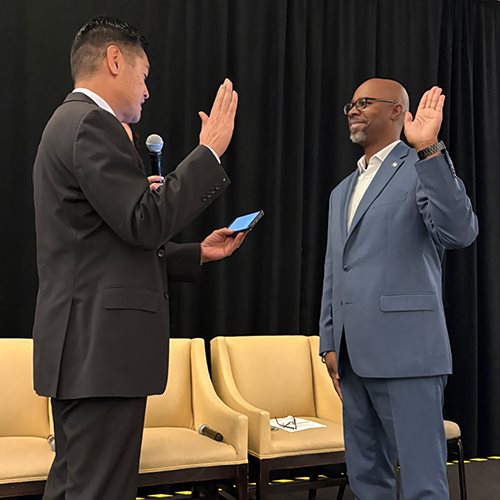
According to the El Dorado County Office of Education, Toston was sworn in as a commissioner by Manansala shortly before the symposium panel.
The appointment brings Toston into a statewide commission responsible for advancing behavioral health prevention, intervention and accountability efforts.
For El Dorado County, Manansala’s participation placed the county’s education leadership in a statewide discussion about the future of student support systems.
The symposium’s central message was that successful student support cannot be measured simply by how many programs exist or how many services are delivered. It must also consider whether students feel heard, develop resilience, build meaningful connections and experience measurable improvements in their lives.
As California continues investing in student behavioral health, the challenge for counties, schools and community partners will be turning those measurements into practical improvements for the young people they serve.