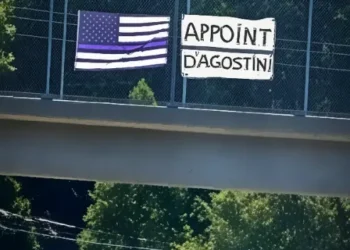

El Dorado Sheriff Appointment Faces Records Challenge
PLACERVILLE, Calif. — An El Dorado County resident is asking county supervisors to delay the appointment of Undersheriff Eric Palmberg as the next sheriff until outstanding public records concerning the Sheriff’s Office’s June 2026 California State Sheriffs’ Association conference have been produced and reviewed.
Leslie Schlag, a District 3 resident and county employee of 21 years, submitted a written notice ahead of the Board of Supervisors’ Oct. 20 meeting. Her filing raises questions about planned law enforcement staffing, security arrangements, transportation and potential taxpayer costs associated with the conference.


The challenge comes as supervisors prepare to consider a recommendation from the Chief Administrative Office to appoint Palmberg as sheriff-coroner-public administrator when Sheriff Jeff Leikauf retires. The county’s agenda lists the appointment under item 26-1683, with a proposed effective date of Dec. 26, 2026, or earlier if the office becomes vacant before then. The appointment would cover the remainder of the current term, ending Jan. 8, 2029, at a proposed monthly salary of $25,701.87.
Schlag argues that the board should not make the appointment before the relevant conference records are available for scrutiny. She also wants an independent inquiry into what was planned, what actually occurred, who authorized the arrangements and what role individual members of the Sheriff’s Office command staff played.
“The Board should explain how District 3 residents will have a voice in this decision,” Schlag wrote in her notice.
Conference plan raises questions about staffing and security
The concerns center on an Incident Action Plan produced by El Dorado County through the California Public Records Act process, according to Schlag’s filing.
She says the plan assigns two El Dorado County Sheriff’s Office jet skis to accompany the Rum Runner, a commercial lake cruise. Separately, the document assigns a patrol boat staffed by two deputies to operate on the lake near Valhalla and identifies a nearby marine unit.
The plan also assigns a plainclothes sergeant aboard the Rum Runner and designates plainclothes deputies and a sergeant to provide security for spouses’ shopping, according to the notice.
Schlag says the spouses and partners referenced in the assignments were connected to sheriffs and Sheriff’s Office officials attending the conference, including individuals associated with Leikauf and Palmberg. The plan, as described in her filing, does not identify each person or specify which official each person accompanied.
A conference email referenced in the notice reportedly said transportation would be provided for a spouse-only Rum Runner cruise, while the Incident Action Plan described the cruise as within walking distance.
Those details raise questions about the operational rationale for the planned deployments and whether the assignments were necessary for legitimate law enforcement or security purposes. However, the plan alone does not establish which assignments were carried out, how much staff time was spent, whether overtime was incurred or what the event ultimately cost county taxpayers.
Schlag says those questions can be answered only through additional records, including deployment documentation, timekeeping records, payroll information and financial accounting.
The county has not established in the records described in the notice that the planned assignments resulted in misconduct. The distinction between a proposed deployment and an actual expenditure is central to the questions Schlag wants investigated.
Public records remain outstanding
Schlag’s notice says the county was producing records about the conference in stages and had estimated completion by Nov. 20, 2026.
The requests seek information that could help establish what occurred, who received transportation or security services, how personnel were deployed and what costs were incurred.
The records status provided by Schlag, current as of Oct. 16, identifies several requests as completed and others as still in progress.
| Public records request | Status as of Oct. 16, 2026 |
|---|---|
| P009312-051926 — County complaint handling and related human resources records | Completed; some records withheld or redacted |
| P009313-051926 — Sheriff’s Office complaint records | Combined with P009312; completed |
| P009314-051926 — District Attorney complaint records | Combined with P009312; completed |
| P009325-052026 — County whistleblower policies | Completed |
| P009497-062226 — CSSA conference records | Production in stages; estimated completion Nov. 20 |
| P009498-062226 — District Attorney whistleblower, conflict and complaint policies | Completed; county reported no responsive records |
| P009499-062226 — Whistleblower and retaliation training records | Completed; final response received Sept. 16 |
| P009927-082526 — Sheriff’s Office overtime records | In progress; estimated completion Oct. 30 |
| P010122-092626 — Gifts, benefits and donations | In progress; estimated completion Dec. 4 |
Source: Records-request status supplied by Schlag. These dates are estimates reported in her notice, not independently verified production deadlines.
The outstanding overtime records could help determine actual personnel costs, while the pending gifts and benefits records could clarify whether officials received any benefits connected to the event.
Schlag is asking the board to direct the Chief Administrative Office and County Counsel to coordinate with the relevant records units, prioritize the outstanding conference requests and report which records remain unavailable and when they are expected to be released.
Passes and reimbursements need a final accounting
The notice also raises questions about conference passes, reimbursements and a deposit.
According to Schlag’s review of the records produced so far, one order associated with Leikauf lists a $200 spouse pass. An order associated with Palmberg totals $600 and includes a $200 spouse pass and a separate $400 law enforcement pass.
The produced records also include $200 reimbursement entries and refer to a deposit. Schlag says the underlying deposit record and a final accounting have not been produced.
Those entries do not, by themselves, establish that the county improperly paid for any pass or that a public official received an improper benefit. A complete accounting would be needed to establish how the charges, reimbursements and deposit were handled, which entity paid each amount and whether any expense ultimately fell to county taxpayers.
Schlag wants investigators to examine the financial records alongside deployment and payroll documentation rather than draw conclusions from partial records.
Monterey County case provides a comparison, not proof
Schlag points to the 2019 California State Sheriffs’ Association conference in Monterey County as a reason for closer scrutiny of the El Dorado County arrangements.
In that earlier case, Monterey County’s Sheriff’s Office hosted the statewide conference. Allegations concerning the use of county personnel and resources prompted an investigation by the Monterey County District Attorney’s Office.
The District Attorney’s investigative report addressed allegations involving public expenditures, transportation services, timekeeping and county property. The District Attorney concluded that criminal violations could not be proved beyond a reasonable doubt.
In May 2021, the Monterey County Board of Supervisors adopted a resolution censuring Sheriff Stephen Bernal for allowing inappropriate county expenditures during the conference. The board’s action followed the District Attorney’s report, despite the absence of criminal charges.
The Monterey case illustrates that questions about the appropriate use of public resources can lead to administrative or political consequences even when criminal charges are not brought. It does not establish that El Dorado County officials committed comparable violations.
Schlag argues that the similarities between the two conference plans warrant a review of the El Dorado County arrangements. She wants investigators to determine whether the staffing and security assignments were justified, whether county policies were followed and whether the expenses were properly authorized.
Questions about command responsibility
Schlag is asking that any inquiry examine the individual roles of Leikauf, Palmberg and other senior command staff.
Among the questions she wants answered are:
-
What threat assessment justified the jet skis, patrol boat, two-deputy boat crew, plainclothes sergeant aboard the cruise and security detail for spouses’ shopping?
-
Who developed and approved the assignments, and what did each member of command staff know?
-
Did any official approve, change, object to or document the plan?
-
Were the Board of Supervisors, Chief Administrative Office, County Counsel, District Attorney, county finance officials or Auditor-Controller informed about the event and its projected costs?
-
Did finance officials question any planned spending?
-
Did any official receive a gift, door prize, donation or other benefit connected to the conference, and were any such benefits properly reported?
-
What records establish actual deployments, transportation, staff hours, overtime and the final cost to the county?
These are requests for investigation, not findings that any named official engaged in unlawful conduct.
Schlag also calls for review of the applicable legal and policy framework, including California Penal Code section 13510.8 and El Dorado County Sheriff’s Office Policy 340, Standards of Conduct. She argues that an independent inquiry should determine whether the evidence warrants further review of any individual peace officer’s conduct under the applicable statutory standard.
That determination would require evidence of each person’s individual role and an assessment of the relevant legal requirements. Similarities to another county’s case are not sufficient on their own to establish a violation.
District 3 representation and timing of the decision
Schlag’s request also raises a question about public participation in the appointment process.
She says she understands that District 3 Supervisor Brian Veerkamp may be unavailable for the Oct. 20 meeting and asks the board to explain how residents of the district will be represented in the decision. His availability was not independently confirmed for this article.
The county’s published agenda schedules the Board of Supervisors meeting for 9 a.m. Tuesday, Oct. 20, at 330 Fair Lane, Building A, in Placerville, with remote participation available. The appointment is listed as agenda item 24 in the published meeting details.
The county’s recommendation cites Palmberg’s 19 years of progressively responsible law enforcement experience with the Sheriff’s Office and his current position as undersheriff. Leikauf recommended Palmberg to succeed him in the retirement letter included with the appointment proposal.
Schlag is not simply asking supervisors to reconsider a personnel recommendation. She wants them to postpone the appointment until the conference records have been produced and reviewed, with an inquiry that examines the planning, approvals, actual expenditures and responsibilities of individual command staff.
The outstanding records create a timing question for the board: whether it should proceed with the appointment while important information remains unavailable or delay the decision until the relevant documentation can be evaluated.
What happens next?
The Board of Supervisors will consider the Palmberg appointment recommendation on Oct. 20. The county’s agenda establishes the proposed appointment and its terms, but the available materials do not establish what action the board will take.
The next stage of the conference review depends on obtaining the outstanding records and determining what they show. Deployment logs, timecards, payroll records, pass transactions, deposit documentation and final financial accounting could establish whether the planned assignments occurred and identify the actual public cost.
An inquiry would then need to assess whether the arrangements were justified, properly authorized and consistent with applicable law and county policy. Any conclusions about individual responsibility would need to be based on evidence, not on the conference plan alone.
Schlag says she can provide the records she received through the Public Records Act process upon request.
For El Dorado County residents, the immediate questions are straightforward: What public resources were used? What did those resources cost? Who approved the arrangements? And will the board review the available evidence before deciding who should lead the Sheriff’s Office through the remainder of the current term?