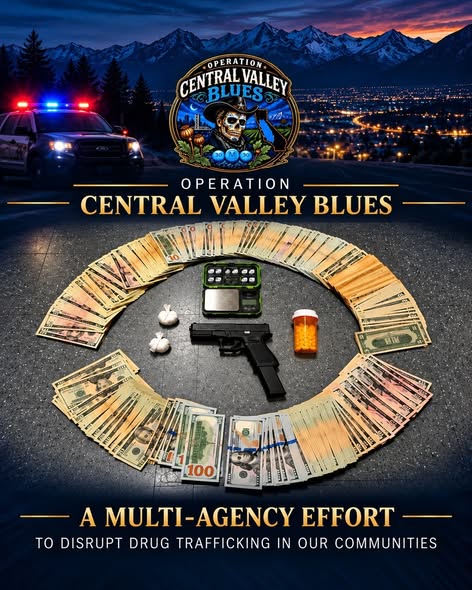
A coordinated law enforcement operation targeting drug dealers who use digital platforms to reach customers has resulted in 146 arrests, the seizure of more than 3,286 pounds of narcotics and the recovery of 43 firearms, federal authorities announced Oct. 22.
The operation, known as Operation Central Valley Blues, brought together 38 federal, state and local agencies across 14 California counties. Investigators focused on the retail end of drug and firearms trafficking — the transactions through which illicit substances and weapons reach local communities.


The U.S. Drug Enforcement Administration’s San Francisco Field Division announced the results in a joint release with the Sacramento County District Attorney’s Office and other participating agencies.
For residents of El Dorado County, the announcement highlights a continuing public safety challenge: drug trafficking increasingly involves online communication and transactions that can cross jurisdictional boundaries, requiring cooperation among local police, county sheriffs and federal investigators.
However, officials’ published statewide totals do not identify a specific number of arrests or seizures attributable to El Dorado County.
Fentanyl, methamphetamine and other drugs seized
Authorities reported narcotics seizures with an estimated street value of $7.4 million. The operation’s reported results included:
-
146 arrests across the participating jurisdictions.
-
3,286 pounds, 15.2 ounces of narcotics, in addition to 18,542 pills.
-
16,136 fentanyl pills, along with 7.5 ounces of fentanyl powder or other seized fentanyl material as categorized in the release.
-
91 pounds, 13.1 ounces of methamphetamine.
-
7 pounds, 12.3 ounces of cocaine.
-
3,184 pounds, 15.4 ounces of cannabis.
-
Smaller quantities of heroin, psilocybin and gamma-hydroxybutyrate, commonly known as GHB.
-
43 firearms recovered and $338,222 in currency seized.
The quantities and street-value estimate were reported by the DEA and its partners. The release does not provide a county-by-county breakdown of the seizures or explain how the estimated street value was calculated.
Fentanyl was a central concern because illicitly manufactured fentanyl can cause fatal overdoses, including when people unknowingly consume it in counterfeit pills or other substances. Methamphetamine and other illegal drugs also remain targets of regional enforcement efforts.
Investigators focused on digital platforms
Operation Central Valley Blues expanded on a regional enforcement model known as Folsom Blues, according to the Sacramento County District Attorney’s Office and the DEA.
Investigators used intelligence-led investigations, undercover operations, patrols, search warrants and probation and parole compliance checks. The effort sought to connect online activity with real-world evidence of suspected drug and firearms trafficking.
Meta Platforms, the parent company of Facebook and Instagram, supported the operation by assisting investigators through lawful investigative processes and providing information in response to appropriate requests.
Meta reported removing more than 800 accounts for violations of its policies and sharing information that helped lead to enforcement actions. That figure represents accounts removed, not necessarily 800 individual suspects or criminal cases.
Sacramento County District Attorney Thien Ho said the operation built on previous investigations targeting online drug and weapons dealers.
“Our office is proud to have been a key partner in Operation Central Valley Blues (OCVB), which builds upon the success of the local Folsom Blues drug operations in identifying and arresting online drug and weapons dealers,” Ho said in the joint announcement.
A regional effort with implications for rural counties
The operation involved agencies across 14 counties, illustrating how investigators can combine local knowledge with federal investigative resources when suspected trafficking extends beyond one jurisdiction.
For El Dorado County, the regional approach is relevant because drug investigations can involve suppliers, intermediaries and buyers in different communities. Digital communications may help investigators identify suspected networks, while search warrants, physical evidence and coordinated enforcement can establish whether criminal activity occurred.
Still, regional participation should not be confused with a documented local result. The announcement does not establish that the El Dorado County Sheriff’s Office participated, nor does it identify any local arrests, search warrants or seized property attributable to the county.
Those details would require confirmation from the Sheriff’s Office or other participating agencies.
What residents should know
Operation Central Valley Blues demonstrates the scale of a coordinated strategy aimed at disrupting the retail distribution of illegal drugs and firearms. Its reported results provide a snapshot of enforcement activity, but arrests and seizures alone do not establish the operation’s long-term effect on overdose deaths, drug availability or crime rates.
For residents seeking a clearer picture of local impacts, the key questions are whether El Dorado County agencies participated, whether any investigations resulted in local cases, and whether authorities expect further arrests or prosecutions.
The DEA’s announcement establishes the statewide results. A county-specific accounting has not been established in the publicly available release reviewed for this article.
Sources