El Dorado County Sheriff Outlines License Plate Camera Program, Costs and Privacy Safeguards
PLACERVILLE, Calif. — The El Dorado County Sheriff’s Office is asking the Board of Supervisors to receive and file a presentation detailing its automated license plate recognition systems, a countywide investigative tool that officials say has helped solve crimes while raising questions about data security, surveillance and public accountability.
The presentation, identified as agenda item 26-1650, describes a program operating at 30 camera locations throughout El Dorado County. It outlines the technology’s investigative uses, reports hundreds of cases and drug seizures associated with the system, and details the department’s procedures for controlling access to the collected information.


The recommendation is to receive and file the presentation. That administrative action is distinct from approving a new camera network or authorizing additional spending.
A decade of license plate recognition in the county
The Sheriff’s Office began using license plate recognition technology in the Lake Tahoe Basin in 2014, according to its presentation. The program later expanded, with funding approved in the fiscal year 2020-21 budget using California Multi-Jurisdictional Methamphetamine Enforcement Team, or CALMMET, funds.
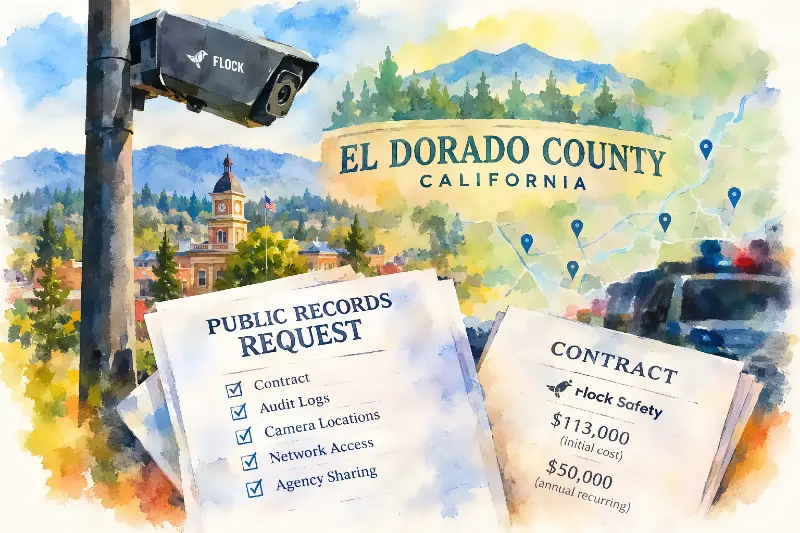
The current system uses two platforms — Motorola and Flock — that provide similar investigative capabilities. The department says access to both platforms improves coverage and coordination with other California law enforcement agencies that use different systems.
The presentation identifies approximately $250,000 in annual maintenance and licensing costs, funded through a CALMMET grant.
The briefing does not, by itself, establish how long that grant funding will remain available, whether the full annual cost will change or what the county would pay if grant support ended.
The county previously considered license plate reader purchases and related funding in Board of Supervisors proceedings. In 2022, the board considered a budget transfer of up to $675,000 for license plate reader hardware, software and maintenance, funded through methamphetamine enforcement and homeland security grant funds. That earlier authorization provides historical context but should not be confused with the current program’s stated annual operating cost. County agenda item 22-0879.
What the cameras capture — and what they do not
According to the Sheriff’s Office presentation, the cameras capture still images of rear license plates, along with visible vehicle characteristics such as make, model and color. Each reading is associated with a date, time and location.
The department says the cameras are not designed to photograph vehicle interiors, identify drivers or passengers through facial recognition, or continuously track people in real time.
That distinction is central to how the agency describes the system: It records vehicle observations that investigators can search when a legitimate law enforcement need arises.
A license plate alert, however, does not establish that a person committed a crime or that a vehicle’s presence at a particular location proves wrongdoing.
As the Sheriff’s Office presentation puts it, “A hit is only an investigative lead.”
The department says investigators must corroborate an alert against police reports, witness statements, other evidence and applicable legal standards before making enforcement decisions.
How investigators use the system
The presentation describes a four-step process: an investigator identifies a legitimate case-related need, searches the system or receives an alert, corroborates the information, and then uses the resulting lead to guide further investigation.
Reported uses include narcotics trafficking, burglaries, stolen vehicles, shoplifting and organized retail theft, missing-person cases, and search-and-rescue operations.
The department also outlines several cases in which it says the technology contributed to investigative progress:
-
Double homicide: Investigators used the system to help locate a suspect vehicle and direct law enforcement toward a suspect who was arrested.
-
Human trafficking: Vehicle information helped another California agency locate a juvenile victim and arrest a suspect.
-
Narcotics trafficking: Investigators located a vehicle suspected of transporting drugs into the county; the subsequent investigation resulted in the seizure of more than 20 pounds of methamphetamine.
-
Fentanyl overdose death: Investigators used the system to help locate and arrest a suspect.
-
Residential burglary: A vehicle lead helped investigators identify a suspect and make an arrest in Stockton.
These examples are reported by the Sheriff’s Office. The presentation does not provide the underlying case files, independent evaluations of the technology’s contribution to each outcome or enough detail to determine whether the cases could have been solved without license plate reader data.
Sheriff’s Office reports 191 solved cases and 356 drug seizures
The presentation reports 191 license plate reader-assisted solved cases and 356 license plate reader-assisted drug seizures from 2022 through Sept. 7, 2026.
It also states that the number of solved cases recorded in 2026 year to date had already exceeded each full prior year shown in the department’s spreadsheet.
Those figures offer a measure of the program’s reported investigative activity, but they require careful interpretation. A case classified as license plate reader-assisted is not necessarily a case solved solely because of the technology. Similarly, the drug seizure figure does not necessarily represent 356 separate criminal cases, individual suspects or successful prosecutions.
The presentation does not independently establish the system’s overall clearance-rate impact, cost per case solved, or how often searches produce no useful investigative lead.
Those additional measurements would help the public assess the program’s effectiveness alongside the department’s case examples.
Access controls and monthly audits
The Sheriff’s Office says it has established several safeguards intended to prevent unauthorized searches and improper use of license plate data.
Under the procedures described in the presentation:
-
Training is required: New deputies receive instruction from a system administrator on both platforms, including applicable policies and statutory requirements.
-
Individual logins are used: Each authorized user has a separate account, creating an audit trail tied to that person.
-
Periodic briefings are conducted: The system administrator provides continuing instruction to patrol teams.
-
Monthly audits are performed: The Investigations lieutenant reviews search justifications, repeat searches, unusual activity and inconsistencies in case numbers or explanations.
The department says license plate reader information receives a level of care comparable to Criminal Justice Information Services-protected information, even though the presentation says the data is not technically classified under that category.
The distinction matters because the stated safeguards depend on both written policy and effective implementation. Audit records, documented violations, corrective actions and independent reviews would help demonstrate how well those controls work in practice.
The Sheriff’s Office’s publicly available Policy 426, Automated License Plate Readers, addresses the capture, storage and use of license plate reader information while recognizing the public’s established privacy rights.
Data sharing with other agencies
The presentation says El Dorado County shares license plate reader data with California law enforcement agencies but does not share it with out-of-state agencies, federal agencies or private entities.
It identifies connections to 213 agencies through Motorola and 264 through Flock. Those figures describe the platforms’ current agency connections as reported in the presentation; they do not establish that every connected agency has access to every record or that all connections are used equally.
The presentation also cites California Senate Bill 54 as a restriction on sharing information with federal immigration authorities, including U.S. Immigration and Customs Enforcement and U.S. Customs and Border Protection.
The distinction between the county’s stated sharing practices and the broader legal framework is important. Residents seeking to evaluate the safeguards may want to know how access permissions are configured, how sharing requests are reviewed, and how the county verifies compliance with state law.
State law and local policy establish the rules
California law governs the collection, security, use, disclosure, retention and sharing of automated license plate reader information.
The Sheriff’s Office presentation identifies Senate Bill 34 as establishing requirements for agency policies, authorized access, training, audit logs, data sharing, retention and destruction.
The department also identifies its own Policy 426 as the governing local policy. The published policy provides a starting point for residents who want to examine the rules rather than rely solely on the department’s summary.
Key accountability questions include how long data is retained, who can authorize access, how violations are investigated, whether audit findings are documented, and what happens when a user searches records without a valid purpose.
The presentation describes the safeguards in place but does not, on its own, provide a comprehensive history of audit findings, complaints or disciplinary actions involving the system.
What the Board and public should examine
The Sheriff’s Office is recommending that supervisors receive and file the presentation. That wording does not necessarily call for a new policy, a change in camera locations or a new appropriation.
Nevertheless, the briefing gives county residents an opportunity to evaluate a law enforcement technology that operates across multiple communities, from the Tahoe Basin to the western slope.
For residents, the central issue is not simply whether license plate readers can help solve crimes. It is whether the county can demonstrate that the technology is effective, appropriately funded and subject to enforceable safeguards.
Several questions merit particular attention:
-
Funding: How long will CALMMET grant funding cover the stated $250,000 in annual maintenance and licensing costs? What happens if the grant expires?
-
Effectiveness: How does the Sheriff’s Office define a solved case or a drug seizure as ALPR-assisted, and can it provide supporting records?
-
Data retention: How long are records kept, and what rules govern deletion or preservation for evidence?
-
Oversight: How many improper searches, policy violations or substantiated complaints have audits identified, and what corrective action followed?
-
Data sharing: How are participating agencies vetted, and how does the county verify that access and sharing comply with California law?
-
Public accountability: Will the Sheriff’s Office publish periodic reports documenting system use, audit results, costs and measurable investigative outcomes?
These questions do not establish that the system has been misused. They identify information that would help residents independently assess the safeguards and benefits described by the department.
Where residents can find the records
Residents can review the Sheriff’s Office’s Policy 426 on automated license plate readers and consult the El Dorado County Board of Supervisors’ official website for meeting agendas, supporting documents and official actions.
On BOS agenda 10/27
The county’s Legistar meeting records provide another route to agenda materials and recorded decisions. The supplied presentation is identified as item 26-1650; residents should consult the official agenda and meeting record to verify the meeting date and any action ultimately taken.
The broader question for El Dorado County is how to balance the investigative value of vehicle identification technology with transparent oversight. The Sheriff’s Office has outlined the program’s reported results and internal controls. Demonstrating how those controls perform over time will be essential to maintaining public confidence.