EL DORADO COUNTY, Calif. — Terri Cissna left the El Dorado County Sheriff’s Office more than five years ago, but her name continues to surface in federal court proceedings and county records.
The central question is not whether Cissna is still a thorn in the side of local law enforcement. It is why her past work continues to attract legal scrutiny, what judges have actually decided and whether the public record supports the broader allegations that have circulated about her.


The documented answer is narrower — and more consequential — than the rumors and accusations that can surround a former law enforcement officer.
Cissna, also listed as Terrie Cissna in county records, began working for the Sheriff’s Office in July 1997 and retired in 2021. County records confirm that her retirement prompted the Sheriff’s Office to seek approval to sell her department-issued Glock 22 service weapon to her for $300 plus tax.
Her retirement ended her employment with the county. It did not end the legal questions associated with some of her investigative work.
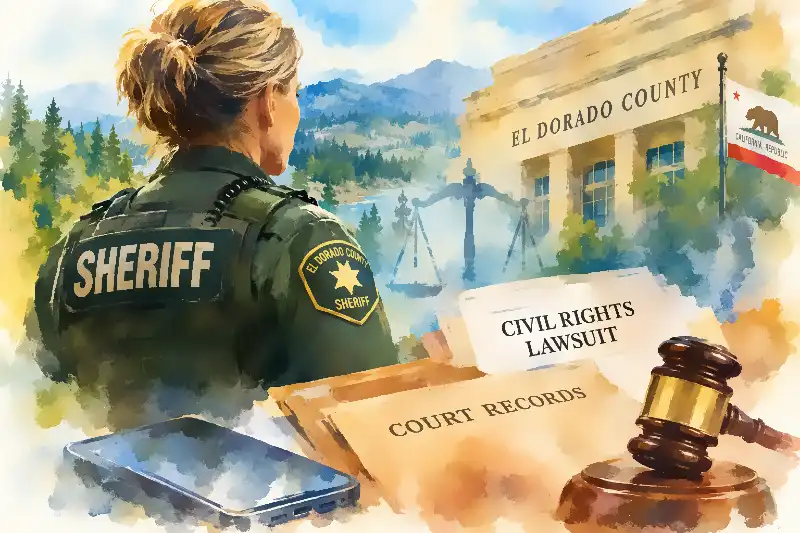
The most significant documented example is Burke v. El Dorado County Sheriff’s Office et al., a federal civil rights lawsuit filed in the U.S. District Court for the Eastern District of California.
The Burke lawsuit: What the federal court decided
The case, filed in 2023, concerns Orval Z. Burke’s allegations about the seizure and subsequent examination of his cellphone.
According to the court’s April 30, 2024, order, Burke alleged that the Sheriff’s Office seized his cellphone on Oct. 24, 2019, and that Cissna prepared an affidavit supporting a search warrant issued on Nov. 7, 2019.
Burke further alleged that his phone was accessed improperly before and after the warrant was issued. His complaint included allegations involving access to online accounts, data from a hunting application and photographs stored on the device. These are allegations in a civil complaint, not findings that the alleged conduct occurred.
The distinction matters because the case involves constitutional protections against unreasonable searches and seizures — protections that apply to government investigators as well as other law enforcement personnel.
In its April 2024 ruling, the court granted some portions of Cissna’s motion to dismiss but denied dismissal of a key portion of the claim involving alleged searches of Burke’s cellphone.
The court’s February 2025 order then addressed a separate motion filed by the county and Sheriff Jeff Leikauf. The judge granted that motion, giving Burke an opportunity to amend his complaint.
The order explained the consequence if Burke chose not to amend: the case would proceed on the remaining claims against Cissna, while the county and sheriff would be dismissed from the action. The judge noted that Cissna had already filed an answer to the amended complaint.
That ruling is important for two reasons.
First, claims against Cissna survived the relevant dismissal proceedings. The court did not dismiss the entire case against her.
Second, the survival of those claims does not mean the judge found that Cissna violated Burke’s constitutional rights. A motion to dismiss examines whether claims can proceed under the applicable legal standards; it is not a trial on the truth of the allegations.
The distinction between a surviving claim and proven misconduct is essential to an accurate account of the case.
The court’s written order provides the clearest official statement of the procedural posture: if the plaintiff did not amend the complaint, the case would proceed against Cissna on the remaining claims.
As of the February 2025 ruling, Cissna was therefore still facing civil claims arising from the cellphone search allegations. A current docket check is necessary to establish whether subsequent filings, settlement discussions, further rulings or a final judgment have changed that status by October 2026.
A 2012 search warrant in Garden Valley
Cissna’s investigative work has also appeared in published California appellate opinions.
In People v. Shropshire, the California Court of Appeal reviewed issues arising from investigations involving alleged thefts, firearms and marijuana in El Dorado County.
The opinion describes Cissna executing a search warrant at a property on Dewer Road in Garden Valley on Sept. 17, 2012. During the search, she encountered firearms in a bedroom, including a shotgun with a barrel shorter than the law permitted. The investigation later involved additional search warrants and evidence connected to suspected thefts of vehicles and equipment.
The case raised questions about the sufficiency of information supporting a search warrant and whether the evidence should be excluded.
The appellate court’s discussion of the earlier proceedings stated that Cissna’s reliance on the warrant was objectively reasonable. It explained that the affidavit included information about thefts in a remote part of Garden Valley, physical evidence connecting properties through off-road trails, information from sources the deputy considered credible and details from earlier investigations.
The court concluded that the warrant application contained more than a bare-bones affidavit and that Cissna should not have known the affidavit failed to establish probable cause.
That outcome does not support a claim that the appellate court found Cissna had falsified evidence or knowingly obtained an unlawful warrant. In this proceeding, the court’s reasoning supported the objective reasonableness of her reliance on the warrant.
The case illustrates why appellate opinions must be read in context. A court can scrutinize an investigation without finding the officer acted unlawfully.
Workers’ compensation claims in county records
Cissna’s name also appears in the El Dorado County Board of Supervisors’ closed-session records.
A Jan. 7, 2020, agenda item identified an existing litigation matter titled Claim of Terrie Cissna v. County of El Dorado; Sedgwick, involving three workers’ compensation claim numbers. The board’s published record listed the matter as a closed-session item and reported no action.
The record confirms that Cissna had workers’ compensation claims involving the county. It does not establish that the claims were fraudulent, that they involved misconduct or that the county found wrongdoing.
Workers’ compensation disputes are not, by themselves, evidence of professional misconduct. Any suggestion otherwise would require additional documentation, such as findings, settlement records or other reliable evidence establishing what happened.
For residents interested in county oversight, the legitimate questions concern the nature and disposition of the claims, the public costs involved where those costs are lawfully disclosable, and whether the county followed the procedures required by law.
Those questions should be answered with records rather than inference.
The Craig litigation and other allegations
Cissna has also been identified as a defendant in litigation involving former Sheriff John D’Agostini.
The case referenced in the supplied background is Craig v. Cissna et al., associated with federal proceedings in the Eastern District of California. Public docket records show that litigation involving a plaintiff named Craig and Cissna existed in the federal court system. However, the available records reviewed for this article do not establish a definitive appellate outcome supporting every characterization of that case.
Before drawing conclusions about the case, a reporter should obtain the operative complaint, relevant dismissal orders and any Ninth Circuit opinion directly addressing Cissna’s conduct. A defendant’s appearance in a lawsuit does not establish liability, and the dismissal of a claim does not necessarily establish that every underlying allegation was false.
Other allegations reportedly circulated in local commentary and public complaints, including claims that Cissna failed to process a citizen’s arrest, trespassed or falsified investigative reports.
Those allegations require independent verification. The court records identified above do not, by themselves, establish that Cissna committed any of those acts. Without authenticated records, a court finding, an official investigative conclusion or other independently corroborated evidence, they should not be presented as established facts.
That standard is particularly important when reporting on an identifiable former law enforcement officer. Serious accusations warrant scrutiny, but they also warrant evidence.
Why the case still matters to El Dorado County
For county residents, the significance of the Burke lawsuit extends beyond one retired deputy.
The case raises questions about how law enforcement agencies handle seized electronic devices, document searches, preserve evidence and supervise investigations that may affect a person’s constitutional rights.
Cellphones can contain years of private communications, photographs, location information and access to personal accounts. The legal authority to seize a device and the legal authority to examine its contents are not necessarily identical. Search warrants must be evaluated under the facts and law applicable to the particular investigation.
When a citizen alleges that an officer exceeded that authority, civil litigation can provide a mechanism for testing the allegations. The court’s rulings determine which claims may proceed; the evidence and subsequent proceedings determine whether liability is established.
There is also a public-accountability question for county government. When a former employee faces litigation over actions taken while employed by the county, residents have a legitimate interest in understanding the case’s procedural status, the county’s legal position and any publicly disclosed financial consequences.
El Dorado County’s June 23, 2026, Board of Supervisors agenda included a closed-session item concerning the Burke litigation. The agenda listed the matter as existing litigation and reported no action. That entry establishes that the litigation remained a subject of county legal business at that meeting, but it does not reveal the substance of confidential legal discussions or establish the case’s ultimate outcome.
A further review of the federal docket is needed before publishing a definitive statement about the case’s status today.
The unanswered questions
The public record establishes several facts: Cissna worked for the Sheriff’s Office beginning in 1997, retired in 2021, was involved in investigations later examined in court proceedings, and remained a defendant in the Burke civil rights litigation through the rulings documented in early 2025.
It does not establish that every accusation circulated about her is true.
For residents seeking a fuller accounting, the next steps are specific:
-
Check the current federal docket. Determine whether Burke’s claims resulted in a settlement, trial, judgment or additional dismissal orders after February 2025.
-
Obtain the complete Craig case record. Identify the specific claims against Cissna and D’Agostini and document how the courts resolved them.
-
Seek official complaint dispositions. Determine whether any alleged failure to process a citizen’s arrest, trespass or falsification of reports was formally investigated and what findings, if any, resulted.
-
Clarify the workers’ compensation matters. Distinguish the existence of claims from their disposition and any findings that were made.
-
Ask the Sheriff’s Office and county counsel for comment. Give the relevant agencies an opportunity to explain the public record and identify information they can lawfully disclose.
These are verifiable lines of inquiry, not conclusions in search of evidence.
The bottom line
So, why does Terri Cissna’s name continue to surface in El Dorado County law enforcement discussions?
The strongest documented answer is that litigation involving her former investigative work has continued to generate legal and public-record questions after her retirement. The Burke case is especially significant because the federal court declined to dismiss all claims against her, leaving allegations about cellphone searches to proceed at that stage of the litigation.
But the public record must be described accurately. A surviving lawsuit is not a finding of guilt, a workers’ compensation claim is not proof of abuse, and an appellate court’s examination of a search warrant is not automatically evidence of misconduct.
For El Dorado County residents, the issue is bigger than whether one former deputy remains controversial. It is whether allegations involving the exercise of government power are investigated fairly, adjudicated on the evidence and explained to the public with enough transparency to sustain confidence in local institutions.
That is the standard by which Cissna’s record — and the Sheriff’s Office’s handling of any substantiated misconduct — should be judged.
Primary sources and records
The following public records provide a starting point for readers who want to examine the underlying documentation.
Federal court — Burke v. El Dorado County Sheriff’s Office
Court orders dated April 30, 2024, and February 12, 2025, address the cellphone-search allegations and the claims that survived dismissal proceedings.
California Court of Appeal — People v. Shropshire
Published case materials discuss the Garden Valley investigation, search warrants and the court’s analysis of the evidence.
El Dorado County — Cissna retirement record
County agenda documentation concerning the proposed sale of Cissna’s service weapon upon retirement.
El Dorado County — Workers’ compensation litigation
The Jan. 7, 2020, Board of Supervisors record identifies Cissna’s workers’ compensation claims as a closed-session litigation matter.
El Dorado County — 2026 litigation agenda
The June 23, 2026, Board of Supervisors agenda lists the Burke litigation in closed session.