A white-rock treasure: The story of El Dorado County’s Alabaster Lime Works
The Alabaster Lime Works was more than a limestone quarry. It was a manufacturing enterprise, a transportation challenge, a tourist destination and an important piece of El Dorado County’s early industrial history.
Its story began in 1860, when William Gwynn, a Gold Rush-era entrepreneur, recognized the commercial value of an unusually white limestone deposit near the El Dorado Valley turnpike.
What followed was an operation that helped supply the growing demand for lime in California’s expanding communities.
A quarry becomes an unexpected attraction
According to the El Dorado County Historical Society and an 1862 account by California historian and publisher James M. Hutchings, Gwynn employed workers in early 1860 to extract limestone and construct a kiln.
He named the operation the Alabaster Lime Quarry and Kiln, reflecting the remarkable whiteness and purity of the stone.
On April 18, 1860, two quarry workers, George S. Halterman and John Harris, made a discovery that would give the property a second identity.
While removing limestone, they broke through into a previously concealed underground cavern.
The discovery revealed an extraordinary subterranean landscape filled with stalactites, stalagmites and elaborate mineral formations. The largest chamber became known as the Crystal Chapel because of a formation resembling a church pulpit.
The cave quickly attracted attention beyond El Dorado County.
In his account, Hutchings described the cave’s unusual formations and recorded that its visitor register contained 2,721 names by Sept. 30, 1860. Hundreds more had visited before the register was established.
The cave had become a destination almost immediately after its discovery.
The Sacramento Pioneer Association’s historian Michael Shepard later documented the discovery and the cave’s early popularity in a 2021 historical article.
One particularly memorable description came directly from Gwynn himself. Writing about the Crystal Chapel, he called it:
“the most beautiful cave you ever beheld.”
The description captured the excitement surrounding a discovery that transformed an ordinary industrial worksite into a regional attraction.
From local quarry to industrial enterprise
The Alabaster operation was part of a much larger California industry.
Following the Gold Rush, communities throughout the state increasingly relied on more substantial building materials. Brick buildings, masonry foundations, mortar and plaster required dependable supplies of lime.
Lime production involved heating limestone in specialized kilns to create quicklime, which could then be processed for construction and other industrial applications.
Gwynn’s operation eventually passed into the hands of Henry Thomas Holmes, a prominent California lime manufacturer whose business expanded into several regions.
The Sacramento Pioneer Association’s research places the H. T. Holmes Lime Company’s acquisition of the Alabaster property at approximately 1880.
Holmes’ business was substantial. Research published by the Friends of the Cowell Lime Works Historic District at the University of California, Santa Cruz, identifies him as one of California’s major lime manufacturers during the late 19th century.
His company operated in the Sierra foothills and expanded into markets including Sacramento and San Francisco.
The Alabaster property became one of the company’s important foothill operations.
A 3,000-barrel monthly operation
The scale of the Alabaster Lime Works is documented in the California State Mining Bureau’s Fourth Annual Report of the State Mineralogist, published in 1884.
The report identified the El Dorado County operation as having a patented-style Monitor kiln with a capacity of 3,000 barrels of lime per month.
That figure is particularly significant because it provides a contemporary government record of the operation’s industrial capacity.
The report also specifically identified the property as belonging to the H. T. Holmes Company and noted that the Alabaster Cave was included within the company’s holdings.
The state mineralogist described the product in favorable terms:
“The lime made at this locality is noted for its purity and whiteness.”
The report also documented an important industrial use beyond conventional construction.
The lime was suitable for gas purification and was used by several gas companies in California’s interior.
During the 19th century, manufactured gas was widely used for lighting and other purposes. Lime played a role in treating gas by removing unwanted compounds during production.
The Alabaster deposit therefore supplied more than builders and plasterers. It contributed to an emerging industrial economy.
Getting the lime to market: A demanding transportation operation
Producing thousands of barrels of lime was only part of the challenge. Getting the finished product to customers required a substantial transportation effort.
The Alabaster operation was situated in rugged country near the American River, and the nearest practical railroad shipping point was Newcastle in Placer County, on the Central Pacific Railroad.
The 1884 State Mineralogist report provides an unusually detailed description of the operation.
It records that five tons of lime were hauled in a daily trip using four wagons drawn by two teams of horses.
The report also confirms that the lime was shipped in bulk and in 10-ton railroad carloads. Markets included Virginia City, Marysville, Red Bluff, Chico, Sacramento and San Francisco.
One particularly interesting detail connects the operation directly to another familiar piece of regional history: the report states that Folsom Prison was built entirely with lime from this source.
For residents familiar with the history of Folsom, that is a remarkable connection between an El Dorado County industrial operation and one of the region’s most recognizable historic institutions.
The transportation network also helps explain why the American River crossing mattered so much. Gwynn constructed a wire suspension bridge near Rattlesnake Bar in 1862-63, making access to the cave and its surrounding property easier for visitors arriving from the railroad side.
Alabaster Cave becomes a regional destination
While the lime business supplied an important commercial market, the cave developed a separate identity as a tourist attraction.
Gwynn recognized its potential and worked to accommodate visitors. A hotel and dancing hall were advertised in the Sacramento Daily Union in June 1862.
The advertisement described the cave as:
“THE GREATEST NATURAL CURIOSITY yet discovered in the State”
The location was advertised as approximately 10 miles from Folsom, with transportation available to visitors.
The attraction even became a destination for organized excursions.
In September 1863, the Sacramento Pioneer Association arranged a special railroad excursion from Sacramento to Auburn Station, followed by wagon transportation to the cave.
The excursion proved considerably more popular than organizers anticipated.
According to Michael Shepard’s historical account, 340 excursionists boarded the train, overwhelming the transportation arrangements awaiting them at Auburn. Additional wagons and teams had to be pressed into service, while some visitors simply walked the remaining distance.
The group enjoyed a picnic, music, dancing and a tour of the cave.
It is a wonderful glimpse into 19th-century recreation, when an excursion into the El Dorado County foothills could be an entire day’s adventure.
The cave also attracted visitors of considerable distinction. Historical accounts document a visit by Prince Kamehameha of the Sandwich Islands in 1860.
Holmes expands the attraction
The H. T. Holmes Lime Company eventually acquired the property, probably around 1880, according to the Sacramento Pioneer Association’s research.
The company reopened Alabaster Cave to the public in 1886, investing in improvements that included as many as 50 gas burners to illuminate its chambers.
Bridges and stairways were installed to make the underground attraction more accessible.
The company even considered constructing a new limestone hotel near the cave.
However, the arrangement did not last.
By 1888, the company had sold the cave to J. H. Russell, who continued marketing it as a natural wonder and charged visitors 50 cents admission.
The lime business and the tourist attraction had developed together, but their histories eventually took separate paths.
What happened to the Alabaster Lime Works?
The story did not end when the Holmes company relinquished the cave.
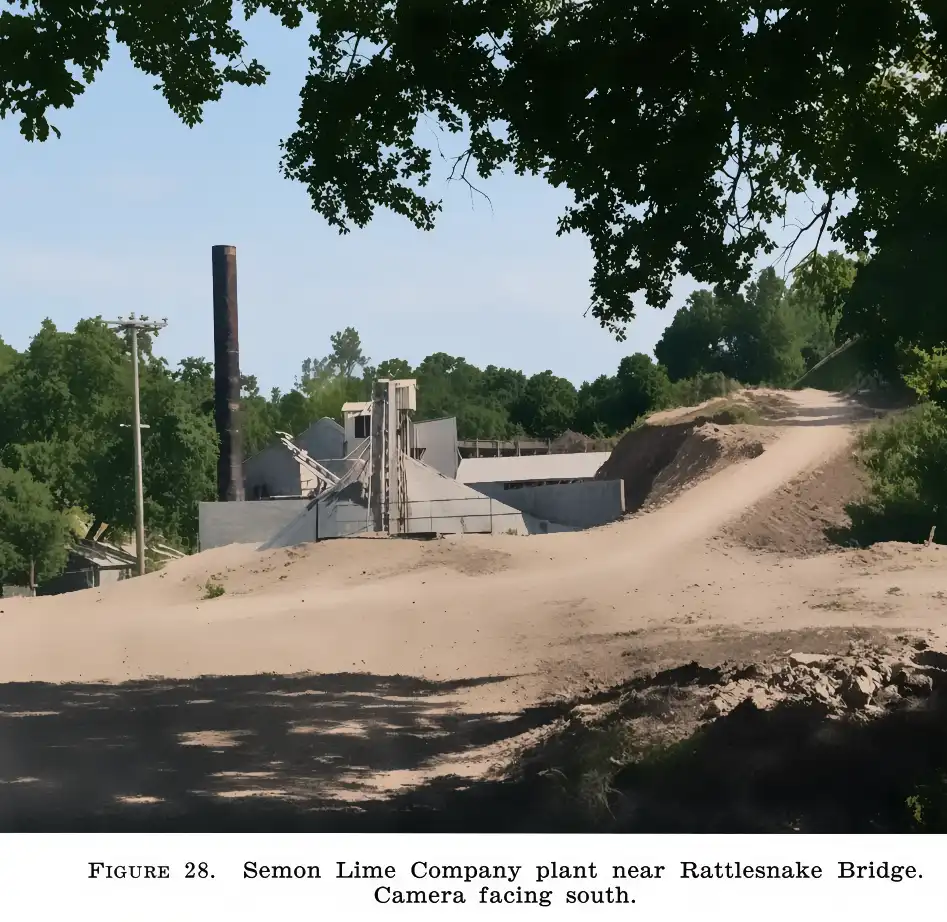
The limestone deposit continued to attract commercial interest. A 1956 California Division of Mines and Geology report identified the Rattlesnake Bridge, Alabaster Cave and Rattlesnake Bar deposit as a limestone resource that had been worked intermittently by several companies since the 1860s.
The report identified subsequent operators, including Auburn Chemical Lime Company, Auburn Lime Products Company, Hughes-Vertin Lime Company and Vertin Lime Company.
The property was purchased by Semon Lime Company in July 1955.
That history is important because it demonstrates that the limestone deposit had an industrial life extending well beyond the original Gwynn and Holmes operations.
The arrival of modern manufacturing methods and changing construction materials eventually altered the economics of traditional lime production. Nevertheless, the deposit remained commercially relevant into the 20th century.
A forgotten chapter beneath the Folsom Lake landscape
Research published in the Journal of Spelean History, the official publication of the American Spelean History Association, reports that the cave was closed and sealed by its owners around 1993.
Its location on private property means it is not an ordinary recreational destination.
The broader Rattlesnake Bar district also underwent significant changes when Folsom Reservoir was created in the 1950s. Parts of the historic mining landscape were submerged, changing the geography of an area that once supported mining, transportation and industrial activity.
For modern El Dorado County residents, it can be difficult to imagine the activity that once surrounded the North Fork of the American River.
There were quarry workers extracting limestone, kiln operators tending continuous-burning furnaces, teamsters hauling heavy loads, railroad connections moving finished products and visitors traveling from Sacramento to explore a remarkable underground cave.
The Alabaster Lime Works connected a relatively remote corner of El Dorado County to the expanding commercial economy of California.
Its products went into buildings, mortar, plaster and industrial applications. Its cave attracted thousands of visitors. Its transportation network connected the foothills to Sacramento and markets throughout the state.
Perhaps most importantly, its history reminds us that El Dorado County’s Gold Rush legacy did not end when the easily accessible gold disappeared.
The region continued producing valuable natural resources, developing industries and supplying the materials that helped build California.
The next time you look across Folsom Lake toward Rattlesnake Bar, remember that the landscape once held a thriving industrial enterprise — and one of California’s most remarkable underground attractions.
The water may have changed the landscape, but it did not erase the history.
Historical sources and further reading
-
California State Mining Bureau — Fourth Annual Report of the State Mineralogist (1884), particularly pages 106-109.