POLLOCK PINES, CALIFORNIA — A Community Built Along the Road to Somewhere
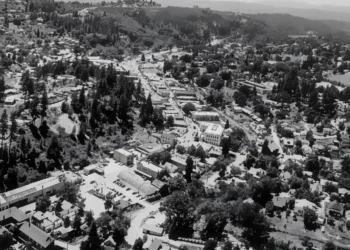
Today, Pollock Pines is known for its towering pine trees, mountain homes, snow-covered winters, outdoor recreation and its location along U.S. Highway 50. For many residents, it is a place to escape the congestion of the Sacramento Valley while remaining connected to Placerville, Lake Tahoe and the communities of the Sierra Nevada.
But the history of Pollock Pines reaches much further back than its modern residential subdivisions.

Long before the community acquired its name, the surrounding mountains and meadows served as important gathering places, transportation corridors and stopping points for people traveling across the Sierra Nevada.
Its history is a story of Native American heritage, westward migration, stagecoaches, Pony Express riders, lumber operations and the development of a mountain community.
Before Pollock Pines: Native American Heritage and Early Trails
The forests, waterways and meadows surrounding present-day Pollock Pines and Sly Park were inhabited and used by Indigenous people long before European-American settlement.
The surrounding region was part of the traditional homeland and seasonal-use areas of Native American communities, including Nisenan and Miwok peoples. The forests and meadows provided food, hunting grounds, plants and access to water.
One particularly important location was Sly Park, where the natural meadow offered grazing opportunities and seasonal resources.
The arrival of American emigrants during the 1840s and 1850s brought substantial changes to the region.
In 1848, members of the Mormon Battalion traveled through the Sierra Nevada while searching for a route back to Salt Lake City. Their journey helped establish an important emigrant corridor through the region.
According to the historical account maintained in The Pollock Pines Epic, one member of the party, James Calvin Sly, identified a large meadow suitable for grazing livestock.
The location became known as Sly Park.
The meadow would eventually become the site of one of the most recognizable recreational destinations in eastern El Dorado County.
Historical accounts also describe the tragedy of three advance scouts who disappeared while searching for a route through the mountains. Their remains were later discovered, and the nearby location became known as Tragedy Springs.
These place names remain reminders of the difficult journeys undertaken by early emigrants crossing the Sierra Nevada.
The Placerville-Carson Road and the Pony Express
During the Gold Rush, the region’s importance grew as thousands of travelers, merchants and freight operators moved between Sacramento, Placerville and the mining communities of Nevada.
The Placerville-Carson Valley Road became a critical transportation route across the Sierra Nevada.
It was more than a trail for gold seekers. It became a commercial artery carrying supplies, passengers, livestock and mail.
Roadhouses developed along the route to provide food, lodging, fresh horses and other services.
Among the most important was Sportsman’s Hall, located in the Pollock Pines area.
Originally established as a stopping place for travelers, the establishment became particularly busy after the discovery of the Comstock Lode in Nevada in 1859.
Freight wagons carrying supplies eastward and transporting gold and silver westward created an enormous demand for transportation services.
The route also became part of the legendary Pony Express.
On April 3, 1860, the Central Overland Pony Express Company began its celebrated mail service between Missouri and California.
Pony Express riders relied on strategically located stations where horses could be changed quickly and riders could continue their journeys.
The riders operated under a strict code of conduct. Their employment oath included the declaration:
“I will under no circumstances, use profane language: that I will drink no intoxicating liquors.”
The service lasted only until October 1861, when the completion of the transcontinental telegraph made the expensive horse-and-rider operation obsolete.
The road itself continued to serve travelers and freight operators for decades.
Sportsman’s Hall remains one of the area’s important historical landmarks. California Registered Historical Landmark No. 704 recognizes its connection to the stagecoach era and the Pony Express.
The historical account of the route, including its roadhouses, transportation operations and Pony Express history, is documented in The Pollock Pines Epic.
The Lumber Industry Creates an Economic Foundation
As the Gold Rush economy matured, the demand for lumber increased throughout El Dorado County.
Mining operations needed timber to support underground workings. Communities needed lumber for homes, businesses, barns and other structures.
The heavily forested mountain country surrounding Pollock Pines offered an abundant supply.
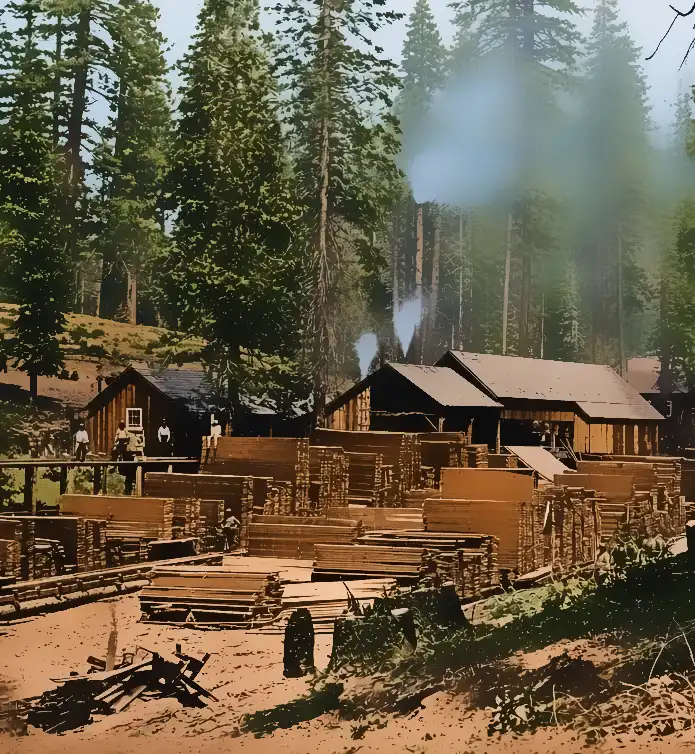
Lumber operations became an important part of the local economy, with mills and logging activities scattered throughout the region.
One of the men who would eventually leave a permanent mark on the community was Hiram Robert Pollock, commonly known as H.R. or Hime Pollock.
Pollock arrived in the area around 1909 with his wife, Anna, and their son, Claude Earl.
Originally from Michigan, Pollock was an experienced lumberman who recognized the commercial potential of the surrounding timber.
He entered into a partnership to establish a sawmill producing box-grade lumber for the regional fruit-packing industry.
After business difficulties ended the partnership, Pollock took responsibility for completing the mill. He borrowed money to finish construction and worked alongside his son to operate the business.
The operation represented the kind of entrepreneurial activity that helped sustain rural El Dorado County during the early 20th century.
But the family’s fortunes would soon change.
In 1932, fire destroyed Pollock’s sawmill.
Rather than abandon the property, Hiram and Anna Pollock looked for another way to make the land productive.
Their next venture would ultimately give the community its name.
1935: The Pollock Family Gives the Community Its Name
The early 1930s brought increased automobile travel through the Sierra Nevada.
Improved highways made the journey between Sacramento, Placerville and Lake Tahoe increasingly accessible.
Pollock recognized an opportunity.
Travelers passing through the mountains were interested in purchasing property where they could build summer cabins and escape the heat of the Sacramento Valley.
In 1935, Hiram and Anna Pollock began selling lots in a subdivision they established along the ridge on both sides of Cedar Grove School.
They called the development Pollock Pines.
The name was not derived from an old mining camp, a Gold Rush pioneer or a prominent political figure. It came directly from the family responsible for creating the subdivision.
As the development grew, Cedar Grove School became known as Pollock Pines School.
The community’s identity was becoming established.
According to El Dorado County historian Doug Noble’s research, published in The Post Offices of El Dorado County, the Pollock Pines Post Office officially opened April 28, 1936.
Alice P. Grout served as its first postmaster.
That date provides an important historical milestone: Pollock Pines had become an officially recognized postal community.
The Pollocks continued expanding their development, filing additional subdivision maps in 1947 and 1948.
Hiram died in 1951, approximately two and a half years after Anna’s death in 1949.
The community they helped establish continued to grow.
The 1950s: Sly Park Becomes Jenkinson Lake
Another major turning point came with the development of Sly Park Reservoir.
For generations, the Sly Park meadow had been a natural stopping place for travelers, livestock and Indigenous communities.
In the mid-20th century, that landscape underwent a dramatic transformation.
The El Dorado Irrigation District pursued the development of a reservoir to improve water storage and supply for the growing region.
Construction of Sly Park Dam began in the early 1950s, and water storage began in November 1954.
The resulting reservoir became known as Jenkinson Lake, named after Walter E. Jenkinson, who served as secretary-manager of the El Dorado Irrigation District and was instrumental in advancing the project.
The reservoir became an important component of the county’s water infrastructure.
It also created a recreational destination that would attract visitors from throughout Northern California.
Today, Jenkinson Lake and the surrounding Sly Park Recreation Area provide opportunities for boating, fishing, camping, hiking, swimming and other outdoor activities.
The transformation of the meadow into a reservoir changed the area’s landscape and helped establish a new recreational identity for Pollock Pines.
Source: El Dorado Irrigation District – Sly Park: A Dream Realized.SMUD’s Crystal Basin Projects Bring New Residents
Another important chapter began in 1959 when the Sacramento Municipal Utility District began major construction activity associated with its Upper American River Project, commonly known as the Crystal Basin hydroelectric development.
The construction projects brought workers and their families into the mountain region.
Pollock Pines became an attractive location for employee housing, and mobile home parks and permanent residences began appearing throughout the community.
The growing population placed additional demands on local schools.
According to the area’s historical account maintained by Gold Ridge, Pinewood School was constructed in three phases and completed in 1963. Together with Pollock Pines School, the facilities served more than 600 students.
As construction activity eventually declined, some temporary residents moved away.
However, many families who had initially purchased mountain properties as vacation homes decided to make them permanent residences.
The community’s character was changing.
Pollock Pines was no longer simply a summer destination or a stopping place along the road to Lake Tahoe. It was becoming a residential community with schools, businesses and services of its own.
Highway 50 Changes the Community Again
Transportation has always been central to Pollock Pines’ development.
The old Placerville-Carson Valley route evolved into a modern highway corridor, eventually becoming U.S. Highway 50.
During the early 1960s, Sunday evening traffic returning from Lake Tahoe became increasingly congested.
The old highway passed directly through the commercial portion of Pollock Pines, creating challenges for residents and businesses.
A new freeway alignment was completed in 1965 south of the business district.
The former highway became known as Pony Express Trail, preserving the connection to the region’s transportation history.
The new alignment changed traffic patterns, improved regional travel and helped establish the modern arrangement of the community.
For residents today, the distinction between Highway 50 and Pony Express Trail is more than a matter of road names. It reflects two different periods in the community’s history: the era when travelers passed directly through town and the modern era when the highway carries much of that traffic around its commercial center.
The Pollock Pines Library: A Community Institution
One particularly interesting story involves the Pollock Pines Library.
According to the El Dorado County Library’s historical account, Doris Cloherty established the community’s first library in 1951 using a couple of shelves inside her coffee shop.
She kept the small library open during evening hours, sometimes bringing her children along.
Cloherty and county librarian Edith Gantt eventually approached local businessman Harvey West about creating a permanent library.
In 1952, West donated a small building for that purpose.
As the community grew, the original building became inadequate. West subsequently moved it to Shingle Springs, where it was again used as a library.
He then constructed the present Pollock Pines Library building in 1960 and donated it to the community.
Otis and Myrtle Carr, who owned the property, contributed by donating the land.
The library’s distinctive knotty-pine interior continues to reflect the mountain character of the community.
It is a reminder that Pollock Pines’ development was not accomplished solely through roads, construction projects and commercial investment. Local residents and business owners also helped establish the institutions that make a community endure.
Source: El Dorado County Library – Library History.
Fire and the Challenges of Living in the Sierra Nevada
The 2014 King Fire became one of the most consequential wildfire events in the modern history of eastern El Dorado County.
The fire started Sept. 13, 2014, and burned approximately 97,717 acres before it was contained in October.
It threatened communities, homes, infrastructure and natural resources throughout the region.
The destruction of structures and the extensive damage to forestland demonstrated the risks associated with living in a heavily forested mountain environment.
For Pollock Pines residents, wildfire preparedness, evacuation planning, forest management and emergency communications remain important community concerns.
The region’s history is inseparable from its natural environment, including both the benefits and the hazards of living among the Sierra Nevada forests.
Pollock Pines Today: A Mountain Community With a Long Memory
Its economy has evolved from transportation services and lumber production to residential development, recreation, tourism and businesses serving both residents and travelers.
The surrounding landscape continues to attract people looking for outdoor recreation and a rural mountain lifestyle.
Jenkinson Lake remains a major attraction, while nearby portions of the Eldorado National Forest provide access to hiking, camping, fishing and other recreational opportunities.
The historic Pony Express Trail preserves the memory of the transportation corridor that helped establish the region’s importance during the 19th century.
And the community’s name continues to honor the family that recognized the potential of the mountain landscape after a devastating mill fire.
There is something particularly appropriate about that history.
Pollock Pines was not created overnight by a gold discovery or a major railroad project. It developed through generations of people who traveled through the area, worked its forests, built businesses, raised families and invested in the community.
The next time someone drives through Pollock Pines on Highway 50, it is worth remembering that the road beneath their tires follows a corridor that once carried emigrant wagons, freight teams, stagecoaches and Pony Express riders.
The modern community stands on the shoulders of that history.
And the name Pollock Pines remains a lasting reminder of one family’s decision to turn a failed lumber operation into something that would outlive them.
Historical Sources and Further Reading
The following resources provide additional documentation for readers interested in researching Pollock Pines and eastern El Dorado County history.
-
The Pollock Pines Epic — Marilyn Parker’s detailed community history, including transportation, settlement and development. Read The Pollock Pines Epic.
-
El Dorado County Library — Doug Noble’s The Post Offices of El Dorado County, documenting the establishment of the Pollock Pines Post Office in 1936. Read the historical postal records.
-
Doug Steps Out — Doug Noble’s historical account of the Pollock family and the development of the community. Read Community Profiles – Pollock Pines.
-
El Dorado County Library History — The origins of the Pollock Pines Library and the contributions of local residents. Read the library’s history.
-
El Dorado Irrigation District — Historical information about Sly Park Reservoir and Jenkinson Lake. Read the EID historical account.
-
Gold Ridge — Local historical documentation of the Pollock Pines area’s development. Read Area History.
Historical note: Dates and accounts in this article draw on published local histories and archival research. Some early road-house names, station locations and route descriptions vary among historical accounts. The distinction between the broader Pollock Pines area and the later subdivision is important when interpreting those records.