EL DORADO COUNTY, Calif. — For the Shingle Springs Band of Miwok Indians, the effort to bring the Nisenan language back into everyday life is about much more than teaching words and phrases. It is about restoring a connection to ancestral history, cultural identity and the land that has sustained generations.
A new generation of tribal members is helping lead that effort, developing educational resources and creating opportunities for children, adults and elders to reconnect with a language that generations of forced assimilation threatened to erase.
At the center of the initiative is the tribe’s Language Department, which oversees revitalization efforts for both Nisenan and Northern Sierra Miwok.
Jonathan Geary, the department’s language director, and other language staff are developing practical ways for tribal members to learn and use the languages beyond formal lessons.
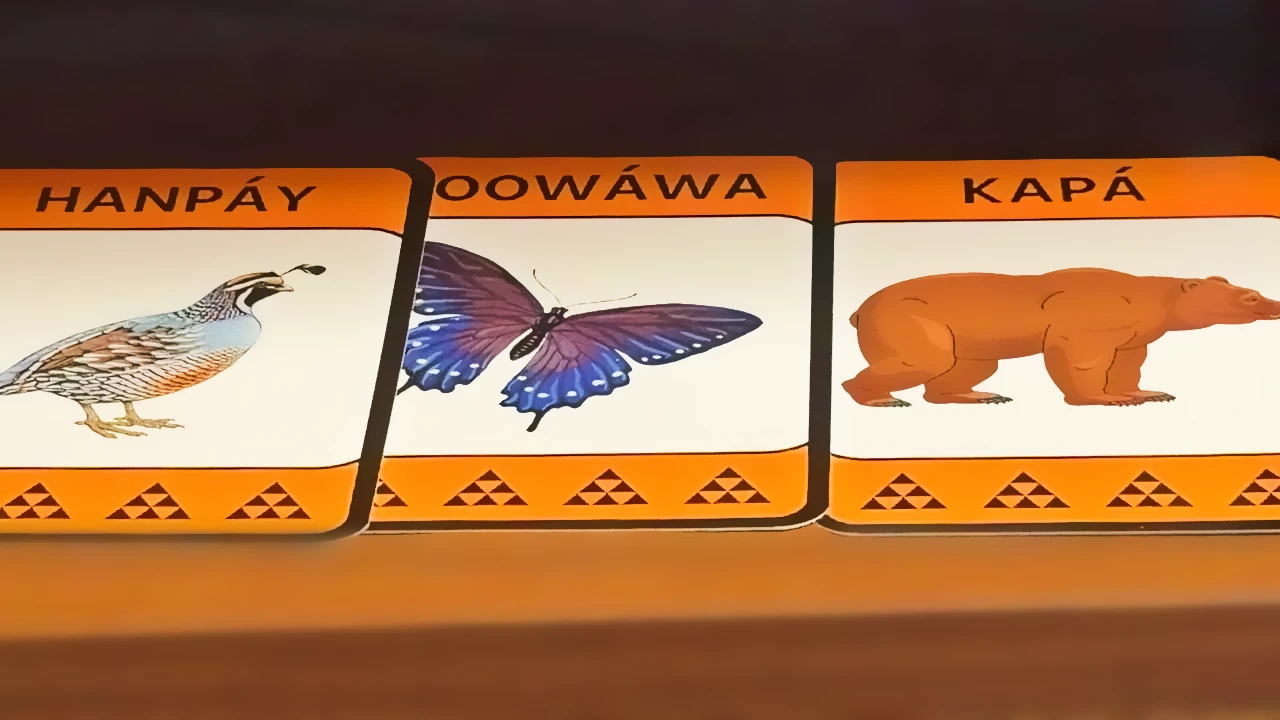
The educational materials include flash cards featuring animal names, everyday expressions and additional phrases that help learners understand how words fit into ordinary conversation.
During a demonstration, Geary introduced one example: “Otter is K’o.”
The department also uses children’s literature to connect language instruction with traditional stories and cultural teachings. One story shared in the recent report follows two boys who are thrown into a river and transform into salmon, bringing traditional knowledge into a format younger generations can experience through their ancestral language.
More than words: Preserving cultural identity
For tribal member Marcela Tayaba, language revitalization represents something deeply personal.
“Without language, our identity is lost. We don’t know who we are. It’s like the land doesn’t know who’s here,” Tayaba said.
Her words capture the significance of the work taking place in El Dorado County. Language carries traditional knowledge, relationships with the natural world and cultural perspectives that cannot always be translated through English vocabulary alone.
The effort also reflects a painful chapter in American history.
For generations, federal Indian boarding school policies separated Native American children from their families and communities. These institutions frequently attempted to replace Indigenous identities with those of mainstream American society. Children were often discouraged or prohibited from speaking their Native languages or practicing their cultural and religious traditions.
The U.S. Department of the Interior’s Federal Indian Boarding School Initiative documented these assimilation practices, including the suppression of Native languages and cultural traditions. The department’s investigation also recognized the lasting, intergenerational consequences for Indigenous communities.
For Tayaba, hearing the experiences of elders who were unable to pass their languages to younger family members makes the work especially emotional.
“Just hearing all the boarding school stories and listening to other elders not having their language passed down, it’s just really emotional for us,” she said.
The revitalization effort is therefore about more than recovering forgotten vocabulary. It is also about rebuilding connections that historical policies deliberately disrupted.
Taking Nisenan from the classroom into the home
The tribe’s long-term objective is to make Nisenan a living, spoken language within the community.
Geary explained that success means reaching a point where adults can comfortably speak the language and their children acquire it naturally by hearing it used at home.
“We want to get to a point where there are adults in the community who speak the language, and whose children are learning the language just by hearing it spoken to them,” Geary said.
That goal represents an important distinction between documenting a language and restoring its everyday use.
Books, flash cards, recordings and organized lessons provide the foundation. But the lasting measure of revitalization will be whether families begin using the language in ordinary conversations, passing expressions, stories and knowledge from one generation to another.
A growing language program in El Dorado County
The effort is not limited to printed educational materials.
The Shingle Springs Band of Miwok Indians maintains a dedicated Language Department website offering Nisenan and Northern Sierra Miwok learning resources, including self-paced lessons, audio recordings and activities.
The department’s recent programs demonstrate how language instruction is being incorporated into community activities.
In July 2026, the department hosted its fifth Language Day Camp, where tribal youth participated in Nisenan-language Bingo, learned animal names and received a commemorative honeybee pin.
Earlier, in May 2026, the department organized a language-focused trip to the Folsom City Zoo Sanctuary. Tribal members and participating families learned animal vocabulary in both Nisenan and Northern Sierra Miwok through activities involving the tribe’s Language and Environmental departments.
Other educational projects include animal flash cards, language games, plant identification signs and children’s storybooks.
One notable publication, May, was released in December 2025 as part of the tribe’s Nisenan Storytelling Collection. The story explores how salmon acquired the orange-red color of their flesh and how the river began moving during Creation Time. The book includes Nisenan and English versions, along with audio recordings.
These projects demonstrate an effort to make language learning part of everyday experiences rather than something confined to a classroom.
The tribe’s official Language Department identifies its mission as revitalizing Nisenan and Northern Sierra Miwok through education and the development of a strong speaking community.
The meaning of water: A language that keeps flowing
For Tayaba, the importance of preserving Nisenan is reflected in a single word: móm, meaning water.
Water has always been central to the lives, traditions and knowledge of Indigenous communities. Its movement also provides a fitting metaphor for the continuing effort to keep the language alive.
“Language, you know, it’s always flowing in and out of our minds and it’s always there. So we’re always here, and we’re going to keep revitalizing our language for future generations to come,” Tayaba said.
That sentiment reflects the broader purpose of the tribe’s work: ensuring that Nisenan is not simply preserved in historical documents, recordings or museum exhibits, but remains a living part of the community.
The Shingle Springs Band of Miwok Indians is making that vision tangible through the work of its language specialists, elders, educators and younger tribal members.
For El Dorado County, the initiative also serves as a reminder that the region’s history did not begin with the Gold Rush or the arrival of European settlers. Indigenous cultures, languages and traditions are an enduring part of the area’s heritage.
The work underway today is helping ensure that future generations will have an opportunity not only to learn about that history, but to hear it, speak it and carry it forward.
Nisenan is more than a language being remembered. It is a language being reclaimed.
Sources and Additional Information
-
CBS Sacramento: Younger tribal members lead effort to revitalize Nisenan language in Placerville — Nov. 6, 2026. Original reporting and interviews with Jonathan Geary and Marcela Tayaba.
-
Shingle Springs Band of Miwok Indians — Language Department — Official language-learning resources, educational programs, publications and community activities.
-
Shingle Springs Band of Miwok Indians — Departments — Official department information and language revitalization mission.
-
U.S. Department of the Interior — Federal Indian Boarding School Initiative — Historical documentation of federal boarding school policies and their lasting effects.