El Dorado County Voters Get Two Sides of Measure S
As El Dorado County voters prepare to decide the most consequential local tax measure on the November ballot, a new pair of interviews is putting supporters and opponents of Measure S in front of the public.
Gary Kinghorn, host of the El Dorado Hills Insider, has released two interviews — one featuring representatives supporting Measure S and another with former El Dorado County Supervisor and rancher Ray Nutting, a leading opponent.


Kinghorn is encouraging residents to listen to both conversations before deciding how to vote.
“Listen to both sides and decide!” Kinghorn said in announcing the interviews.
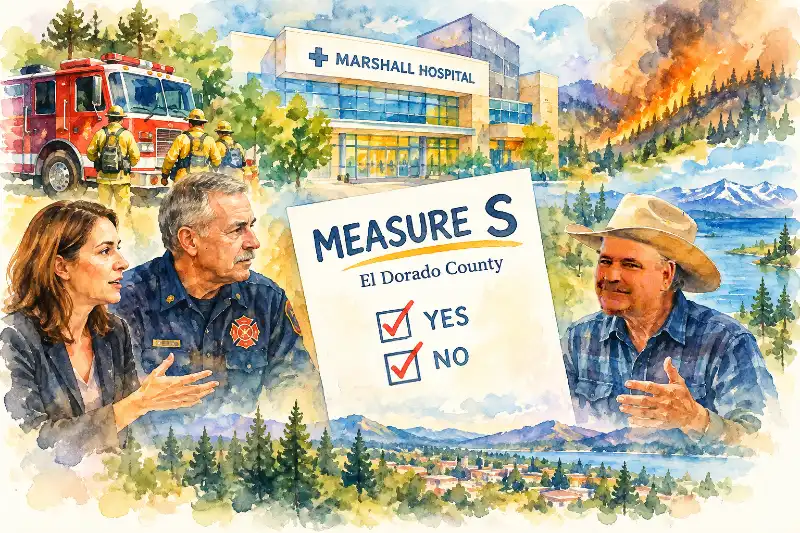
Measure S will appear on the Nov. 3, 2026, general election ballot. The official county ballot question asks voters whether to approve a 3/8% sales tax for 30 years, expected to generate approximately $13 million annually [$390 million tax for 30 years] for hospital facilities and equipment, wildfire-risk reduction and rapid 9-1-1 emergency response.
Supporters: Hospital, fire and wildfire protection are connected
In the first interview, Kinghorn speaks with Maia Schneider, Marshall Medical Center’s executive director of business and strategy, and Tim Cordero, retired El Dorado County fire chief and a Measure S supporter.
The two describe Measure S as a coordinated approach to maintaining what supporters characterize as an interconnected emergency-response system — from wildfire prevention and fire engines to ambulances and the local emergency room.
The campaign supporting the measure says the proposed revenue would remain under local control and would be subject to annual audits and an independent citizens oversight committee.
One of the central arguments concerns Marshall Medical Center and California’s hospital seismic requirements.
According to the Measure S campaign, Marshall has already spent more than $70 million addressing state seismic requirements and has met the state’s 2020 “safe and standing” requirement. The campaign says additional requirements associated with the state’s 2030 deadline include ensuring hospitals can remain operational for at least three days following a major earthquake, including maintaining water, power, fuel, medical gases, food and other supplies.
Supporters say Marshall needs approximately $40 million for those required improvements, with additional funds available for other capital needs, including deferred maintenance, building repairs and outpatient expansion.
The measure’s hospital allocation is structured around capital improvements rather than ordinary operating expenses. The campaign says Marshall would use the funding to support a $125 million bond issuance for qualifying capital projects.
How Measure S would distribute the money
The proposed sales tax would add three-eighths of 1%, or 0.375 percentage points, to applicable taxable purchases.
County election materials estimate approximately $13 million in annual revenue.
Supporters say the money would be divided among local emergency and wildfire-prevention priorities. According to the campaign, Marshall would receive revenue supporting capital-project financing, 5% would go to qualifying nonprofit organizations for wildfire-risk reduction, and the remaining revenue would be distributed to local fire agencies based on the number of engine companies they operate.
The campaign also emphasizes that sales taxes are paid by visitors as well as county residents, meaning tourists and other consumers making taxable purchases in El Dorado County would contribute to the revenue.
The proposed measure specifically identifies rapid 9-1-1 response, hospital access and wildfire prevention as its core purposes.
The opposition: Is Measure S too broad?
The second El Dorado Hills Insider interview takes a substantially different view.
Kinghorn interviews Nutting, who argues that the measure combines several important issues — hospital infrastructure, fire protection and wildfire prevention — into a single 30-year tax proposal.
Nutting’s concerns center on what he describes as insufficient accountability, the structure of the hospital funding and whether the measure provides enough specificity about wildfire-prevention projects and measurable results.
Those concerns echo objections previously raised publicly by Nutting and political consultant Dan Dellinger, who characterize Measure S as a tax increase packaged as a public-safety measure.
The opposition questions whether voters should approve a tax lasting three decades when some of the specific projects and future funding decisions will be determined after the measure passes.
That criticism is particularly focused on wildfire prevention.
Supporters say Measure S would fund vegetation management, defensible-space work, evacuation planning, emergency alerts and other wildfire-risk reduction activities. The measure also provides funding to qualifying nonprofit organizations for wildfire-prevention programs.
Opponents question whether those provisions go far enough and whether voters will have sufficient information to measure the results.
The hospital question is central to the debate
Few issues are likely to generate more discussion than Marshall Medical Center.
Supporters contend that maintaining local emergency-room access is inseparable from maintaining an effective emergency-response system. Their argument is that firefighters and paramedics can only do so much if critically injured or ill patients must ultimately be transported farther from home for emergency care.
The campaign also points to financial pressures affecting rural and independent hospitals, including rising costs and reimbursement challenges. It argues that without additional capital investment, complying with state requirements could become increasingly difficult.
Nutting, meanwhile, questions whether taxpayers should provide a dedicated revenue stream for hospital capital projects and whether hospital funding should have been presented to voters separately from wildfire and fire-protection funding.
That distinction gets to the heart of the Measure S debate: Are these separate problems that should be funded separately, or are they components of one countywide emergency-preparedness system?
Accountability and local control
Both sides recognize that accountability will be a major concern for voters.
The Measure S campaign says the initiative includes an independent citizens oversight committee, annual audits and public reporting requirements. It also states that the revenue is dedicated to the purposes specified in the measure.
Opponents remain skeptical about whether those protections provide sufficient control over a tax that could remain in place for 30 years.
The measure itself states that its revenue is to remain local and not be diverted by county, state or federal governments. The opposition argues that voters should nevertheless examine how those protections would operate over such a long period.
A decision that reaches every corner of the county
Measure S is not limited to one community.
Its proposed revenue structure affects taxpayers and businesses throughout El Dorado County, from El Dorado Hills and Cameron Park to Placerville, the western foothills and the Lake Tahoe Basin.
For residents in wildfire-prone rural communities, the question may center on vegetation management and fire response. For others, the priority may be maintaining local emergency-room access. And for taxpayers concerned about government spending, the 30-year duration and sales-tax increase may be the overriding issue.
The county’s Elections Department currently lists Measure S among the measures appearing on the Nov. 3 ballot. The department describes the proposal as a 3/8% sales tax for 30 years, with estimated annual revenue of approximately $13 million.
That makes the measure more than a debate about a few cents on a taxable purchase. It is a $ 390 million tax.
It is a decision about how El Dorado County intends to finance emergency preparedness, wildfire prevention, fire protection and hospital infrastructure for the next generation.
For voters who have not yet made up their minds, Kinghorn’s two interviews provide an opportunity to hear the arguments directly from both camps rather than relying solely on campaign advertising.
Why Measure S Makes Sense — supporters:
Watch the El Dorado Hills Insider interview with Maia Schneider and Tim Cordero
The Case Against Measure S — Ray Nutting:
Watch the El Dorado Hills Insider interview with Ray Nutting
Official El Dorado County Measure S information:
El Dorado County Elections Department — Local Measures
Measure S campaign information:
El Dorado Ready — Vote Yes on S
Editor’s note: The interviews represent the views of the participants and campaigns. Statements about the measure’s provisions, tax rate and proposed funding structure above are based on the county’s official election materials and publicly available Measure S campaign information; campaign claims are identified as such.