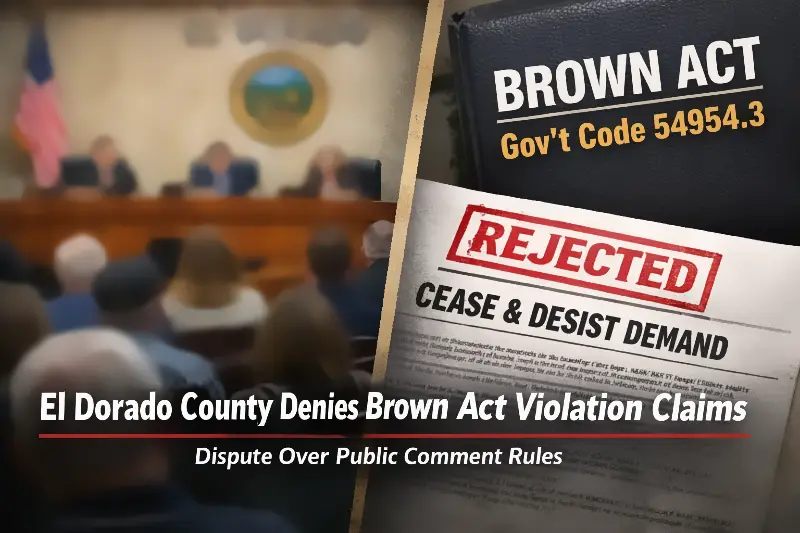
El Dorado County Rejects Brown Act Violation Claim Over Public Comment Procedure
PLACERVILLE — A dispute over how the El Dorado County Board of Supervisors structures public comment during meetings has escalated, with county officials formally rejecting allegations that the board violated California’s open meetings law.
In a Feb. 13 letter sent via email, David A. Livingston, county counsel for El Dorado County, responded to a Jan. 16 “cure or correct / cease and desist” demand from Lee Tannenbaum of the Taxpayers Association of El Dorado County.


The association alleges the board violated the Ralph M. Brown Act when it voted Nov. 18, 2025, to consolidate public comment on most agenda items. According to board minutes cited in the county’s response,
“Public comment for all Agenda items (excluding Public Hearings) will be taken following consideration of the Consent Calendar.”
The Brown Act, codified in Government Code section 54954.3(a)(1), requires that agendas provide an opportunity for the public to address the legislative body “before or during the legislative body’s consideration of the item.”
In his response, Livingston wrote that the law also permits local legislative bodies to adopt “reasonable regulations” governing how public comment is received.
“While that section requires a legislative body to provide an opportunity for public comment ‘before or during the legislative body’s consideration of the item,’ it also recognizes that the legislative body can adopt reasonable regulations concerning that opportunity,”
Livingston stated in the letter.
The demand under Government Code section 54960.2 seeks a formal commitment from the board to cease and desist from alleged ongoing violations before litigation may proceed. That section requires such notice prior to filing an action to determine the applicability of the Brown Act to past actions.
The central issue is whether consolidating comment on non-hearing agenda items — rather than taking comment immediately before each item — satisfies the statutory requirement that the public be allowed to speak “before or during” consideration.
The county’s position is that the revised procedure complies with state law because the opportunity to address items remains available prior to final board action. The Taxpayers Association contends the change may limit meaningful participation by disconnecting comment from individual agenda discussions.
The matter could carry implications for how local governments across California structure meetings amid ongoing debates about transparency, efficiency and public engagement.
As of this week, no lawsuit had been filed in El Dorado County Superior Court. It remains unclear whether the Taxpayers Association will pursue further legal action.
See original complaint here: http://inedc.com/24/government/el-dorado-county-petition-seeks-reversal-of-new-public-comment-rules-at-board-of-supervisors-meetings