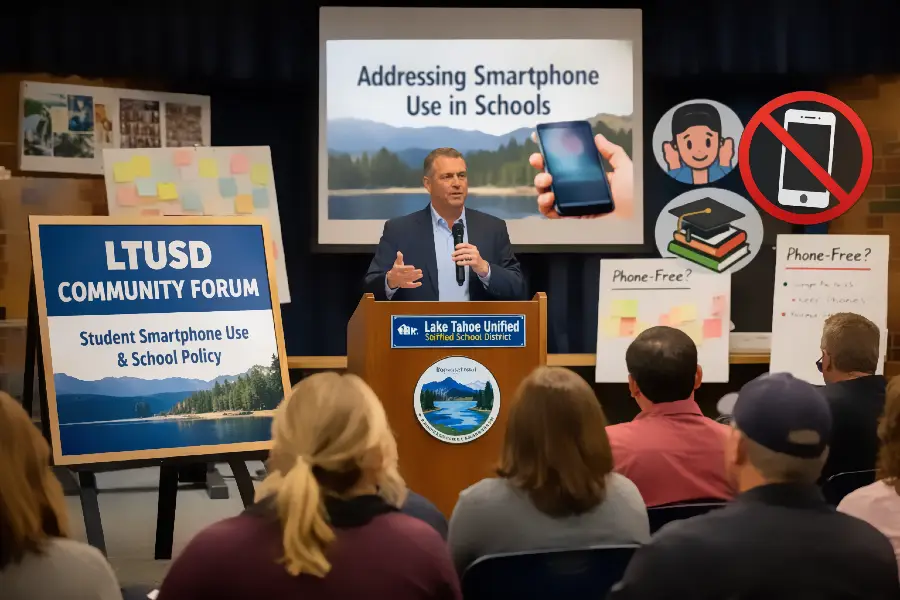
SOUTH LAKE TAHOE, Calif. — The Lake Tahoe Unified School District convened more than 65 parents, students, educators and community members Jan. 20 for a Community Conversation on student smartphone use, signaling potential changes ahead for campus policies.
The evening forum, held in South Lake Tahoe, included representatives from the Superintendent’s Student Advisory Committee and district leadership. Superintendent Dr. Todd Cutler opened the meeting by acknowledging what he described as growing academic and social challenges linked to smartphones in schools.


“The purpose of tonight is to listen and learn,” Cutler told attendees, emphasizing that the district has not predetermined an outcome. “We want to gather ideas and perspectives before considering any next steps.”
Research and Rising Concerns
Cutler referenced research highlighted in The Anxious Generation by Jonathan Haidt, noting that around 2010 — when smartphones became widely adopted among adolescents — reported rates of anxiety and depression began climbing significantly nationwide. He shared the view that while adults often overprotect children in the physical world, they may be underprotective in the digital one.
Schools, he suggested, may need to explore phone-free environments to better support academic engagement and student well-being.
Community Feedback: Divided but Engaged
Participants first met in small groups to discuss classroom experiences and broader concerns. Common themes included declining student engagement, increased distraction, reduced social awareness, the influence of artificial intelligence tools on academic integrity, and amplified bullying and peer pressure through social media platforms.
Parents of younger children voiced concern about feeling pressured to provide smartphones because devices are normalized among peers, even when they would prefer to delay access.
When invited to align with a general viewpoint, 35 attendees supported removing phones from schools entirely, 20 favored allowing phones to remain, and seven remained undecided.
Operational and Logistical Questions
Attendees raised practical questions about how any policy might work at South Tahoe High School, including storage options, check-in and check-out procedures, and managing early release or tardy students. Others questioned how students would decompress between classes without phone access and how rules could be enforced without placing the burden solely on teachers.
There was broad agreement that any change must be clearly communicated, consistently enforced and supported by administration rather than classroom educators acting as “phone policy babysitters.”
Age-Appropriate Expectations
Many participants supported differentiated rules by grade level:
-
Elementary school: No phones except for documented health or safety needs.
-
Middle school: Restricted access during the school day, potentially allowing basic phones or watches.
-
High school: Structured smartphone use with possible locked pouches or secure storage during instructional time.
Several attendees said students should wait until at least eighth grade before receiving smartphones.
Student Well-Being and Academic Integrity
Beyond logistics, much of the conversation focused on healthy digital habits and mental health. Participants called for ongoing digital literacy curriculum, expanded mental health education and structured student check-ins to strengthen peer connections.
Attendees also cited research suggesting that students often report improved focus, peer interaction and overall happiness after reduced smartphone use.
Strong support emerged for a consistent, districtwide policy with clearly defined expectations and leveled consequences administered by school leadership to protect instructional time and academic integrity.
Parent and Community Role
Community members stressed that digital responsibility must begin at home and urged the district to provide parent education on monitoring tools and apps. They also highlighted the importance of emergency protocols, noting that first responders expect students to remain off phones during emergencies and follow official directions.
Among the tools discussed were Yondr-style locked pouches — estimated at $12 to $20 per student — secure storage systems, and strengthened communication through district platforms such as ParentSquare and Aeries. Participants suggested exploring grants or fundraising to offset implementation costs.
Next Steps
Cutler concluded by thanking attendees for their input and reaffirming the district’s commitment to research and community engagement.
LTUSD has formed a Superintendent Student Smartphone Use Advisory Committee to gather additional feedback and review best practices from other districts before proposing any policy revisions. District officials said any future decisions will prioritize student learning, mental health, safety and family partnership.