The Road They Built by Hand: The Remarkable Story of the Mormon Emigrant Trail
In the summer of 1848, long before asphalt highways sliced through the Sierra Nevada and decades before steam-powered excavation equipment became common in the American West, a small band of exhausted pioneers accomplished something that still seems nearly impossible today.
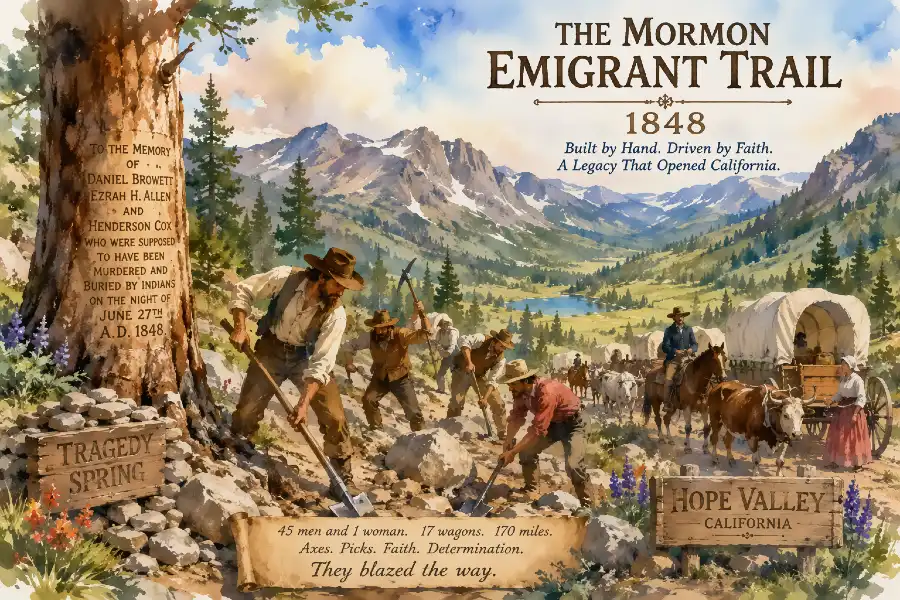
Using little more than axes, crowbars, ropes, picks, shovels, and brute determination, roughly 45 men and one woman carved a 170-mile wagon route across some of the harshest granite wilderness in North America. Their work became known as the Mormon Emigrant Trail — the first practical east-west wagon road into Northern California.

Today, much of that route still winds through El Dorado County under the name Mormon Emigrant Trail Road, connecting Pollock Pines to Highway 88 through the Eldorado National Forest. Travelers speeding through the pines often have little idea they are driving across a corridor hacked by hand through solid granite during one of the most transformative moments in California history.
From Soldiers to Trail Builders
The men who built the trail were veterans of the Mexican-American War and former members of the Mormon Battalion, a volunteer unit organized by members of The Church of Jesus Christ of Latter-day Saints.
After marching thousands of miles to Southern California during the war, many of the battalion veterans remained in California in 1847 at the request of church leaders to earn money and gather supplies for families preparing to settle in the Salt Lake Valley.
More than 100 of the former soldiers found employment working for pioneer entrepreneur John Sutter. Several worked directly on the construction of Sutter’s Mill near present-day Coloma.
That placed them at the center of one of the most consequential discoveries in American history.
On Jan. 24, 1848, James W. Marshall found flakes of gold in the American River while constructing the sawmill. Some Mormon Battalion veterans were eyewitnesses to the discovery that ignited the California Gold Rush.
Yet despite witnessing fortunes being pulled from the rivers around them, many chose to leave.
“The people are coming from all quarters … some making their hundreds daily,” Mormon Battalion veteran Henry W. Bigler wrote in his journal. “It is a striking contrast to our present situation, but we have made up our minds to leave.”
That decision would alter California forever.
Building a Road Through Wilderness
By April 1848, Mormon leaders in California determined the existing Donner Pass route was too dangerous for their heavily loaded wagons and livestock. Instead, they proposed an entirely new route south of the old emigrant crossing.
The expedition departed from Pleasant Valley near present-day Placerville in June 1848.
Their caravan included:
- 45 men and one woman, Melissa Coray
- 17 heavily loaded wagons
- Hundreds of cattle
- Approximately 150 horses and mules
- Seeds, blacksmith equipment, tools, and provisions for settlement in Utah
Scout Jason Calvin Sly guided the company eastward into the Sierra.
Their first major encampment on July 4, 1848, became known as Sly Park, now a familiar recreation area for residents of El Dorado County.
What followed was less a journey than a prolonged engineering battle against the mountains themselves.
The pioneers encountered towering granite shelves, dense timber, boggy meadows, steep ravines, and near-vertical climbs. Unlike later emigrants, they had no established wagon track to follow. Every mile had to be created from scratch.
Daily journal entries describe crews felling massive trees, levering boulders out of the roadbed, and laying corduroy roads made of heavy logs across marshlands.
In some places, the terrain became so steep the men rigged rope-and-pulley systems to hoist loaded wagons up rocky escarpments by hand.
Without explosives or mechanized tools, they advanced only inches at a time.
Tragedy in the High Sierra
The trail’s construction was marked by one of the darkest episodes in Sierra emigrant history.
On June 27, 1848, three advance scouts — Daniel Browett, Ezra H. Allen, and Henderson Cox — disappeared while searching for a workable route through the mountains.
Weeks later, near a cold alpine spring east of present-day Silver Lake, the main wagon company made a grim discovery.
Bigler recorded the scene in his diary:
“Yesterday we trailed about eight miles when we came to the place where the Brethren were supposed to have been killed and thrown into that hole, and covered with dirt … We call the place Tragedy Spring.”
The men found the bodies buried in a shallow pit littered with arrows. The pioneers reburied their companions beneath a stone cairn and memorialized them by carving their names into a nearby fir tree.
Part of that historic “Tragedy Spring Tree” survives today at Marshall Gold Discovery State Historic Park.
The exact circumstances surrounding the killings remain historically debated. Contemporary records attributed the attack to Native Americans, though historians caution that many frontier-era accounts were incomplete and reflected the tensions and misunderstandings of the period.
The spring itself still bears the name Tragedy Spring.
The Birth of Hope Valley
After crossing the brutal granite heights near Carson Pass, the exhausted pioneers descended into a broad alpine meadow ringed by peaks and watered by the Carson River.
According to diary accounts, the sight lifted the morale of the battered emigrants, who believed they might finally survive the crossing.
The valley became known as Hope Valley — a name it still carries today.
For the trail builders, the emotional shift was profound. Their journals transition from grief and exhaustion to cautious optimism as the company moved eastward toward Utah.
Nineteen-year-old Azariah Smith, one of the men who had witnessed the original gold discovery at Sutter’s Mill, abandoned the gold fields to help complete the crossing and reunite with family and fellow Saints in the Salt Lake Valley.
Their choice reflected a remarkable sacrifice at a moment when California gold fever was beginning to grip the world.
The Road That Opened California
Ironically, the Mormon pioneers built the trail not to enter California — but to leave it.
Within months of their departure, news of gold discoveries spread globally. By 1849, the California Gold Rush exploded into one of the largest human migrations in American history.
The Mormon Emigrant Trail immediately became the preferred route into Northern California.
Historians estimate that within only a few years, roughly 50,000 wagons and more than 200,000 emigrants traveled the corridor first cut by the Mormon Battalion veterans.
By 1854, the route had transformed into a bustling emigrant highway lined with trading posts, blacksmith shops, livestock stations, inns, and supply depots.
What began as a desperate hand-built escape route became one of the most important transportation arteries in early California history.
A Living Piece of El Dorado County History
Today, portions of the original trail remain remarkably intact throughout El Dorado County.
Travelers can still follow sections of the old emigrant road through Pollock Pines, Sly Park, Iron Mountain, Caples Lake, Carson Pass, and Hope Valley.
For local historians, hikers, off-road enthusiasts, and descendants of pioneer families, the Mormon Emigrant Trail remains more than a scenic mountain road. It is a surviving monument to endurance, sacrifice, engineering ingenuity, and the violent complexity of California’s frontier era.
Modern drivers can cross the Sierra in a matter of hours with heated seats, GPS navigation, and paved highways.
In 1848, it took a month of relentless labor simply to make passage possible.