Located along Benham Street — once called Oregon Ravine — Placerville’s Chinatown stretched downhill toward Pacific Street, Sacramento Street, and the area where the modern post office stands today. During the late 1800s, it became a bustling commercial and cultural district serving thousands of Chinese immigrants who arrived in El Dorado County seeking opportunity during and after the Gold Rush.
Historical records and oral histories describe a densely populated neighborhood filled with Chinese-owned merchant stores, laundries, blacksmith shops, and boarding houses. While a handful of successful merchants constructed buildings of brick and stone, most structures were made of wood, leaving the district especially vulnerable to fire.
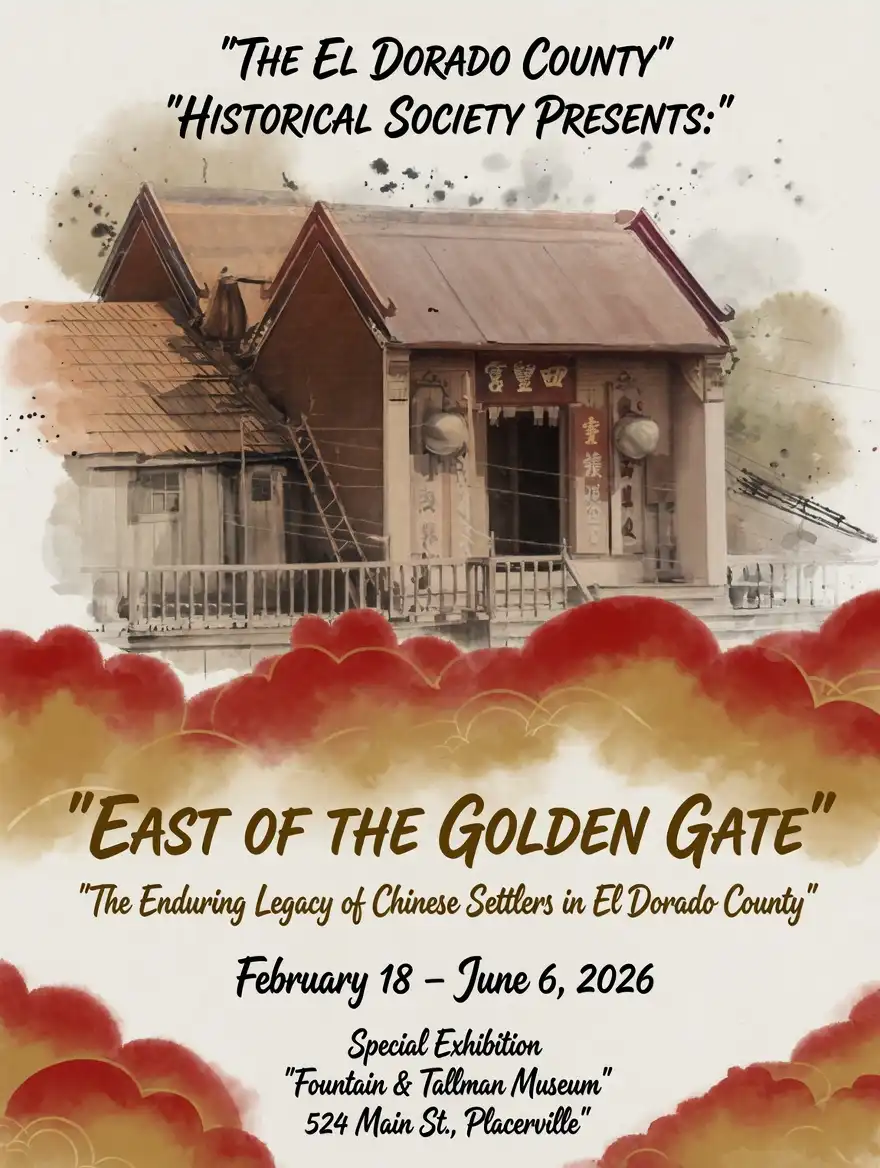
At the center of the community stood the Placerville Chinese Temple, often referred to as the Joss House. Built in 1872 near Pacific and Goldner streets, the temple served not only as a religious sanctuary but also as a civic and social gathering place for local Chinese residents. The structure was eventually razed in 1921.
The district suffered repeated setbacks during a period marked by rising anti-Chinese hostility across California. One of the most devastating moments came in January 1886, when a major fire destroyed much of Chinatown. Historical accounts widely attribute the blaze to arson amid the climate of discrimination surrounding the era of the Chinese Exclusion Act.
“Many of these items are connected to Placerville’s former Chinatown, where only one original building remains today,” organizers said in announcing the exhibit’s extension.
That surviving structure is the historic Stone House at 847 Pacific Street, believed to date back to around 1865. Historians recognize it as the last remaining structural remnant of Placerville’s Gold Rush-era Chinese community.
As economic pressures, exclusionary laws, and social discrimination forced many Chinese residents from the area, the neighborhood gradually disappeared. Over time, the city transformed the ravine into what is now Benham Park.
Today, the exhibit at the Fountain & Tallman Museum seeks to reconnect residents with that lost landscape. Visitors can view rare artifacts, historic photographs, and personal narratives on loan from the El Dorado County Historical Museum, many tied directly to Placerville’s Victorian-era Chinatown. The exhibit also highlights the county’s once-vibrant Chinese New Year celebrations that continued long after the Gold Rush faded.
Local historians say the exhibit offers an important opportunity for reflection.
For decades, Placerville’s Chinatown existed largely in fragments — scattered photographs, fading newspaper references, and memories passed quietly between generations. The exhibit assembles those pieces into a fuller portrait of a community that helped build the economic backbone of early El Dorado County while enduring exclusion and erasure.
In recent years, communities across California have renewed efforts to preserve and interpret Chinese-American history connected to the Gold Rush era. Placerville’s renewed focus reflects a broader recognition that the county’s history cannot be fully told without acknowledging the immigrants who helped shape it.
The Fountain & Tallman Museum is located on Main Street in downtown Placerville. The museum periodically partners with local historians to offer walking tours exploring the “Lost Chinatowns of El Dorado County,” guiding visitors through the geographic footprint of the former neighborhood.
For many local residents, the exhibit answers a surprising question:
Yes — Placerville once had a Chinatown.
And traces of it are still here.
- Custom Group Tours: You can book private, docent-led tours of Historic Main Street by calling (530) 626-0773. Phone lines are open Wednesday through Sunday between 11:00 AM and 4:00 PM. These tours can be scheduled for any day or time based on guide availability. They usually begin at the Fountain & Tallman Museum (524 Main St) and last 60 to 90 minutes. While technically free, there is a suggested donation of $2 per adult or $5 per family to support the museum.
- Private & Research Requests: You can also email the society directly at contact@edchs.org to request specialty or educational group tours.
- Special Event Calendar: The EDCHS runs a popular ticketed Saturday morning tour series throughout the year. While the specific Lost Chinatowns event has already concluded for the season, you can check for upcoming seasonal walks (such as the Gold Star Veterans of Placerville’s Union Cemetery tour or autumn cemetery walks) and buy tickets online directly through the El Dorado County Historical Society Events Page.


- Fountain & Tallman Museum: Drop by the museum at 524 Main Street during their open hours (Thursday through Sunday, 12:00 PM to 4:00 PM) to pick up a free physical map and pamphlet for the Self-Guided Placerville Main Street Walking Tour.
- Online Resources: The Walk Old Hangtown Project provides online resources and map details for exploring public art, historic gardens, and points of interest across downtown independently.