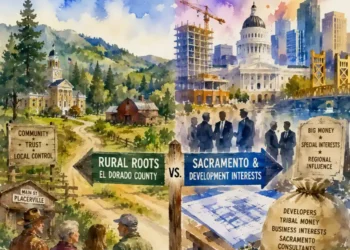



Across the four campaigns in this El Dorado County supervisor field — Gaines, Posey, Clark, and Deitz — a coherent political map emerges that is less about individual candidates and more about competing governing coalitions. The finance records function like a diagnostic: they show who believes power is shifting, who is trying to preserve influence, and which institutional blocs are aligning behind each candidate.
At the highest structural level, the race splits into three recognizable funding ecosystems: an establishment development–business coalition, a grassroots/local-reliant network, and a hybrid professional-policy network that draws from Sacramento and statewide institutional actors.
Gaines for Supervisor 2026:
The campaign finance filings for Ted Gaines reveal the most institutionally connected and professionally financed operation among the major supervisor campaigns examined so far. The records show a campaign backed by business executives, developers, PACs, lobbyists, consultants, insurance interests, and established Republican political networks — combined with an unusually sophisticated expenditure structure for a county supervisor race.
The committee, “Gaines for Supervisor 2026,” bears the hallmarks of a seasoned statewide political operation rather than a purely local grassroots campaign. The filings show large maximum-level donations, coordinated late independent-style funding pushes, professional consulting expenditures, targeted voter-guide advertising, and sustained payments to Sacramento-area political firms.
The dominant financial story in the filings is the extraordinary concentration of high-dollar donors tied to development, senior housing, insurance, lobbying, engineering, and corporate management.
Among the largest contributors were members of the Gallaher Companies and Oakmont Senior Living network:
- William Gallaher — $5,900
- Cynthia Gallaher — $5,900
- Will Gallaher — $5,900
- Molly Flater — $5,900
- Scott Flater — $5,900
Collectively, that cluster alone contributed roughly $29,500, all arriving in a coordinated burst at the end of March through both standard filings and late 497 reports. Politically, coordinated maximum-level donations from a connected executive network are often interpreted as a signal that influential regional business interests view a candidate as strategically important.
The filings also show support from major business and political interests connected to construction, engineering, labor, insurance, and waste management:
- Doug Veerkamp — $2,000 total
- Laborers Local 185 PAC — $1,000
- Ron Mittelstaedt — $1,000
- Personal Insurance Federation of CA Agents & Employees PAC — $1,000
- Stuart Casillas — $2,500
- Charles Demmon — $2,000
- High Hill Ranch LLC — $2,500
This donor composition strongly suggests Gaines consolidated support from what might broadly be described as the county’s “institutional growth coalition”: engineering, land-use, insurance, labor, business lobbying, and regional development interests.
The presence of both business PACs and organized labor is particularly significant. In county politics, labor and development interests do not always align. Gaines appears to have assembled a coalition broad enough to attract both establishment Republican business donors and at least portions of organized labor infrastructure.
Another revealing element is the campaign’s professional consulting ecosystem. Significant expenditures flowed to:
- Capital Development Strategies
- Gilliard, Blanning, & Associates, Inc.
- Integrated Solution:Political
- The KAL Group, Inc.
- Capitol Tech Solutions
Those expenditures point to a campaign run with experienced statewide political infrastructure rather than volunteer management alone. The spending pattern resembles legislative or congressional campaign mechanics more than a typical foothill supervisor race.
The campaign also invested heavily in slate mailers and targeted voter guides — classic California professional-politics tactics. Payments were made to:
- California Voter Guide
- Budget Watchdogs
- Senior Advocates
- COPS Voter Guide
- No Party Preference Voter Guide
- Asian American Pacific Islander Voter Guide
That strategy indicates a highly targeted turnout and persuasion campaign designed to reach segmented voting blocs across demographics and ideological categories.
Locally, the filings show support from politically connected El Dorado County figures and business leaders, including:
- Robert Reeb
- Todd White
- Marc Strauch
- Art Marinaccio
- Heather Masten
Politically, the filings portray Gaines as the establishment Republican and institutional-business candidate in the race. The money network surrounding the campaign extends far beyond El Dorado County into Sacramento, Sonoma County, Bay Area executive circles, statewide lobbying infrastructure, and corporate leadership networks.
At the same time, the campaign maintained visible local foothill support and leveraged Gaines’ longstanding political identity in El Dorado County. The combination of local Republican infrastructure, statewide donor access, labor outreach, business interests, and professional consultants created a fundraising machine substantially larger and more sophisticated than the more grassroots-oriented campaigns in the field.
The filings do not indicate wrongdoing or improper influence. Campaign disclosure laws exist so voters can examine who finances candidates and draw their own conclusions regarding political alliances, institutional backing, and the interests surrounding a campaign.
Greg Clark for Board of Supervisors 2026
The campaign finance filings for Greg Clark reveal a coalition strikingly different from many traditional El Dorado County supervisor campaigns. The records show a hybrid political network built from progressive foothill activists, Sacramento-area professionals, legal-sector donors, public employees, and rural community supporters rather than large developer or construction interests.
Unlike campaigns heavily financed through candidate loans or major business donors, the “Greg Clark for Board of Supervisors 2026” filings show a broader donor spread with mid-level contributions clustered around attorneys, state workers, consultants, retirees, and civic activists. The campaign appears structured more like an issue-oriented political movement than a conventional establishment county operation.
One of the campaign’s most politically notable contributions came from sitting Supervisor Lori Parlin, who donated $2,500 on Feb. 20 — the single largest monetary contribution disclosed in the filings. That donation signals an important political alignment inside El Dorado County government and suggests Clark’s candidacy was viewed favorably by Parlin’s political network and policy allies.
Another standout donor was Laura Jensen, whose combined contribution totaled $2,083.96 through both a standard filing and a late 497 filing. Additional high-dollar contributors included:
- Richard Weiss — $1,000
- Arnie Chandola — $1,041.98
- Costen Hickman — $1,041.98
The campaign also leaned heavily on nonmonetary support. The largest in-kind contribution came from Nathan Ferris with $1,600 in nonmonetary assistance, supplemented by additional direct contributions. Other in-kind contributors included:
- Nanci’s Screen Printing
- Howard Penn
- Sam Parlin
Geographically, Clark’s donor base extends well beyond El Dorado County. The filings contain substantial support from Sacramento, Oakland, San Francisco, Sunnyvale, Pasadena, Lafayette, Carmichael, Fair Oaks, and other urban or suburban California communities. That distinguishes Clark’s committee from campaigns financed primarily through local retiree networks or foothill business circles.
Professionally, the donor list is especially revealing. Attorneys, consultants, psychologists, state workers, executives, and nonprofit-adjacent professionals appear repeatedly throughout the filings. Examples include:
- Adam Bier
- John Glowacki
- George Chikovani
- Brian Augusta
- Andy Langdon
- David Koenig
That profile suggests Clark’s support network may have resonated more strongly with policy-oriented, professional-class, and civically engaged Democratic or center-left constituencies than with traditional rural conservative blocs.
The expenditure reports reinforce the image of a modest but organized grassroots campaign. Spending focused primarily on:
- campaign literature and printing
- election filing fees
- community venue rentals
- digital fundraising infrastructure through ActBlue
- local event outreach and civic gatherings
Payments to local venues and organizations such as the Pilot Hill Grange and the Shingle Springs Community Center indicate a field-oriented campaign emphasizing local organizing rather than expensive media operations.
Politically, the filings position Clark in a distinct lane within El Dorado County politics. Whereas some candidates relied on rural populist rhetoric paired with local business donors, Clark’s committee appears tied to a coalition of progressive activists, government professionals, legal-sector donors, and civic-engagement networks. The presence of ActBlue expenditures further signals alignment with Democratic-style digital fundraising infrastructure uncommon in more conservative county campaigns.
At the same time, Clark maintained meaningful foothill support from Coloma, Placerville, Pilot Hill, Camino, Shingle Springs, and Lotus contributors, showing the campaign was not purely Sacramento-driven. Instead, the records suggest an attempt to bridge rural foothill activism with broader regional progressive networks.
The filings do not indicate wrongdoing or improper influence. Campaign disclosure laws exist so voters can evaluate who finances candidates and draw their own conclusions about the political alliances and interests surrounding a campaign.
Gina Posey Supervisor – 2026
The campaign finance filings for Gina Posey reveal a hyper-local grassroots campaign built on retired residents, community networks, self-funding, and small-business support — but one that also depended heavily on candidate loans and a small circle of repeat donors.
The committee, officially listed as “Committee to Elect Gina Posey Supervisor – 2026,” shows a fundraising structure dramatically different from more development-oriented county campaigns. Rather than large-scale institutional money or major real-estate interests dominating the filings, Posey’s reports reflect a neighborhood-style operation powered by foothill residents, retired supporters, and local event-based organizing.
The single largest source of financing was Posey herself. The filings show at least $11,000 in loans from Gina Posey to her own campaign, including multiple $2,000 loans in June 2025 and another $5,000 loan in February 2026. That level of self-financing indicates the campaign relied substantially on personal capital to stay operational during early organizing and outreach phases.
The largest outside donor was Monte Osborne, owner of A-Total Fire Protection Co. Osborne contributed a combined $4,785.37 through multiple donations between February and May 2026, including a late-election 497 filing. That made him the campaign’s most significant non-family financial backer.
Another dominant figure in the filings was Judith Spaletta, who repeatedly contributed throughout the campaign cycle. Her donations totaled roughly $4,050, including several late 497 contributions. Spaletta emerges in the records as one of the campaign’s core financial loyalists rather than a one-time donor.
Family support also played a major role. Michael Posey contributed at least $5,020 over the course of the campaign, including multiple $1,000 donations and a $3,000 contribution in February 2026. That pattern suggests the campaign functioned partly as a family-backed political effort supplemented by community fundraising.
Politically, the donor map is notable for what it lacks. Unlike many El Dorado County races, the filings contain relatively little evidence of large-scale developer financing, Sacramento political money, labor PAC activity, or major corporate involvement. Instead, the reports are saturated with retirees, self-employed residents, consultants, small business owners, and rural foothill contributors from communities such as Shingle Springs, Georgetown, Rescue, Garden Valley, Coloma, Placerville, and Pilot Hill.
Several recurring donor profiles reinforce that image:
- Ken Calhoun — realtor and repeat donor
- Liz and Bruce Drummond — consulting background
- Steven Payne — repeat retiree donor
- Nora Buhler — repeat rural foothill donor
- Fred Ott — repeat supporter
The campaign also leaned heavily on in-kind and nonmonetary support, another hallmark of low-budget grassroots operations. Donations included catering, event support, music, printing, signage, online services, baked goods, and hospitality contributions. Businesses and contributors providing nonmonetary support included:
- Moonraker Millhouse
- SPOT-ON Signs
- El Dorado Press
- goodparty.org
The expenditures show a campaign focused on direct voter contact and low-cost visibility rather than high-end consulting or media buys. Significant spending went toward:
- printing and literature production through The Clipper and El Dorado Press
- Facebook advertising
- election filing fees
- sticker and sign production
- shipping and mailing through FedEx
- website and digital services through Wix and Constant Contact
One especially revealing contribution came from the El Dorado County Chamber of Commerce, whose PAC contributed $500 late in the reporting period. While modest in size, that donation suggests Posey had at least some support from segments of the county’s organized business community despite running a campaign that otherwise appeared rooted in rural populist and retiree networks.
Overall, the filings portray a campaign operating more like a community coalition than a traditional county political machine. The money came primarily from personal relationships, repeat loyalists, retirees, and small local businesses rather than major institutional players. The tradeoff, however, was financial scale: the committee compensated for comparatively modest fundraising with substantial candidate loans and a reliance on volunteer-style, in-kind campaign support.
The records do not indicate wrongdoing or improper influence. Campaign disclosures exist so voters can examine who finances candidates and determine for themselves what interests, relationships, or community factions may stand behind a campaign.
Robert Deitz Supervisor 2026
The campaign finance filings for “Neighbors for Responsible Government – Robert Deitz Supervisor 2026” paint the picture of a small but determined rural campaign fueled by a blend of local donors, development-connected money, and candidate self-financing.
At the center of the filing is candidate Robert Deitz, whose committee relied heavily on a handful of larger contributors rather than broad grassroots fundraising. The campaign’s biggest single disclosed contribution came from Larry Abel, who gave $3,000 on April 4. Another notable donor was D.G. Granade, Inc. with $2,500.
The filings also show repeated contributions from Sacramento real estate consultant Michael Di Grazia, who contributed a combined $1,750 between March and April, including a late contribution filed just days before the election reporting deadline. Those late 497 filings are politically significant because they reveal who moved money into the campaign during the campaign’s closing stretch — often the period when donors believe a race is tightening or influence matters most.
The donor geography is revealing. While many contributors came from rural foothill communities such as Lotus, Pilot Hill, Cool, Placerville, and Diamond Springs, the filings also show financial participation from Sacramento-area business interests and out-of-county contributors. That mix undercuts the simplistic narrative that the campaign was funded solely by “local neighbors.” Instead, the records suggest an alliance between rural anti-growth sentiment and select business or property-rights interests aligned against establishment county leadership.
Several donors appear connected to land-use, construction, fuel, engineering, or real-estate sectors:
- Marc Strauch — petroleum business owner
- Steven Viani — civil engineering
- Michael Di Grazia — real estate consulting
- D.G. Granade, Inc. — construction/development
- Kelly Newby — industrial manufacturing executive
Politically, that coalition matters because El Dorado County supervisor races frequently revolve around growth policy, wildfire resilience, infrastructure expansion, and the rural-versus-suburban divide. Campaign filings often expose which factions believe a candidate will protect their economic or political interests once seated at the dais.
The filings also reveal a campaign operating on comparatively lean expenditures. Payments largely went toward printing through El Dorado Press, event-related expenses tied to the Placerville Elks Lodge, and small hardware purchases through Gold Country Ace Hardware. That spending pattern suggests a traditional ground campaign emphasizing mailers, local gatherings, and volunteer-style organizing rather than high-dollar media saturation.
Another notable detail is Deitz’s own financial involvement. The filings show $2,840.12 in loans from the candidate to his own committee in early March. Candidate self-funding is often interpreted as both commitment and necessity: commitment because the candidate is personally invested, necessity because outside fundraising may not yet be sufficient to sustain operations.
The repeated appearance of Lotus-area contributors is also politically meaningful. Lotus and the Coloma corridor have increasingly emerged as symbolic territory in county politics — communities where resistance to large-scale development, distrust of Sacramento influence, and concerns over rural identity frequently converge. Donors such as William Bacchi and the organization listed as Zmog reinforce that foothill political alignment.
In broader strategic terms, the filings suggest Deitz was positioning himself as a populist rural candidate while simultaneously attracting support from individuals and entities with direct economic interests in county policy. That duality is common in El Dorado County politics: campaigns often speak the language of preserving rural character while drawing financial backing from interests that depend on land-use decisions, infrastructure approvals, or economic expansion.
The documents do not establish wrongdoing or improper influence. Campaign contributions are legal and publicly disclosed precisely so voters can evaluate who is financially backing a candidate and decide for themselves what those alliances may represent.