
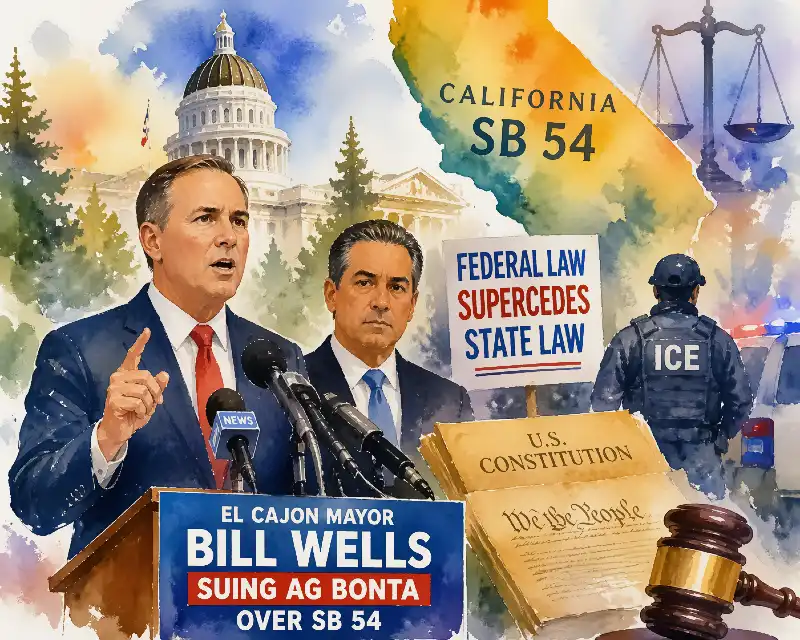
El Cajon Lawsuit Could Renew Immigration Debate Across California
Bill Wells is taking California’s sanctuary state law back to court, launching a lawsuit against Rob Bonta that is already drawing attention far beyond Southern California — including in more conservative inland counties such as El Dorado County.
Standing beside former Congressman Mike Garcia during a Wednesday press conference, Wells announced that the City of El Cajon and the America First Policy Institute filed suit challenging California Senate Bill 54, the state’s sanctuary law limiting cooperation between local law enforcement agencies and federal immigration authorities.


“This might be one of the most important days of my life,” Wells said during the announcement.
The lawsuit argues SB 54 conflicts with federal immigration law by restricting local police and sheriff’s departments from assisting U.S. Immigration and Customs Enforcement officers, commonly known as ICE.
What Is SB 54?
California became a sanctuary state in 2017 when former Gov. Jerry Brown signed Senate Bill 54 into law. Authored by then-Senate President Pro Tem Kevin de León, the law limits how state and local law enforcement agencies can cooperate with federal immigration enforcement operations.
Supporters say the law improves public safety by encouraging undocumented immigrants to report crimes and cooperate with police without fear of deportation.
Critics, including Wells, argue the law interferes with federal authority and hampers local agencies during investigations involving violent offenders, human trafficking and repeat criminal offenders.
At the center of the dispute is an exchange Wells says occurred with the California Department of Justice.
According to Wells, he asked whether local officers could conduct a welfare check involving a child allegedly being sex trafficked by an undocumented immigrant while coordinating with federal immigration authorities. Wells said the response from the Attorney General’s office was that such cooperation would violate SB 54.
“No workaround. No alternative. No explanation for how you’re supposed to save that child,” Wells wrote later on X. “That’s what California’s sanctuary law protects. Not the child. The trafficker.”
Attorney General’s Office Pushes Back
Bonta’s office forcefully rejected Wells’ claims Wednesday afternoon, defending SB 54 as constitutional and legally settled.
“El Cajon should prepare for another loss,” the Attorney General’s office said in a statement. “Anyone, regardless of immigration status, who commits a crime can be held accountable under California law. Period.”
The statement further described SB 54 as “a pro-public safety law” that encourages victims and witnesses to cooperate with law enforcement.
California courts previously upheld much of SB 54 after earlier legal challenges brought during President Donald Trump’s first administration.
Could Other Counties Follow?
The lawsuit is likely to resonate in counties where immigration enforcement and state oversight remain politically divisive issues.
In recent years, several rural and conservative-leaning California counties have openly challenged Sacramento over policies involving law enforcement, gun rights, land use and state mandates.
Although no similar lawsuit has been announced in El Dorado County, the legal arguments raised by Wells could attract attention from local elected officials and residents concerned about state control over local policing decisions.
Last year, the El Cajon City Council passed a resolution declaring its intent to comply with federal immigration law “to the fullest extent.” In March, city officials formally requested clarification from Bonta regarding whether California sanctuary laws conflict with federal statutes prohibiting the encouragement of unlawful residency.
Garcia said the case ultimately centers on constitutional authority.
“What takes precedence, federal or state law?” Garcia asked during the press conference.
Federal Legislation Also Emerging
The legal challenge comes as Congress debates the proposed Sanctuary Shutdown Act of 2026, H.R. 7640, introduced by California Congressman Tom McClintock.
The proposed legislation would penalize sanctuary jurisdictions and expand federal leverage over immigration enforcement cooperation.
For communities throughout California — including foothill counties like El Dorado — the outcome of the El Cajon lawsuit could shape future debates over local control, immigration enforcement and the balance of power between Sacramento and Washington.
Sources
- Public statements from El Cajon Mayor Bill Wells
- Statement from the California Attorney General’s Office
- California Senate Bill 54 text and legislative records
- America First Policy Institute press conference materials