Long before the roar of Highway 50 and the spread of suburban neighborhoods around modern-day Folsom, a lonely flat beside the South Fork of the American River became one of California’s first roaring Gold Rush settlements. Its beginning, according to a 1948 account published in The Sacramento Union, started with two hungry travelers, a deer carcass and a cooking pan.
The settlement was called Mormon Island — though it was never truly an island at all.


Located near present-day Folsom at the crossing of the South Fork of the American River, Mormon Island emerged in the chaotic months following the 1848 discovery of gold at Sutter’s Mill. The area rapidly became a magnet for fortune seekers after members of the Mormon Battalion and other migrants moving through the region uncovered placer deposits along the riverbanks.
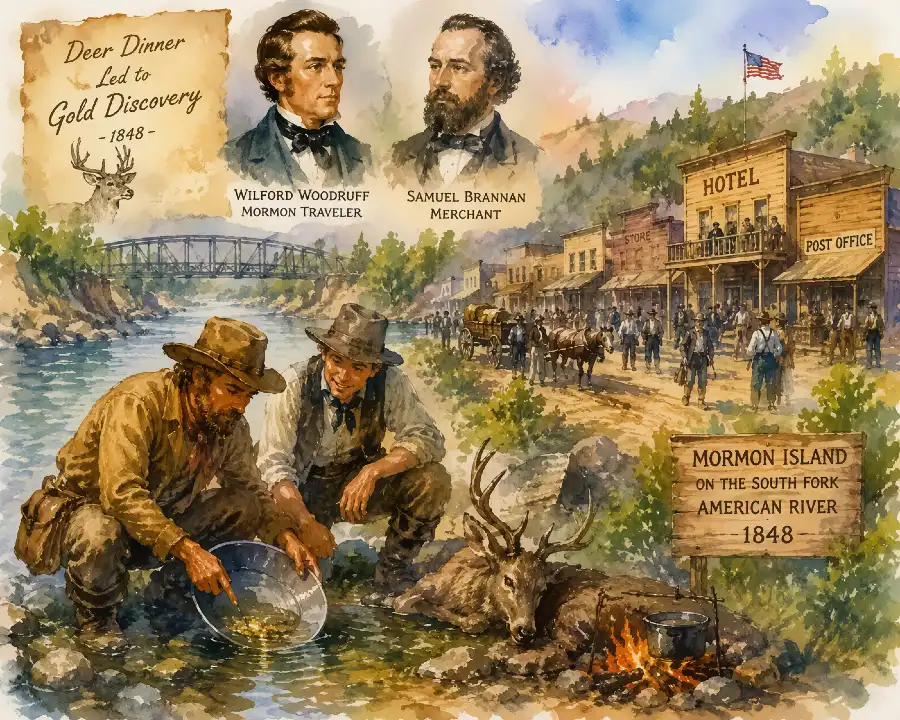
According to the June 20, 1948 edition of The Sacramento Union, two Mormon travelers — one identified as Wilford Woodruff — were journeying from Coloma toward Sutter’s Fort after investigating reports of gold in the foothills.
Unable to reach the fort before nightfall, the men stopped near the river and shot a deer for supper.
“It was still light when they had finished,” the newspaper recounted. “They conceived the idea that if there was gold further up the stream there might be some there.”
Using little more than a cooking pan, the men scraped soil from the riverbank and tested it in the water. Almost immediately, they realized they had found gold-bearing ground.
That simple act — more curiosity than calculated mining operation — helped launch one of the earliest Gold Rush boomtowns in the Sacramento region.
The travelers reportedly carried news of the discovery to merchant and entrepreneur Samuel Brannan at Sutter’s Fort. Brannan, already becoming one of California’s most influential businessmen, hurried to the site and attempted to establish control over the area by charging miners a percentage of their finds.
History would show the arrangement did not last.
Brannan’s proposed royalty system collapsed under the flood of incoming miners who poured into the American River basin during the Gold Rush. Still, the merchant profited enormously from mining supplies, equipment and commerce tied to the frenzy sweeping Northern California.
By 1853, Mormon Island had exploded into a bustling frontier community with an estimated population of 2,500 residents. Hotels, general stores, saloons and a post office lined the dusty settlement. Freight wagons rattled through town while miners worked the river gravels from dawn to dusk.
For a brief moment, Mormon Island rivaled nearby settlements in both population and economic activity.
Then, as happened across much of Gold Rush California, the riches began thinning out.
Mining declined. Residents drifted elsewhere. Businesses shuttered. Eventually, little remained beyond foundations, memories and historical references buried in old newspapers and pioneer accounts.
Today, much of the original Mormon Island site lies beneath the waters associated with the Folsom Lake reservoir system, created after the construction of Folsom Dam in the 1950s. During periods of severe drought, remnants of the old town — stone walls, foundations and cemetery markers — occasionally reappear from the receding shoreline like ghosts surfacing from California’s past.
For residents of El Dorado County, the story of Mormon Island remains more than a colorful campfire tale. It reflects the unpredictable nature of the Gold Rush itself: fortunes born in moments of chance, communities rising overnight, and entire towns disappearing almost as quickly as they came.
What began as
“good dinner and a little walking,”
as the old newspaper headline jokingly framed it, became part of the foundation story of Northern California.
And it all started with two tired men stopping beside a river before dark.