By Cris Alarcon, InEDC Writer. May 11, 2026
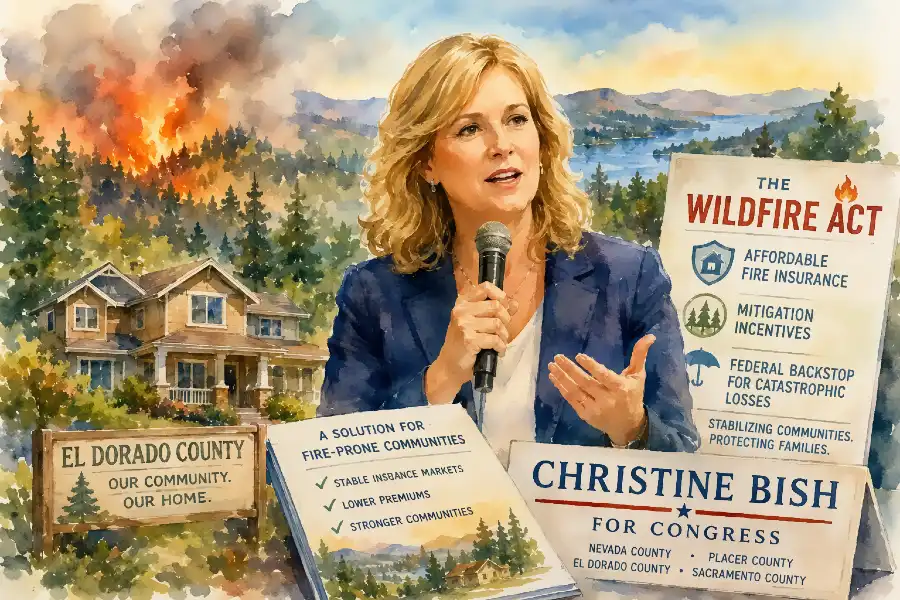
FAIR OAKS, Calif. — As wildfire insurance costs continue to climb across foothill and mountain communities in California, congressional candidate Christine Bish is proposing a federally backed insurance framework modeled after the nation’s flood insurance system.


Bish unveiled the proposal, called “The WILDFIRE Act,” during a candidates forum hosted by the Sacramento Republican Women Federated at Northridge Country Club in Fair Oaks on May 11.
The proposal comes as many residents in wildfire-prone areas of El Dorado County and neighboring foothill communities continue facing policy non-renewals, escalating premiums and limited coverage options through California’s FAIR Plan.
“I have modeled The Wildfire Act after the National Flood Insurance Program,”
Bish said in a statement released following the forum,
“with the intention for people living in communities prone to wildfire to be able to obtain fire insurance similarly to folks living in flood prone areas.”
According to Bish, the proposal would establish a federally administered National Wildfire Insurance Program jointly overseen by the U.S. Department of the Treasury and the Federal Emergency Management Agency. The framework would create baseline wildfire insurance coverage supported by a federal catastrophic reinsurance backstop that would activate only after private insurer and state-level thresholds are exceeded.
The proposal emphasizes a premium-funded structure rather than an unlimited federal guarantee. It also includes repayment mechanisms intended to recover federal expenditures over time.
Bish said the legislation is designed to encourage homeowners and communities to reduce wildfire risk through mitigation efforts such as defensible space, fire-resistant construction and vegetation management. Under the proposal, homeowners implementing verified mitigation measures could qualify for reduced premiums.
“I’ve already been talking to some sitting House members,”
Bish stated.
“They like it and I think we can get it passed through Congress if I’m elected.”
California’s Congressional District 3 includes Nevada County, eastern El Dorado County, South Lake Tahoe, portions of Placer County and much of Sacramento County — regions that have repeatedly faced destructive wildfire seasons over the last decade.
Communities including South Lake Tahoe, Placerville, Grass Valley and Truckee have seen growing concern over insurance availability as insurers reassess wildfire exposure throughout the Sierra Nevada foothills.
The proposal argues that continued instability in the insurance market affects more than homeowners alone. Mortgage lenders often require proof of comprehensive insurance coverage, meaning policy cancellations or unaffordable premiums can complicate home sales, refinancing efforts and long-term property values.
The WILDFIRE Act would roll out in phases under Bish’s proposal. Regulations and actuarial standards would be established within 180 days of enactment, followed by a pilot program within one year in designated high-risk wildfire regions, including California. Nationwide implementation would occur within three years, with a congressional review after five years.
The proposal also seeks to standardize wildfire risk assessments using data from FEMA, the U.S. Forest Service and state agencies. The framework would evaluate vegetation, fuel loads, topography, historical fire activity and local mitigation efforts when determining wildfire risk zones.
Bish, a Sacramento-based financial investigator, is campaigning as a fiscal conservative in the race for California’s 3rd Congressional District seat. Her campaign said she has received endorsements from the Howard Jarvis Taxpayers Association, California Taxpayer Protection Committee, California Parents Union and California Parents United.
Ballots for the June election must be returned by June 2.
Additional information regarding California’s FAIR Plan and wildfire insurance issues is available through the California Department of Insurance and the California FAIR Plan Association.