EL DORADO COUNTY HOMEOWNERS HAVE A NEW PLACE TO LOOK FOR WILDFIRE MONEY
EL DORADO COUNTY, Calif. — For many El Dorado County homeowners, the question isn’t whether their property needs wildfire mitigation.
It’s how much it’s going to cost — and who is going to help pay for it.


A new online resource launched by the Climate & Wildfire Institute is attempting to answer the second question.
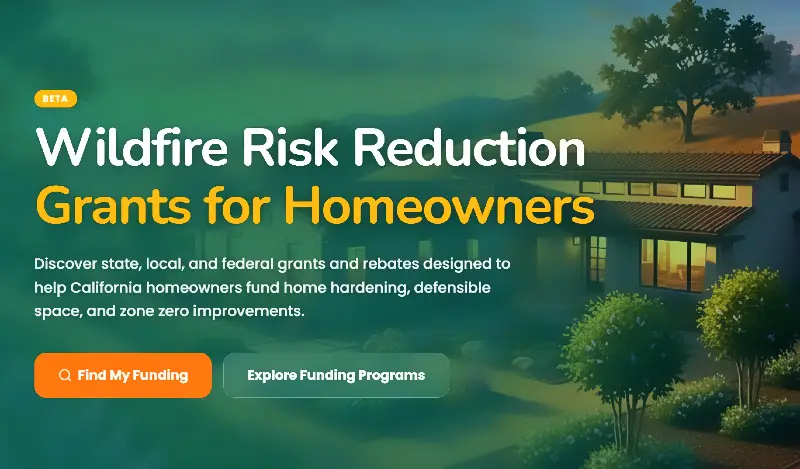
ResilientHomeFund.org is designed as a centralized clearinghouse for federal, state and local grants and rebates that may help California homeowners pay for wildfire home hardening, defensible space and Zone Zero improvements.
The Rural County Representatives of California announced the resource Sept. 18, describing it as a new tool to help homeowners locate available assistance.
For homeowners in El Dorado County — where fire preparedness can mean everything from vegetation removal to expensive structural improvements — the significance is straightforward:
There may be money available. Finding it has been the hard part.
ONE QUIZ, A LIST OF POTENTIAL PROGRAMS
The new website takes a different approach from the traditional grant search.
Instead of requiring homeowners to navigate a collection of federal, state and local government websites, ResilientHomeFund.org asks homeowners to complete a short eligibility quiz.
The system then generates a personalized list of programs for which the homeowner may be eligible. The site also allows users to browse funding opportunities by project category, including home hardening, vegetation management and Zone Zero work.
The site describes itself as a “centralized and evolving directory” intended to help California homeowners find and apply for wildfire and other climate-mitigation grants and rebates.
That distinction matters.
This isn’t a check from the government.
It isn’t an application approval.
And it isn’t a guarantee that a homeowner will receive funding.
It is a search tool designed to help homeowners find programs they might otherwise never discover.
THE FINE PRINT MATTERS
The Climate & Wildfire Institute specifically warns homeowners that grant information, eligibility requirements and funding availability can change.
The organization advises applicants to verify information directly with the agency administering a program before submitting an application.
That warning should not be treated as boilerplate.
Grant programs can have specific requirements involving income, location, property characteristics, project type, application deadlines and available funding. A homeowner who appears eligible through the search tool still has to meet the actual requirements of the program offering the money.
In other words, finding a grant is not the same thing as qualifying for one.
IT’S NOT JUST ABOUT WILDFIRE
Although wildfire mitigation is the primary focus, the database extends into other areas of property resilience.
RCRC said the resource includes programs where mitigation measures overlap with other natural disasters or resilience needs.
Potential projects can include:
- Native and drought-tolerant landscaping
- Wildfire home hardening
- Defensible-space improvements
- Zone Zero work
- Earthquake retrofitting
- Energy-efficiency improvements
That broader approach could be significant for El Dorado County property owners.
A homeowner doesn’t necessarily view a property improvement through the same categories used by government funding programs. Removing combustible vegetation, for example, may be part of a wildfire-prevention strategy while also reducing water use through drought-tolerant landscaping.
The new database attempts to connect homeowners with those overlapping funding opportunities.
THE COST OF PREPARING A HOME
Home hardening is often discussed as a matter of public safety.
For the individual homeowner, however, it is also a financial calculation.
Replacing vulnerable components of a home, improving defensible space, modifying landscaping and addressing areas around a structure where embers can accumulate can require significant expenditures.
That creates an obvious barrier: homeowners may understand the risk but lack the money to address it.
The Climate & Wildfire Institute identified that upfront cost as one of the barriers to getting homeowners to undertake resilience work.
In a recent review of California’s 2026 legislative session, CWI said reducing those financial barriers is important to increasing residential wildfire resilience. The organization also pointed to the state’s ongoing development of financing mechanisms for home hardening and noted that existing grants and rebates are available.
The Resilient Home Fund was launched in May as an effort to centralize information about those existing opportunities.
WHAT THIS MEANS FOR EL DORADO COUNTY
El Dorado County homeowners don’t have to wait for a disaster to start looking.
The new database allows property owners to investigate potential funding before beginning a mitigation project.
That could be particularly useful for homeowners who are already considering vegetation removal, landscaping changes, structural improvements or other measures designed to reduce wildfire exposure.
The search can begin at:
ResilientHomeFund.org — Wildfire Risk Reduction Grants
The website’s program directory is continually updated, and homeowners can also sign up for notifications about new funding opportunities.
The site includes an application tracker for users who complete its eligibility quiz, although homeowners should continue to confirm application status and requirements with the administering agency.
THE BOTTOM LINE
There is no single check waiting for every El Dorado County homeowner.
There is no guarantee that a particular property will qualify.
But there is now a single place to start looking.
For homeowners who have put off wildfire mitigation because of the cost, ResilientHomeFund.org may be worth five minutes of their time before they spend thousands of dollars of their own.
RCRC said additional information is available from Senior Policy Advocate Staci Heaton.
For El Dorado County residents, the practical question is no longer simply What does my home need to make it safer?
It can now also be:
Is somebody else willing to help pay for it?