
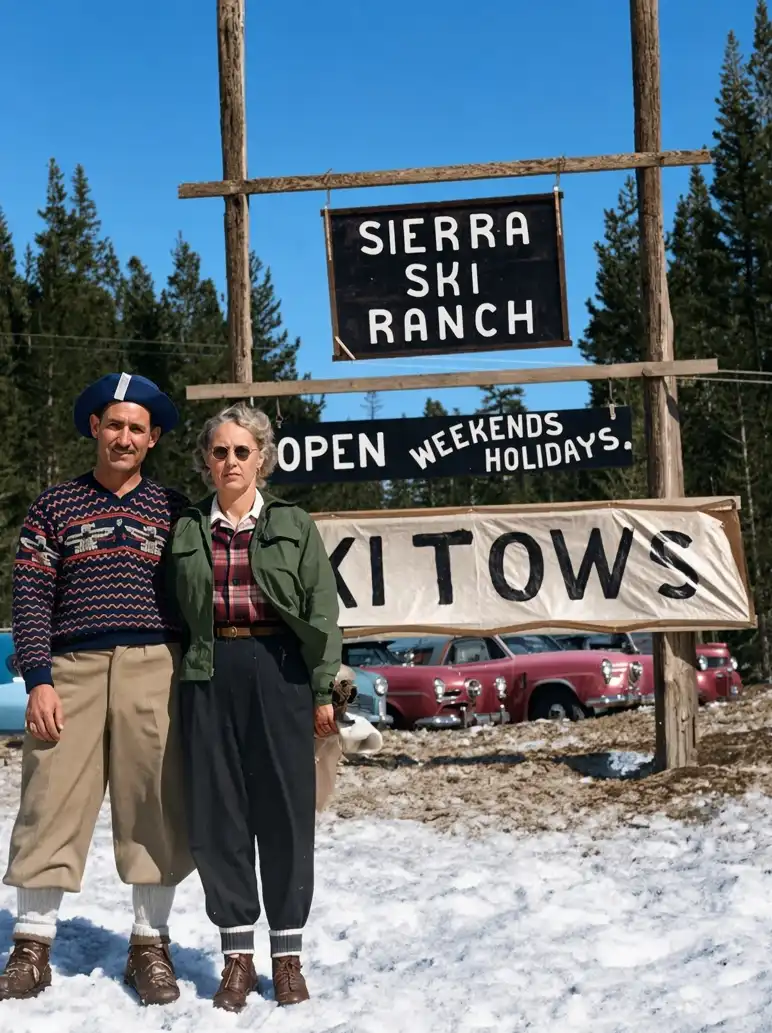
TWIN BRIDGES, Calif. — Before there was Sierra-at-Tahoe, there was Sierra Ski Ranch.
Before the high-speed chairlifts, terrain parks, snowmaking equipment and thousands of skiers streaming up Highway 50, there was a much simpler operation on the mountain: a rope tow, a Poma lift and two brothers who believed they had found a good place to ski.
That little operation began in 1946.


Eight decades later, Sierra-at-Tahoe is celebrating its 80th anniversary, and for El Dorado County, the milestone represents more than another anniversary at a Tahoe-area ski resort.
It is eight decades of local mountain history.
The resort sits along the Highway 50 corridor in eastern El Dorado County, just west of the Lake Tahoe Basin. For generations of county residents, it has been the mountain that can turn an ordinary winter weekend into a snow day without requiring a trip halfway across the state.
And its history is almost as familiar to old Highway 50 travelers as the road itself.
It started with a rope tow
In 1946, brothers Ray and Floyd Barrett opened Sierra Ski Ranch near Echo Summit.
The original operation was modest by today’s standards. There was a small base lodge, a rope tow and a Poma lift.
But the mountain had something far more important: snow.
The Barrett brothers had selected the area because of its reputation for heavy snowfall, laying the foundation for what would become a long-running part of El Dorado County’s winter recreation landscape.
The resort’s history describes those early years as the beginning of a story that would eventually span generations.
In 1953, longtime local Vern Sprock purchased Sierra Ski Ranch. The Sprock family would operate the resort for four decades.
Then came a change that would permanently alter the resort’s location.
Highway 50 helped move the mountain
In 1968, the resort moved to its present location after the California Department of Transportation widened U.S. Highway 50.
That move helped establish the resort as the mountain familiar to today’s Highway 50 travelers.
Sierra Ski Ranch eventually became Sierra-at-Tahoe after Fibreboard acquired the resort in 1993 and changed its name.
The mountain continued to grow.
Today, Sierra-at-Tahoe reports more than 2,000 acres of skiable terrain, 50 trails, 10 chairlifts and 2,212 feet of vertical terrain. The resort also includes beginner areas, terrain parks and expert terrain in Huckleberry Canyon.
The numbers are a long way from the rope tow that started it all.
But the basic attraction hasn’t changed much.
Get in the car, head east on Highway 50, find some snow and spend the day on the mountain.
Eighty years of memories
For its 80th anniversary, Sierra-at-Tahoe is looking beyond statistics and lift tickets.
The resort is asking skiers and snowboarders to share their Sierra memories as part of the anniversary celebration.
That makes sense for a mountain whose history is measured not merely in acres or vertical feet, but in generations.
There are the first-time skiers who discovered the mountain as children.
There are parents who taught their children to ski there and now bring grandchildren.
There are longtime locals who remember when the resort looked considerably different — and when a ski trip meant considerably more time riding a lift and considerably less time worrying about parking reservations.
Sierra-at-Tahoe’s anniversary campaign puts the emphasis on that shared history, describing the mountain as one that “raises you.”
For a resort that has survived ownership changes, changing technology, changing skiing habits and the inevitable evolution of the Highway 50 corridor, the anniversary is an opportunity to remember how it all began.
A new wrinkle for the anniversary season
There will also be something new for visitors to deal with before they reach the lifts.
Beginning with the 2026-27 season, Sierra-at-Tahoe is introducing a parking-reservation system on weekends and holiday periods.
The resort says reservations will be free for season passholders and vehicles carrying four or more people. Other visitors will pay $25 for a parking reservation, according to the resort’s published season information.
The change is aimed at addressing congestion and the challenges created by busy ski days.
For anyone living in El Dorado County, that means one more thing to consider before pointing the family car toward Twin Bridges on a powder Saturday.
Check the parking requirements before leaving home.
The resort says additional information about the reservation process will be released ahead of the season.
Eight decades, one familiar road
There is something particularly appropriate about celebrating Sierra-at-Tahoe’s history in El Dorado County.
The resort’s story is inseparable from the Highway 50 corridor.
For decades, the highway has carried residents and visitors through the foothills, past Placerville and Pollock Pines, through Strawberry and Twin Bridges and toward the Tahoe Basin.
Along the way, Sierra-at-Tahoe became one of the recognizable landmarks of that winter journey.
Its history is also part of the broader story of El Dorado County’s relationship with the Sierra.
The county has always had an unusual geographic identity. It stretches from Gold Rush communities and vineyards in the foothills to high-country forests and the crest of the Sierra Nevada.
Sierra-at-Tahoe occupies that upper-country end of the county — a place where the weather changes quickly, snow can close the road and a sunny morning in Placerville can become a full-blown winter day near Echo Summit.
For county residents, that’s not merely geography.
It’s home territory.
Preparing for another winter
Sierra-at-Tahoe has begun selling its 2026-27 season passes as it prepares for the anniversary season.
The resort’s published offerings include unlimited, weekday and other pass options, along with discounted programs for various age groups and qualifying visitors.
The resort also says certain 2025-26 season products remain valid into the beginning of the 2026-27 season under its rollover policies.
The mountain is currently in its summer offseason, with preparations underway for winter.
And when the snow finally returns, the resort will mark a milestone few local businesses can claim.
Eighty years.
From two brothers and a rope tow in 1946 to today’s sprawling ski area, Sierra-at-Tahoe has become woven into the history of El Dorado County’s eastern edge.
The lifts are faster now.
The mountain is bigger.
The traffic can certainly be worse.
And apparently, even parking now requires a little planning.
But the basic ritual remains remarkably unchanged.
When the snow falls, people still point their cars east on Highway 50.
They’re headed for the mountain.
Editor’s Note: Sierra-at-Tahoe’s published history, anniversary information, season-pass information and parking policies were reviewed for this article. Readers should consult the resort directly for current operating dates, weather conditions, parking requirements and other season-specific information.