A Family Photograph Opens a Window Into the Georgetown Divide’s Mining Past
EL DORADO COUNTY, Calif. — Local history
A photograph can preserve more than the faces of people who lived generations ago. Sometimes, it leaves behind a question that leads to a forgotten corner of local history.

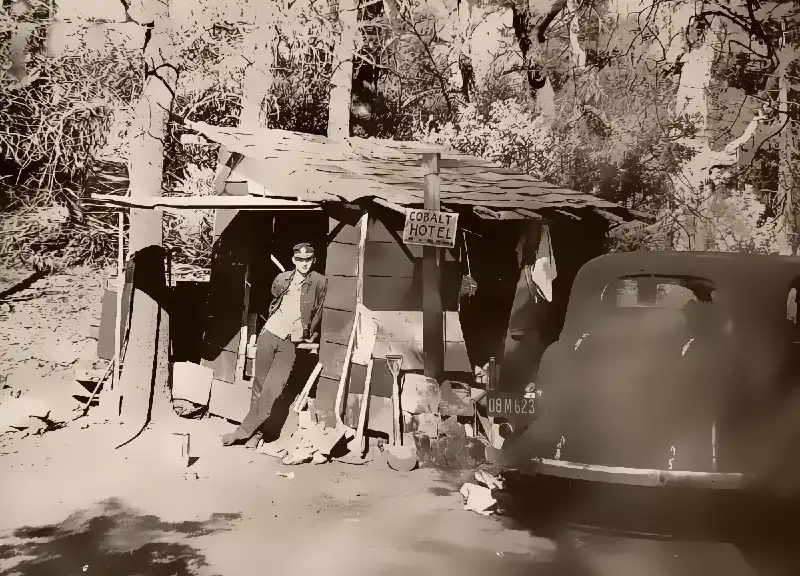
Chris Hammond has shared a family photograph believed to date to about 1936, showing his father standing in front of what Hammond identifies as his grandfather Rufus Hammonds’ “Cobalt Hotel” on the Georgetown Divide.
The image, Hammond says, represents part of a family story that reaches back to the early 20th century, when his grandfather was developing a mining property and its supporting infrastructure in California’s Gold Country.
Hammond also reports that his grandfather held a government contract for mineral specimens. That detail, if substantiated by historical records, could provide another connection between the Hammonds family and the region’s mineral wealth.
The precise date of the photograph, the location of the hotel and the details of the reported government contract remain subjects for further research.
A mining district with a long history
The setting Hammond describes lies within a region whose history is closely tied to California’s Gold Rush.
According to Gold Districts of California, a publication originally issued by the California Division of Mines and Geology in 1976, the Georgetown mining district occupies northwestern El Dorado County, extending from north of Garden Valley through Georgetown and the Georgia Slide area to the Middle Fork of the American River. Mining began there in 1849, and the district supported both placer and hard-rock, or lode, mining.
The district remained active well beyond the Gold Rush era. The Beebe and Alpine mines operated on a substantial scale during the 1930s, the same decade in which Hammond believes the family photograph was taken.
That context makes the family’s account historically plausible. It does not, however, establish that Rufus Hammonds worked at either mine or that the Cobalt Hotel was associated with a particular mining operation.
A property reportedly developed over decades
Hammond’s account places the beginning of his grandfather’s infrastructure development around 1910, roughly a quarter-century before the photograph was taken.
That timeline raises important historical questions. What infrastructure did Hammonds build? Was it associated with a mine, a hotel, access roads or another type of operation? And where exactly was the property located?
Mining ventures in the Georgetown district could involve more than extracting gold. They also depended on transportation, access to water, equipment, labor and facilities that allowed people to work in remote foothill locations.
The surviving documentary record shows that mining development continued across the Divide during the period Hammond describes. The California State Library’s Garden Valley Mining Properties Collection, 1934-1938, for example, contains correspondence, agreements, deeds, leases, lists and reports concerning mining properties near Garden Valley. Its records document efforts to develop the reopened Black Oak Mine and other properties during the 1930s.
The collection is a useful research lead for understanding the period, but there is no verified evidence presented here connecting Rufus Hammonds or the Cobalt Hotel to those specific properties.
The reported government contract
Perhaps the most intriguing detail in Hammond’s recollection is his statement that his grandfather held a government contract for mineral specimens.
Mineral specimens can serve scientific, educational and collection purposes, but the available information does not identify the contracting agency, the minerals involved, the terms of the agreement or the years in which the work occurred.
Those details matter. A government contract, if documented, could help establish Hammonds’ professional activities and the importance of the property beyond ordinary mining. It might also provide a paper trail through procurement records, correspondence, invoices or mineral collection inventories.
At present, the contract should be treated as a family-reported detail awaiting independent confirmation, not as an established fact.
Preserving a piece of El Dorado County history
The Georgetown Divide’s mining legacy is documented in geological surveys, historical collections and accounts of the Gold Rush communities that grew around its mineral deposits. The family photograph adds a different kind of evidence: a personal recollection tied to a specific place and a named individual.
The next steps in documenting the Hammonds family’s story would be to establish the photograph’s provenance, identify the Cobalt Hotel’s location and search historical property records, newspaper archives, mining claim records and government contract files for references to Rufus Hammonds.
A dated inscription, the original photograph’s reverse side, a visible street or building sign, or additional family photographs could help narrow the search.
As Hammond’s account stands, the photograph offers a promising starting point for recovering a piece of the Georgetown Divide’s past. The broader historical record confirms that mining remained an important part of El Dorado County life in the 1930s. Whether the Cobalt Hotel and Rufus Hammonds can be connected to specific operations or government work remains an open question.
Historical sources and research leads
-
Western Mining History — Georgetown District: Historical overview based on Gold Districts of California, published by the California Division of Mines and Geology in 1976.
-
Online Archive of California — Garden Valley Mining Properties Collection, 1934-1938: California State Library collection guide describing mining-related correspondence, deeds, leases and reports.
-
The Georgetown Divide — Mining History of the Georgetown District: Regional history of mining and mineral discoveries in the district.