
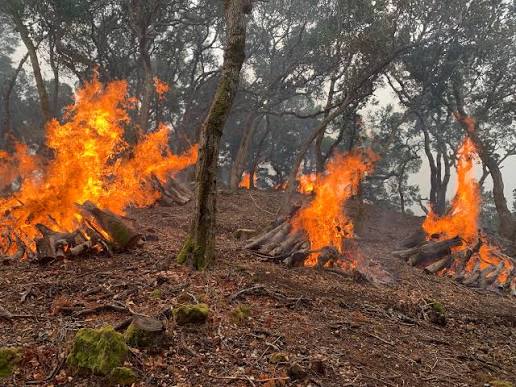
CAL FIRE Lifts Seasonal Burn Suspension in El Dorado County
EL DORADO COUNTY, Calif. — Nov. 6, 2026
El Dorado County property owners can resume permitted residential and agricultural debris burning beginning Friday, Nov. 6, following a decision by CAL FIRE Amador-El Dorado Unit Chief David Wood to lift the seasonal burn permit suspension.


The suspension officially ended at 8 a.m. Friday in the State Responsibility Areas (SRA) served by the Amador-El Dorado Unit. The action covers portions of Alpine, Amador, El Dorado, Sacramento and San Joaquin counties under CAL FIRE’s jurisdiction.
The change comes as cooler temperatures, higher humidity and the possibility of winter weather begin reducing seasonal wildfire threats. However, CAL FIRE cautions that dry conditions persist across much of the region.
“Just because burning is allowed does not mean it is always safe,” CAL FIRE emphasized in its announcement.
For residents of El Dorado County, the lifting of the suspension provides an opportunity to resume clearing accumulated dry vegetation around homes and properties ahead of the winter season. But the return of burning privileges comes with permit requirements and continuing restrictions.
Burn permits remain mandatory
Residents in areas under CAL FIRE jurisdiction must possess a current, valid burn permit before conducting residential debris burning.
Permits are available free of charge through the official CAL FIRE Burn Permit website.
Permits must be available at the burn site, either as a printed document or in digital form. They are valid beginning May 1 of each year and must be renewed annually.
The permits authorize the burning of dry landscape vegetation originating on the property where the burning takes place. They do not authorize the disposal of household garbage, trash or other prohibited materials.
Agricultural burning also may resume on approved burn days, but CAL FIRE requires agricultural burns to be inspected before ignition until the end of peak fire season. Other types of burns may require inspections as well.
Property owners should contact the appropriate local Air Quality Management District to determine whether additional permits or inspections are necessary.
El Dorado County residents must check burn-day status
Lifting the CAL FIRE suspension does not automatically authorize burning on every day or in every location.
The El Dorado County Air Quality Management District establishes daily burn-day restrictions based on local air quality and atmospheric conditions.
According to the district’s Nov. 6 update, both the West Slope of El Dorado County and the South Lake Tahoe Basin portion of the county were designated burn days beginning at 8 a.m. Friday.
Residents must still check the daily status before lighting a debris pile. A day designated as permissible can change as weather and air quality conditions develop.
El Dorado County residents can obtain daily burn-day information through the following telephone numbers:
-
West Slope: (530) 621-5897 or (866) 621-5897
-
South Lake Tahoe Basin: (530) 621-5842 or (888) 332-2876
The county’s Burn Day Information page also provides information about local restrictions and permit requirements.
Residents should also be aware that CAL FIRE permits apply to properties within State Responsibility Areas or other areas where CAL FIRE has jurisdiction. Property owners outside those boundaries should contact their local fire authority regarding applicable requirements.
Fire safety requirements remain in effect
CAL FIRE and local fire officials are reminding residents that a permitted burn is still a potential wildfire hazard.
For residential debris burning, CAL FIRE recommends several precautions:
-
Keep individual burn piles no larger than 4 feet by 4 feet.
-
Clear flammable vegetation and combustible material within 10 feet of the pile, down to bare earth.
-
Keep a water supply and shovel readily available.
-
Maintain adult supervision throughout the burn until the fire is completely extinguished.
-
Do not burn when wind or other weather conditions make it unsafe.
-
Burn only on days approved by the local Air Quality Management District.
These requirements are intended to prevent escaped fires, protect neighboring properties and reduce unnecessary emergency responses.
Burn barrels remain illegal in all five counties covered by the CAL FIRE announcement.
Residents also face potential civil and criminal liability if they allow a fire to escape their control or spread onto neighboring property. Depending on the circumstances, an escaped fire can result in property damage, suppression costs and legal consequences.
Property owners have additional permit responsibilities
El Dorado County residents should pay particular attention to the distinction between CAL FIRE permits and local Air Quality Management District requirements.
CAL FIRE permits are required for residential debris burning of any pile size within applicable State Responsibility Areas. El Dorado County AQMD also requires its own permit for outdoor burn piles larger than 4 feet by 4 feet.
That means residents with larger piles may need to satisfy both agencies’ requirements before burning.
For residents unable to obtain a CAL FIRE permit online, assistance is available by calling (530) 644-2345.
Additional information about residential burning safety is available through CAL FIRE’s Before You Burn guidelines.
A reminder as fire season transitions
The lifting of the suspension marks a seasonal change, not an end to wildfire concerns in the Sierra Nevada foothills.
El Dorado County’s mix of wooded residential properties, rural acreage, dry vegetation and neighboring homes creates continuing challenges when outdoor burning resumes.
CAL FIRE is asking residents to evaluate conditions carefully, follow permit requirements and maintain control of every fire.
For property owners preparing their land for winter, the message is straightforward: Burning may be permitted, but responsibility for preventing an escaped fire remains with the person lighting it.
As CAL FIRE reminds residents, community vigilance is essential to preventing unnecessary fire hazards and keeping El Dorado County communities safe.