
El Dorado Hills Cityhood Raises Questions About County Taxes and Services
EL DORADO COUNTY, Calif. — As El Dorado Hills moves through California’s lengthy incorporation process, one question is surfacing repeatedly throughout the county:
If El Dorado Hills becomes a city, will residents outside the proposed city eventually pay higher taxes or receive fewer county services?


The short answer is not immediately—but potentially over the long term, depending on future county finances, economic growth and the final revenue-sharing agreement negotiated between the county and a future City of El Dorado Hills.
Those questions are now at the center of the fiscal analysis being conducted for the incorporation proposal before the El Dorado Local Agency Formation Commission (LAFCO).
California Law Requires Revenue Neutrality
California’s Cortese-Knox-Hertzberg Local Government Reorganization Act establishes one of the nation’s strictest standards for new city incorporations.
Government Code Section 56815 states that LAFCO cannot approve a city incorporation if it creates a negative fiscal impact on the county unless those impacts are adequately mitigated through negotiated agreements. Those agreements may include tax-sharing arrangements, lump-sum payments or scheduled mitigation payments over many years.
The law specifically declares:
“It is the intent of the Legislature that any proposal that includes an incorporation should result in a similar exchange of both revenue and responsibility for service delivery.”
That principle is commonly referred to as “revenue neutrality.”
Two Financial Phases
If El Dorado Hills voters ultimately approve incorporation and LAFCO grants final approval, the financial transition would generally occur in two stages.
Transition Period
Immediately following incorporation, the new city would begin receiving many locally generated revenues, including local sales taxes and other municipal revenues.
During this startup period, county government may continue providing many municipal services while the new city hires staff, establishes departments and builds financial reserves.
The transition generally lasts until the beginning of the next full fiscal year, although exact timing depends on the final incorporation schedule established by LAFCO.
Revenue Neutrality Agreement
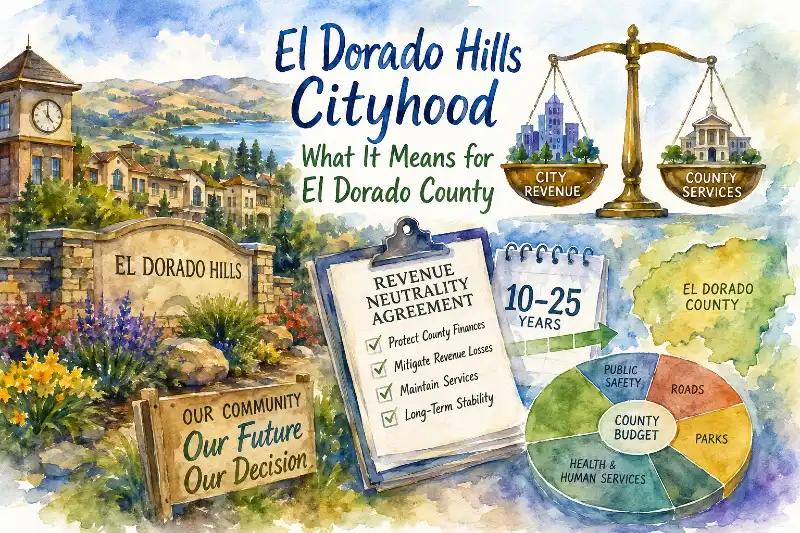
The longer-term protection for county taxpayers comes through a negotiated Revenue Neutrality Agreement.
Rather than immediately keeping all locally generated tax revenue, the new city would make mitigation payments back to El Dorado County.
These payments are intended to offset county revenue losses created when the city begins receiving taxes that previously flowed into county government.
Depending on negotiations, those payments may continue for 10 to 25 years or longer, gradually declining until the city ultimately retains its full share of local revenues. California law allows several different methods for accomplishing that goal.
Why El Dorado Hills Matters Financially
Unlike many smaller communities, El Dorado Hills represents one of the county’s strongest economic engines.
County budget documents do not isolate a single “El Dorado Hills” revenue account because taxes from unincorporated communities are generally pooled into countywide funds.
However, several publicly documented indicators illustrate the area’s financial importance.
Among them:
- Property tax allocated to the County Road Fund from El Dorado Hills generated approximately $3.6 million during FY 2024-25, according to incorporation documents.
- El Dorado Hills contains one of the county’s largest concentrations of retail sales activity.
- Future commercial projects—including the proposed Costco development—could significantly increase future sales tax revenues.
- Planned hotels and resort developments could substantially expand transient occupancy tax collections in future years.
Supporters of incorporation frequently argue that El Dorado Hills contributes a disproportionately large share of county revenues compared with county services received.
County officials, meanwhile, have emphasized the importance of preserving countywide financial stability as the incorporation process moves forward.
Could Residents Outside El Dorado Hills Eventually Feel an Impact?
That remains the central policy question.
In the short term
California law is specifically designed to prevent immediate financial harm.
If the Comprehensive Fiscal Analysis determines that incorporation would leave the county financially worse off, LAFCO cannot approve the proposal without negotiated mitigation measures.
Over the long term
The answer becomes more complicated.
Revenue neutrality payments eventually decline or expire.
If El Dorado Hills ultimately retains all of its locally generated revenues, El Dorado County would permanently lose access to a significant portion of revenues previously supporting countywide operations.
Whether that eventually results in:
- reduced county services,
- new revenue sources,
- budget restructuring,
- economic growth elsewhere in the county,
- or no noticeable change,
will depend on economic conditions decades into the future.
Those future outcomes cannot be predicted with certainty today.
The Comprehensive Fiscal Analysis Will Be Key
The independent Comprehensive Fiscal Analysis commissioned through El Dorado LAFCO is expected to answer many of the financial questions currently being debated.
The study will examine:
- projected city revenues,
- projected county revenue losses,
- future service responsibilities,
- transition costs,
- property tax allocations,
- revenue neutrality calculations,
- and long-term fiscal sustainability.
Only after that analysis is complete can LAFCO determine whether incorporation satisfies California’s statutory requirements.
Timeline
The incorporation proposal remains in the study phase.
According to El Dorado LAFCO, the process includes:
- completion of the Comprehensive Fiscal Analysis,
- environmental review,
- negotiation of a Revenue Neutrality Agreement,
- public hearings,
- possible LAFCO approval,
- and ultimately an incorporation election if all legal requirements are satisfied.
What Residents Should Watch
For residents throughout El Dorado County—not just in El Dorado Hills—the most important document may not be the election itself, but the Comprehensive Fiscal Analysis and the negotiated Revenue Neutrality Agreement.
Those documents will determine whether county taxpayers are adequately protected, how long mitigation payments will continue, and whether county government can continue providing existing service levels after incorporation.
Until those negotiations are complete, any prediction that cityhood will lead to higher taxes or reduced county services would be speculative. Likewise, claims that incorporation cannot affect the county’s long-term finances are not supported by the available evidence. The fiscal analysis and negotiated agreements are intended to quantify those impacts before any final decision is made.