
For most California school districts, an increase in state education funding can be measured across thousands of students.
In southern El Dorado County, the impact can be much more concentrated.


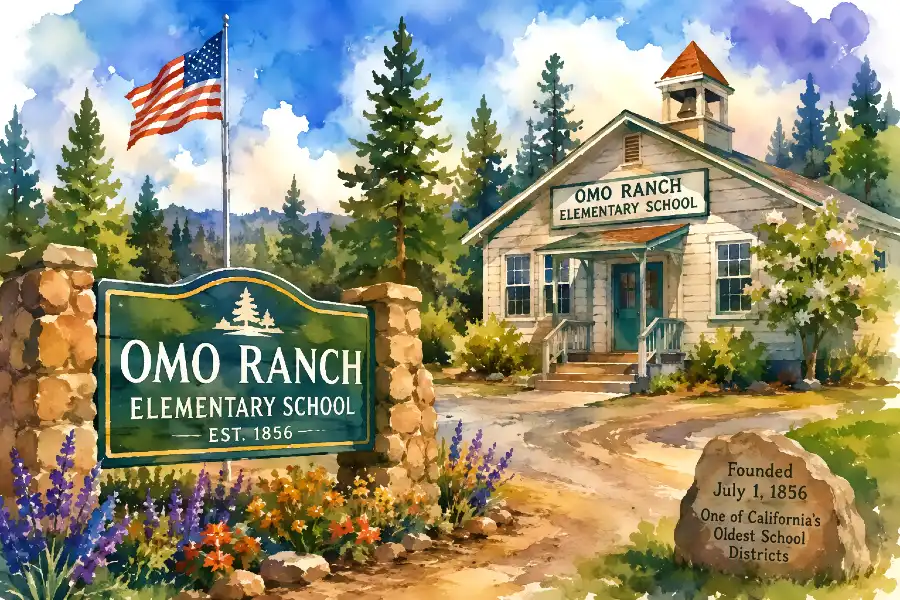
At Omo Ranch Elementary School, a tiny K-8 campus serving a rural community, additional state funding under Assembly Bill 126 could provide meaningful financial breathing room for a district where even routine maintenance and specialized student services can consume a significant share of available resources.
The school was formerly known as Indian Diggings Elementary School. In July 2026, the district and school adopted the Omo Ranch name to comply with California’s Racial Mascots Act. The campus sits at 6020 Omo Ranch Road in the unincorporated community of Omo Ranch, near Somerset.
The California Department of Education identifies the campus as a public K-8 school and lists Grant Coffin as superintendent, principal and teacher.
A funding formula designed for small schools
Assembly Bill 126, part of California’s 2026 education budget package, changes the state’s funding formula for “necessary small schools” beginning with the 2026-27 fiscal year.
The legislation increases the annual state funding calculation for a necessary small school with fewer than 25 students and at least one full-time teacher from $232,700 to $332,948.
That is an increase of $100,248 — substantially more than a simple cost-of-living adjustment.
The law also increases the funding amounts for larger necessary small schools within the qualifying enrollment tiers.
For Omo Ranch, the distinction matters.
The district does not have the economies of scale available to a large school system. A one-school district still must operate a campus, maintain its facilities, employ staff, comply with state requirements and provide educational services to students with varying needs.
‘A really big boost’ for Omo Ranch
Coffin previously described the state’s Necessary Small Schools funding as a long-standing issue for the district.
“This funding stream really hasn’t gotten any kind of increase other than COLA [cost-of-living adjustment] for quite a long time, so this is a really big boost for us.”
Coffin also pointed to the sharp increase in construction costs following the COVID-19 pandemic.
For a school serving only a handful of students, a major repair cannot necessarily be spread across a large student population. The cost of maintaining the building and property remains even when enrollment is measured in single digits or low double digits.
Recent state and federal data illustrate just how small the operation is. EdData reported nine students for the district during the 2025-26 school year, while federal data for the 2024-25 school year listed 12 students.
The district’s own accountability report describes the school as having two multigrade classrooms and serving students from kindergarten through eighth grade.
Rural geography is part of the equation
Omo Ranch is not simply a small school in a small town. It is located in one of the more remote portions of El Dorado County, where geography affects the cost and logistics of providing public services.
The district’s Local Control and Accountability Plan describes the school as being in the southern end of El Dorado County and notes that its extreme rural location has contributed to student transiency.
That isolation also helps explain why California maintains a special funding mechanism for necessary small schools.
The formula recognizes that some schools must remain open because of geography even when their enrollment would make operating a conventional school financially difficult.
For families in remote communities, closing a small local school can mean replacing a nearby neighborhood campus with long transportation distances to another school.
Special education adds another layer
Coffin said the increased funding is important not only for the school’s physical plant but also for educational services.
“That added funding assists our county office with a lot of our special ed needs,” Coffin said.
Special education is an especially important consideration for very small districts.
A district with hundreds or thousands of students can distribute the cost of specialized personnel and services across a much larger enrollment. A district with fewer than a dozen students does not have that same financial scale.
The El Dorado County Office of Education can provide countywide support, but the underlying costs of serving students with disabilities remain part of the broader financial equation for small districts.
AB 126 also makes a much larger statewide investment in special education. The 2026 budget package includes approximately $2.4 billion in additional special education funding, according to reporting on the legislation.
More than a number on a budget spreadsheet
The funding increase illustrates a broader challenge facing rural California schools: The number of students may be small, but the fixed costs of operating a school do not disappear.
At Omo Ranch, one teacher can wear multiple hats. Coffin serves simultaneously as superintendent, principal and teacher — an arrangement that would be unusual in a large district but is part of the reality of operating one of California’s smallest school systems.
The district has roots dating to 1856, making it one of the oldest small school operations in the region. Its current campus has remained a fixture of the Omo Ranch community for generations.
For residents of southern El Dorado County, that history gives the funding debate a local dimension.
The question is not simply how much Sacramento spends on education.
It is whether the state’s funding formula recognizes the very different realities faced by a school serving thousands of students in a suburban district and a school serving a few children in a remote mountain community.
For Omo Ranch, AB 126 represents a significant change in that calculation.
And for one of El Dorado County’s smallest school communities, the additional funding could translate into something far more tangible than a line item in the state budget: additional capacity to maintain its campus, serve its students and keep a local school operating in a community where geography makes small-school education a necessity.